
Use Quantum
Check the guidelines relating to use quantum for business parks.
Last updated on 6 June 2026
Business Park (Non-White) Component
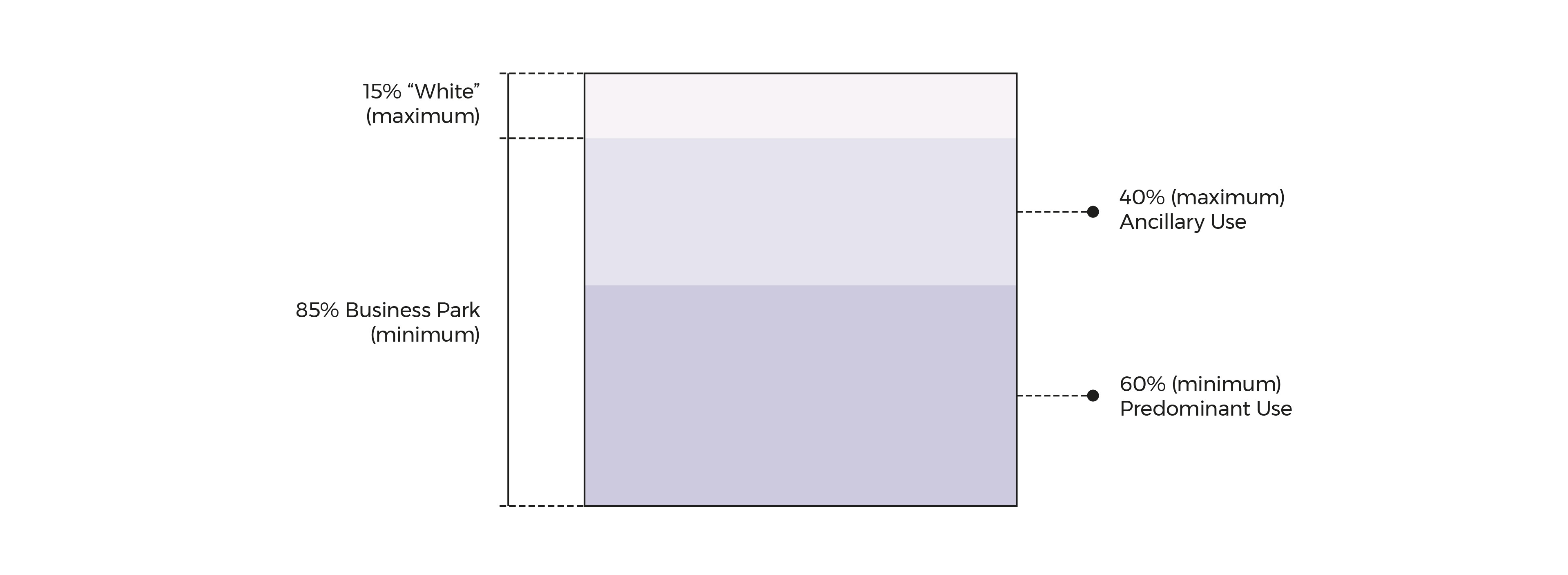
Quantum Control for land zoned BP
For developments on land zoned BP, minimum 85% of the total GFA of the development shall be retained for BP uses. A maximum 15% of the overall proposed GFA may be allowed for White uses.
For developments on land zoned BP-White, the allowable quantum for White use is higher. The remaining GFA shall be retained for BP uses.
For developments on land zoned BP and BP-White, the BP component is subject to a 60-40 sub-quantum control. For example, a site zoned BP with GPR 2.5 shall provide a minimum 85% BP component to ensure:
0.6 x 85% = a minimum of 51% of the BP component shall be allocated to predominant uses
0.4 x 85% = a maximum of 34% of the BP component shall be allocated to ancillary uses
Business Park (Non-White) Component – Allowable Uses
Within the BP (non-white) component, the proposed uses shall comply with the lists of allowable and not allowable uses shown in the table below.
Table 1: List of uses which are allowed and not allowed within BP (non-white) component
Allowable (within the non-White component) | Not Allowable | |
|---|---|---|
Minimum 60% Predominant | Maximum 40% Ancillary* | Uses with the following characteristics |
Core Media Activities1 | Ancillary Office | Pollutive Uses10 |
Research and Development2 | Sick Room/First Aid Room | Bad Neighbour11 |
Central Distribution Centre3 | Industrial Canteen7 | Independent Warehousing |
Test Laboratory4 | Childcare Centre8 | |
Product Design/Development2 | Meeting Room | |
Industrial Training5 | Showroom9 | |
E-Business6 | ||
Manufacturing of High Technology Products using Advanced Processes | ||
*Ancillary activities refer to activities that support the predominant BP uses within the same development.
[1] Core Media
Core media activities, which are production services that require technical facilities such as studios and high-tech production software/hardware, are allowed as part of the 60% predominant use quantum in Business 1, Business 2 and Business Park developments.
Table 2: Types of Core Media Activities
Core Media Activity | Description | Examples |
|---|---|---|
Pre-production* | Provide creative conceptualisation, scripting, editorial editing, composing and text layout | ESPN Star Sports, SPH |
Production^ | Studio production (including dressing rooms), location production, audio recording, dubbing, media library services, printing press | ESPN Star Sports, MTV Asia |
Network Programming# | Scheduling, programme management, transmission services, origination playback | ESPN Star Sports, AXN |
Post-production and Distribution@ | Video editing, digital authoring, audio engineering, format conversion, standard conversion, tape duplication, image and audio restoration, film printing, optical disk media (eg mastering and replication), sorting and packaging for print media | CNBC, Walt Disney TV, SPH |
* Pre-production activities provide creative conceptualisation, scripting, editorial editing, composing and text layout.
^ Production activities may include studio production (including dressing rooms), location production, audio recording, dubbing, media library services, printing press.
# Network programming activities may include scheduling, programme management, transmission services, origination playback.
@ Post-production and distribution activities may include video editing, digital authoring, audio engineering, format conversion, standard conversion, tape duplication, image and audio restoration, film printing, optical disk media (e.g. mastering and replication), sorting and packaging for print media.
[2] Research and Development/Product Design and Development
Such activities are only allowed for manufacturing, manufacturing-related services, and technology-related companies only, and refer to activities that include research, development and/or design of new or substantially modified products or processes, prototype production, laboratory testing and software development.
[3] Central Distribution Centres (CDC)
Facilities that provide total logistics support for multinational corporations' regional/international business and comprise a warehouse which undertakes operations such as freight management, inventory control, storage, packaging and consolidation. CDCs can also undertake regional marketing, sales, technical support and training.
[4] Test Laboratory
Scientific investigation and testing of products and processes including food and feed additives, bio-tech, pharmaceuticals, textiles and geological analysis.
[5] Industrial Training
Training and teaching involving the use of industrial machinery, industrial systems, industrial equipment and industrial components.
[6] E-Business
The e-business activities shown in the table below are regarded as industrial uses allowed as part of the 60% predominant use quantum. Data Farms/Data Centres would require prior planning permission for an assessment to be made in consultation with the relevant technical agencies on the suitability of the premises for such uses.
Table 3: E-Business Activities regarded as Industrial Uses
E-Business Activity | Description | Remarks |
|---|---|---|
Telecommunications | Provides voice/data communication services such as data/information transmission, electronic message sending, voice calls and broadcasting services. | Can be located in Business Park, Business 1 and Business 2 developments. |
Data Farm/Data Centre | Requires the use of predominantly heavy equipment such as servers to process data. Excludes data processing that can be run on desktop computers or laptops. | |
Internet Service Provider | Provides access to Internet and other related services such as web hosting, web site building, etc. | |
Software Development | Provides software design, customisation and maintenance. Includes software application providers. | |
Call Centre | Centralised backend support functions that handle a large volume of telephone services primarily targeted at providing information to meet callers’ needs. Typically require large spaces for their operations, which comprise specialised technology and equipment. | Can be located in Business Park and Business 1, but not in Business 2 developments. |
[7] Guidelines on Industrial Canteen
Industrial canteens within BP industrial developments may include food stalls, cafeteria, food court primarily to serve workers in the BP area and may include members of the public.
These may be approved on Temporary Permission for up to 5 years subject to the following:
The size of the industrial canteen is capped at 700sqm or 5% of the total proposed GFA of the development, whichever is lower.
SLA may assess such industrial canteens based on Group D Industrial rate for the purpose of computing Land Betterment Charge.
[8] Guidelines on Childcare Centre (CCC)
CCCs within BPs are meant to serve parents working in the development. Proposed CCCs may be considered within BP developments, subject to clearances from National Environment Agency and Early Childhood Development Agency. See NEA’s webpage (opens in new tab) and ECDA’s webpage (opens in new tab) for more information.
SLA may assess such CCCs based on Group E Civic and Community Institution rate for the purpose of computing Land Betterment Charge.
[9] Guidelines on Showroom
Showrooms in BPs are meant primarily for the display of two categories of products as follows:
Products that are not typically transacted or exchanged over the counter (eg bulky items such as furniture, motor vehicle); and
Products that are predominantly delivered and installed off-site (eg floor tiles)
Incidental sales of small items or “cash-and-carry” products may be considered only if the main activity of the showroom is for display of the two categories of products listed above.
Showroom proposals will only be considered as part of a Change of Use application, after the building has obtained a Temporary Occupation Permit (TOP) and when prospective end-user or business operator for the showroom space is known.
Showrooms may be considered subject to the following:
Showroom shall be confined to the 1st storey of the development.
SLA may assess such showrooms based on Group A Commercial rate for the purpose of computing Land Betterment Charge.
[10] Pollutive Activity
Examples include use or storage of significant quantities of chemicals, use of solid/liquid fuel burning equipment, use of machinery and processes which require pollution control equipment to abate pollution etc.
[11] Bad Neighbour Activity
Examples of bad neighbour activities include those involving intense glare or heat exposed to the surroundings, high noise levels, ground vibrations etc.
White Component
For BP zone, a maximum of 15% of the overall proposed GFA may be allowed for White uses.
For BP-White zone, the White uses may be more than 15% of the overall proposed GFA.
The maximum allowable White quantum in BP-White varies depending on locational criteria such as public accessibility and compatibility with neighbouring land uses. Sites closer to MRT stations may be allowed to have a larger White quantum.
For example, in the map below, the two sites next to Expo MRT Station are zoned BP-White with an allowable GPR of 2.5. The figures in the square brackets indicate the allowable White quantum as reflected on the prevailing Master Plan. Both sites are allowed a maximum of 40% of the overall GFA for White uses.
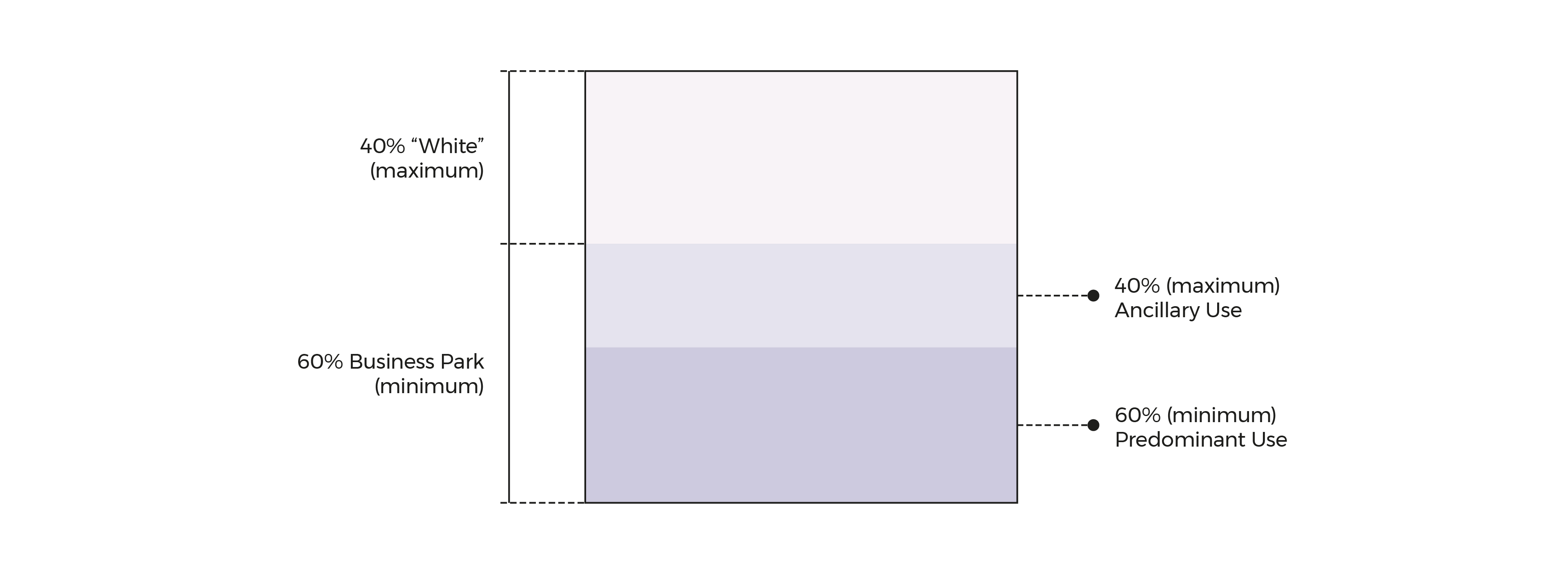
Maximum 40% White Quantum for BP-White zones with allowable GPR of 2.5
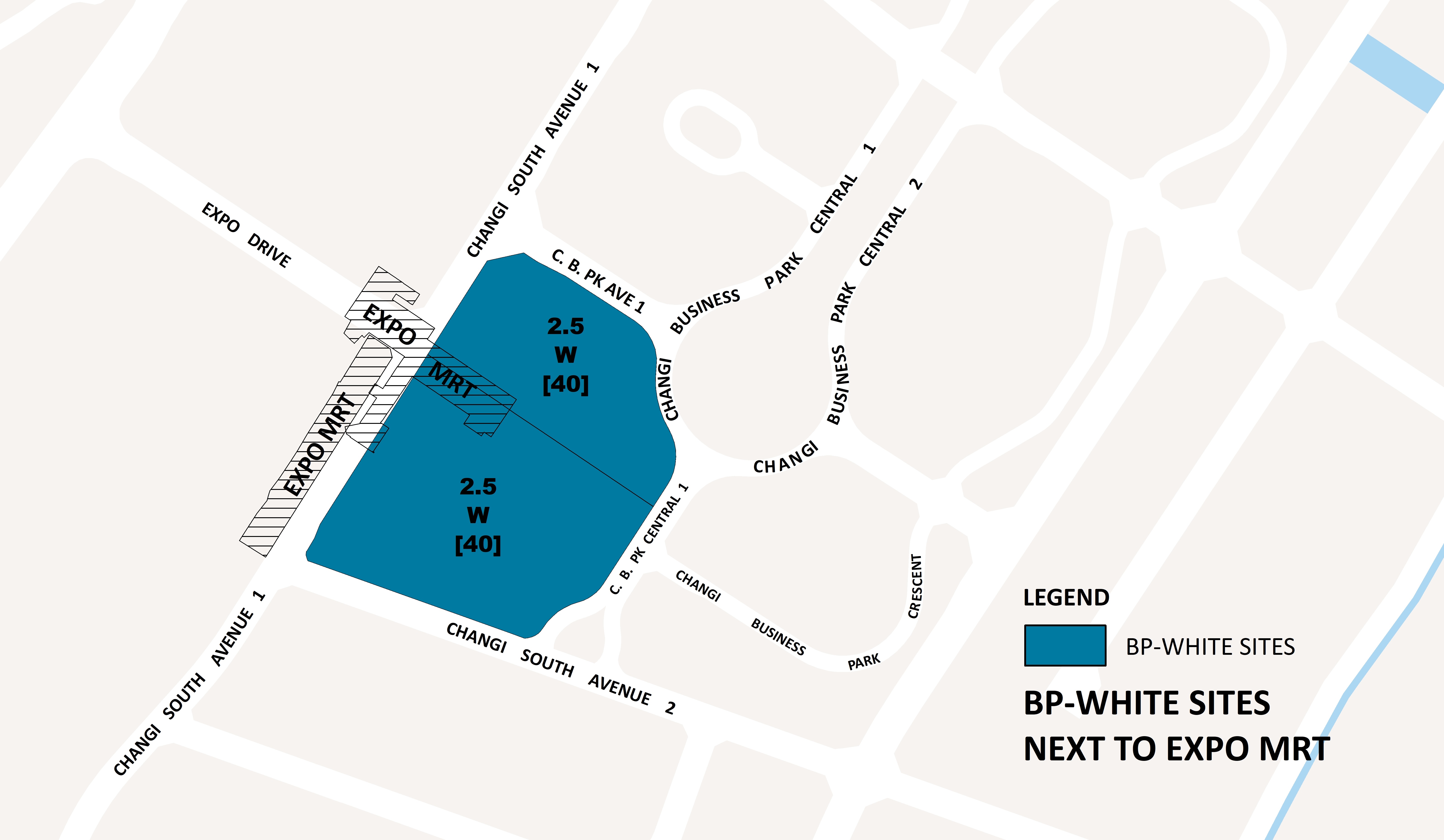
BP-White sites next to Expo MRT Station
White Component – Allowable Uses
Within the White component, the proposed uses shall comply with the lists of allowable and not allowable uses shown in the table below. Other uses may be considered subject to planning evaluation depending on merits.
Table 4: List of uses which are allowed and not allowed within White component
Allowable | Not Allowable |
|---|---|
|
|
The White component within BPs may be strata-subdivided. The BP and White uses within BPs may be contained in separate buildings provided that there is no land subdivision.