
Shaping a Heat Resilient City
Explore the latest innovations in cool paints, district cooling and climate simulations that are helping Singapore stay cooler and more liveable in a warming climate.
Last updated on 9 July 2026
Discovering heat resilience innovations to keep Singapore cool
As a city-state with limited land, forward planning is important to ensure that Singapore remains liveable and sustainable. Climate change effects, such as rising temperatures, pose increasing challenges to our city’s liveability. To strengthen Singapore's heat resilience and mitigate the effects of heat stress, efforts across the public, private and academia sectors are being harnessed to design and plan for a cooler city for generations to come.
Read on to discover new innovations being explored together with the private sector and academia to help keep Singapore cool and liveable amidst rising temperatures.
Innovations for cooler buildings
Cool paint technology
Paint companies have developed a range of cool coatings that can reduce the amount of heat absorbed by built surfaces as well as lower surface temperatures. These coatings contain additives that reflect solar radiation, thereby minimising heat absorption and emission. For example, Nippon Paint’s COOL-TEC cool coatings reflect sunlight from surrounding built surfaces, and can achieve a collective reduction of overall outdoor air temperature by up to 2.4˚C.
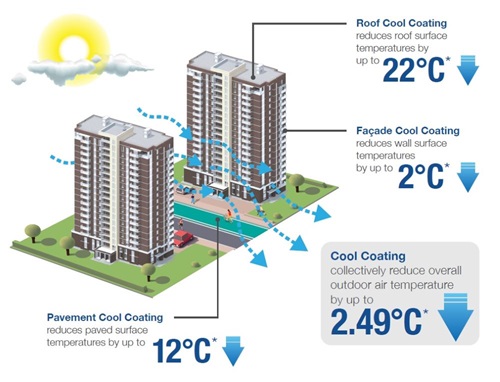
Under the Housing Development Board's (HDB) Green Towns Programme, HDB and Tampines Town Council have embarked on a large-scale pilot where cool paint will be applied to approximately 130 HDB blocks.
Distributed District Cooling network
Tampines town centre will be the first neighbourhood to be retrofitted with a Distributed District Cooling (DDC) network. Benefits of a DDC network include:
Reduced need for individual cooling systems
Enhanced energy savings
Reduced carbon emissions
Space optimisation
Watch to learn more:

Mycelium-based 'elephant' tiles
Inspired by the cooling properties of elephant skin, researchers from bioSEA, Nanyang Technological University and Singapore-ETH Centre have created building tiles that aim to mimic the the same surface structure as elephant skins, to achieve cooling effects.
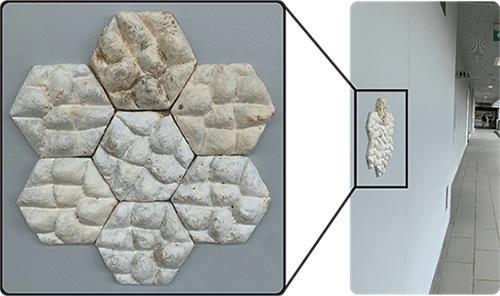
Results show that the elephant mycelium tiles had 25% improvements in the heating/cooling rate ratio when compared to flat tiles. This is because the mycelium tiles are highly porous at the microscopic level, with foam-like structures full of air pockets. Given that air is a poor thermal conductor, heat transfer through the material is significantly reduced, resulting in strong insulative properties that effectively slow unwanted heat gain.
Simulations to improve heat management plans
Digital Urban Climate Twin
The Cooling Singapore 2.0* research team is developing a Digital Urban Climate Twin (DUCT) which will enable policymakers to assess the impact of various heat management strategies.
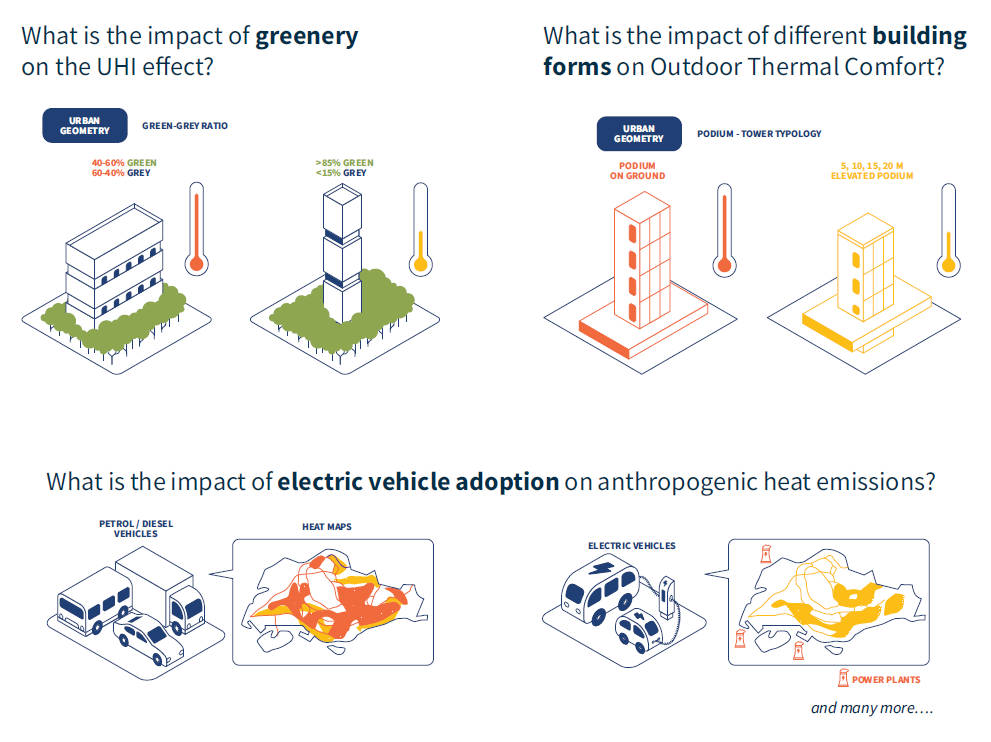
Watch to learn more about DUCT’s capabilities:
*Cooling Singapore 2.0 is a multi-institutional project led by the Singapore-ETH Centre, in partnership with the Singapore Management University, Singapore-MIT Alliance for Research and Technology, TUMCREATE (established by the Technical University of Munich), National University of Singapore, and Cambridge CARES; and is funded by the National Research Foundation.
Integrated Environmental Modeller
HDB and A*STAR collaborated to develop the Integrated Environmental Modeller (IEM) to simulate the interaction of urban micro-climatic conditions and their combined effects on the surrounding urban landscape.
The IEM has enabled urban planners and designers to compare the designs of different heat mitigation strategies, enabling them to better design housing and infrastructure for improved thermal comfort.
Watch to see how IEM is used:

Curious to know more? Find out about the specific planning strategies that URA is undertaking to improve thermal comfort.