
Systems-Level Planning Approach
Planning our city to bring together common resource loops can reduce wastage while increasing efficiency, cost savings and environmental gains.
Last updated on 28 May 2026
Co-locating infrastructure
Integrating different components of the urban system helps to stretch the use of our precious resources.
Our urban infrastructure such as utility plants often use a lot of energy and occupy large sites. As demand for them is expected to increase, we will find ways to integrate them to maximise energy and resource recovery and optimise land use.
Energy from used water and waste
Tuas Nexus integrates a water reclamation plant and a waste management facility to tackle Singapore’s solid waste management and used water treatment needs more efficiently.
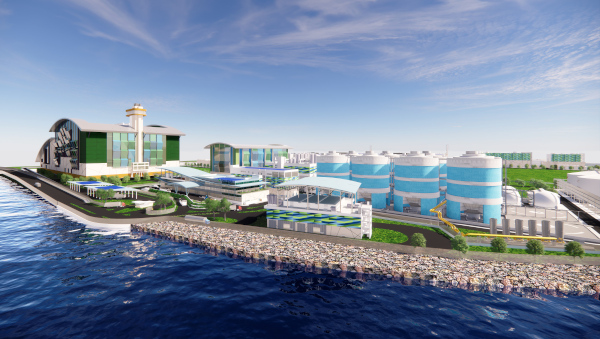
© PUB
The by-product of one facility becomes a resource for the other. For instance, biogas production in the water plant is boosted by 40 per cent from combining its used water sludge with food waste. The gas is then combusted to generate electricity, enough to power both facilities and more!
More than 200,000 tonnes of CO2 savings annually, equivalent to 42,500 cars on the road
Up to 2.6 ha in land savings, about the size of four football fields.
Up to 300,000 four-room HDB apartments can be continually powered by the excess electricity generated.
Supporting circular economies
Industries can be strategically sited to close resource loops in the production process.
Through closing the resource loops between consumers and manufacturers, we can reduce waste, encourage the reuse of resources and move towards a more sustainable way of life.
One's business's waste is another's resource
At the upcoming Sungei Kadut Eco-District, businesses in agricultural technology, food manufacturing and processing, environmental technology, and biosciences will be sited near one another to reap synergies. Similarly in the Lim Chu Kang area, which will be developed into a high-tech agri-food zone, we are exploring the co-location of food production facilities so that the by-products of farms can be more easily used as inputs for other parts of the agri-food ecosystem.
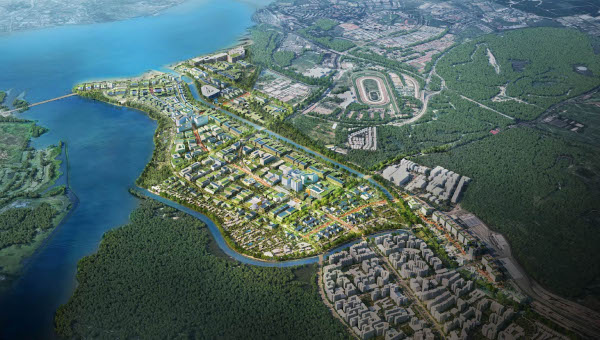
© JTC
Such master planning to create closed-loops – where one business’ waste becomes a resource for another – is good for the world and better for business.
Jurong Lake District: sustainable from the start
The upcoming mixed-use business district is designed and planned to create synergistic ecosystems for people, buildings and businesses to shape a sustainable future together.
Beyond its infrastructure and buildings, the pursuit of sustainability will also bring much benefits in and around the district.
Compact and convenient
The district is planned as a collection of complete neighbourhoods, with flexi-use sites housing both business and residential communities, and a range of amenities and public spaces. Compact planning enables a car-lite yet convenient district where everything is within 10 minutes by foot, cycling or public transport.
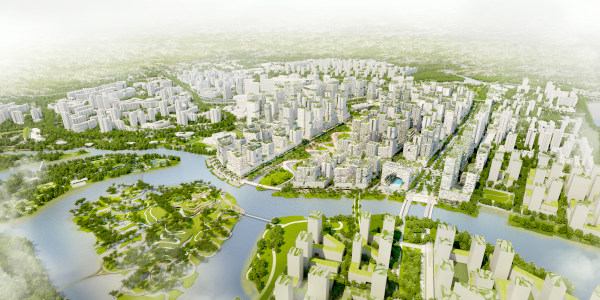
© KCAP Architects & Planners, SAA Architects, Arup, S333 and Lekker
Centralised and coordinated
By planning, coordinating and implementing infrastructure, the district optimises land and energy resources. For instance, a district cooling network will supply the cooling needs of buildings using centralised chiller plants that optimise space, resources, and energy usage. A common services tunnel and duct system will distribute utilities to buildings within the area efficiently and reliably.
At the development scale, buildings will also be designed to higher environmental standards, including attaining the minimal certification of Green Mark Platinum Super Low Energy. This will be achieved by incorporating low carbon materials, solar panels, smart facilities management systems and more.
Cool, comfortable and connected
Lush green buildings and green mobility modes powered by cleaner energy will make moving around the district clean, convenient and enjoyable. People can commute comfortably along tree-lined streets and all-weather linkways and connect with the community in generous open spaces. Residents and businesses can be part of a green community shaping a sustainable future together.
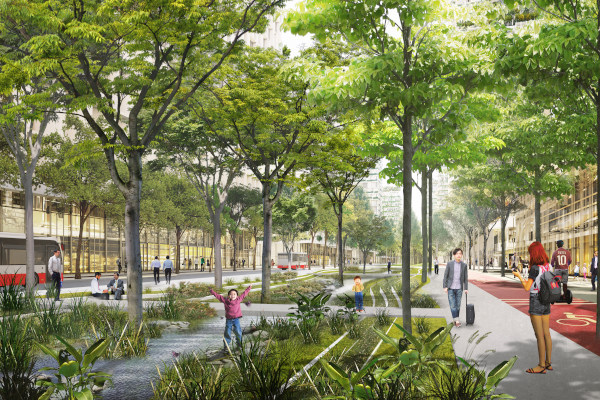
© KCAP Architects & Planners, SAA Architects, Arup, S333 and Lekker