
More Climate-Resilient Infrastructure
Singapore will be better protected from the effects of climate change.
Last updated on 28 May 2026
Climate change will lead to sea level rise and heavier rainfall that increase the risk of flooding, while increasing temperatures will make the environment unbearable. We must adapt by using infrastructure that can better withstand these effects and protect us from their impact.
How will climate change affect Singapore? By 2100:
Mean sea levels are projected to rise by up to one metre
Sea levels could rise up to four to five metres at the confluence of extreme high tides and storm surges
Heavier and more frequent rainfall
An increase in daily temperature of 1.4 to 4.6 deg C
Enhancing flood resilience
Our new infrastructure will be designed to protect against rising seas and intense rain while providing leisure and green spaces.
Source-Pathway-Receptor approach
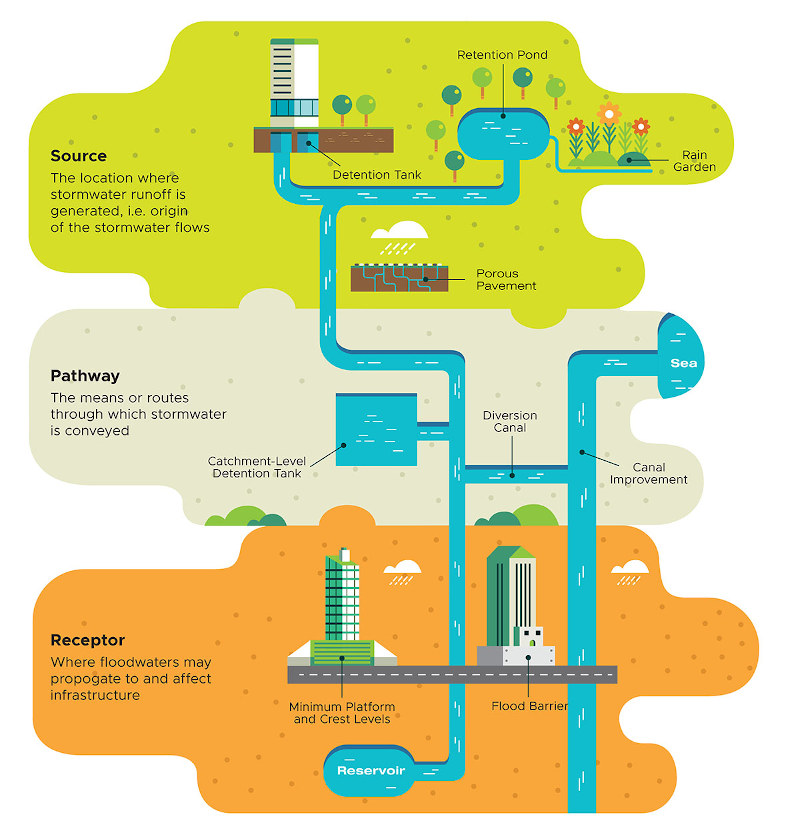
To adapt our drainage system to the challenges posed by growing urbanisation and increasing weather uncertainties, we adopt a holistic ‘Source-Pathway-Receptor’ approach. It focuses on the entire drainage system, addressing not just the drains and canals through which stormwater travels (i.e “Pathway”), but also the areas that generate stormwater runoff (i.e “Source”) and the regions where flooding may occur (i.e “Receptor”).
Going underground
Besides expanding our drainage infrastructure, we are planning for more space-efficient ones to cope with climate change.
For instance, we are exploring an underground drainage and reservoir system consisting of caverns and stormwater tunnels to mitigate increased flood risk and provide synergistic benefits.
Adapting coasts to protect and provide
Besides ensuring our drainage system can handle more intense rainfall, we are developing adaptation strategies to protect our coastal areas against rising sea levels.
We will explore combinations of hard engineering solutions and nature or green and blue elements to create ecological as well as recreational value in the area.
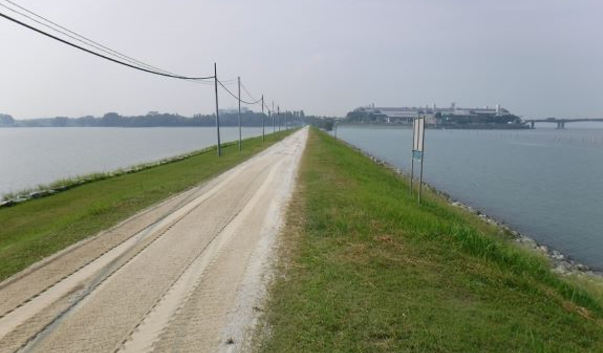
Western catchment dyke (sea side) © PUB
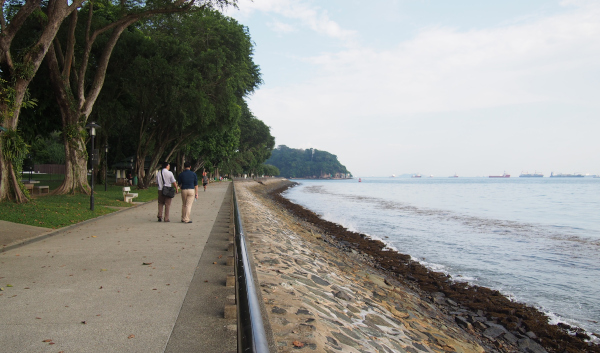
Revetment at Labrador Park © PUB
Coastal protection solutions will be integrated with land use planning strategies for multi-functional uses. In this way, we can protect the coasts while remaking the coastal lands into liveable, adaptable, and sustainable spaces.
Reclaiming 'Long Island'
Climate change strategies when integrated with our long-term plans will help to meet our land use needs and provide opportunities to expand and enhance our green and blue network.
Among various options being studied to protect our coastline is the possibility of integrating coastal protection measures with planned future reclamation along the southeastern coast. This could include creating a new reservoir to manage flood and enhance our water resilience.
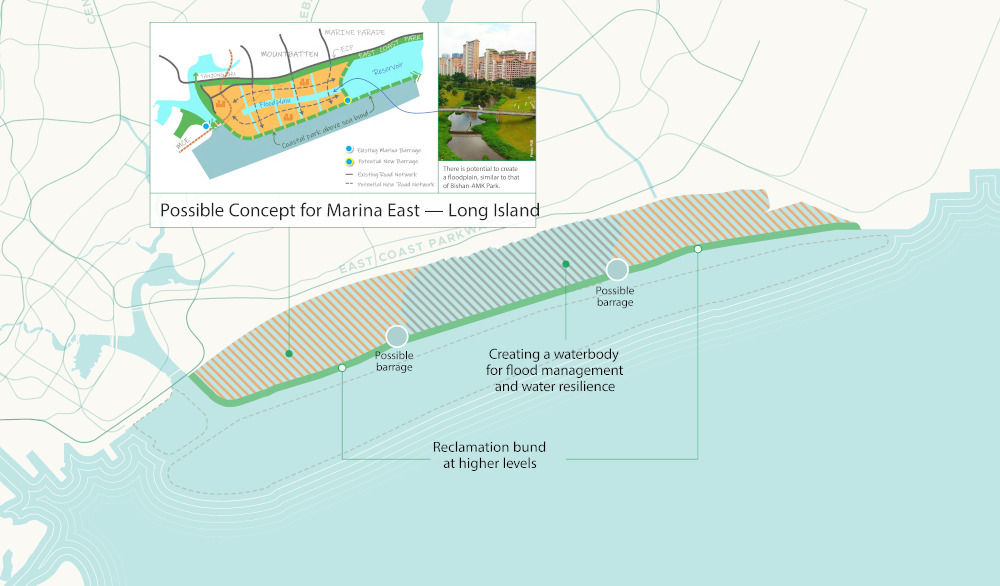
The ‘Long Island’ can be planned for future housing and other uses, and integrated with coastal parks and recreation spaces.
Cooling down urban heat
Our urban environment will be planned, designed, and developed to ensure better thermal comfort.
The rise in temperatures will be compounded by the Urban Heat Island (UHI) effect, where cities are warmer because they absorb and retain more heat than rural areas.
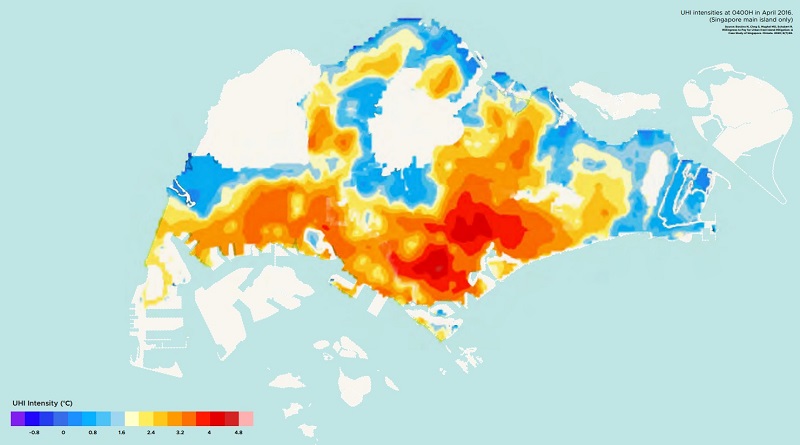
Source: Borzino N, Chng S, Mughal MO, Schubert R. Willingness to Pay for Urban Heat Island Mitigation: A Case Study of Singapore. Climate. 2020; 8(7):82
Under the Cooling Singapore 2.0 programme, Singapore is developing a Digital Urban Climate Twin to help us identify the key sources of UHI to guide our strategies, including the planning of buildings and neighbourhoods to mitigate the effect.
Staying cool by design
Our built environment can adopt various design strategies to ensure thermal comfort.
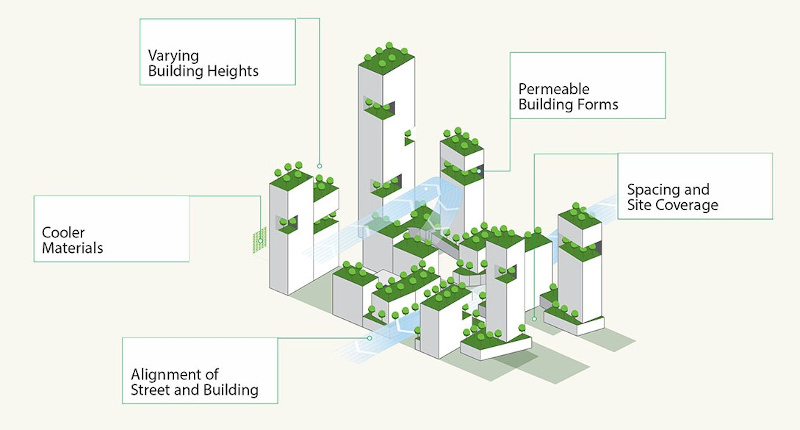
Varying building heights
Creating developments of different heights improves the capture of wind and channels air downwards towards the pedestrians.
Permeable building forms
Increasing the porosity of buildings encourages air flow through and around buildings.
Cooler materials
Employing cool paint coatings on facades and pavements or having more greenery reduces heat absorption and emission.
Spacing and site coverage
Providing more open spaces around buildings can reduce the accumulation of heat.
Alignment of street and building
Arranging streets and corridors around urban breezeway patterns will enable good airflow throughout our city and disperse heat.