
Utility Specific Ducts
Utility Specific Ducts are a smarter way to organise underground utilities. Learn how they optimise space and reduce disruptions from road openings.
Last updated on 11 June 2026
Underground conditions and infrastructure needs vary across Singapore, and there is no one-size-fits-all solution. Before any major underground utility project begins, the Lead Implementing Agency (LA) conducts studies to determine the most suitable approach. Innovative engineering solutions are also explored to better organise and optimise subterranean space. One key solution is the use of Utility Specific Ducts.
What are Utility Specific Ducts (USDs)?
Optimising underground space requires a fundamental rethink of how utilities are installed and organised. USDs represent a shift from individual installation to shared infrastructure systems. Currently, there are more than 20 different telecommunications companies, and instead of each telecommunications company laying separate ducts, similar utilities share organised conduit systems that maximise space efficiency while enabling easier access for maintenance.
For electricity cables, USDs provide manholes for access and maintenance at regular intervals, unlike current systems where cables share duct space but lack accessible maintenance points. In both cases, USD help minimise future road openings by reducing the need for excavation during maintenance or when laying new cables.
A comparison between existing conventional laying and USD for electrical cables
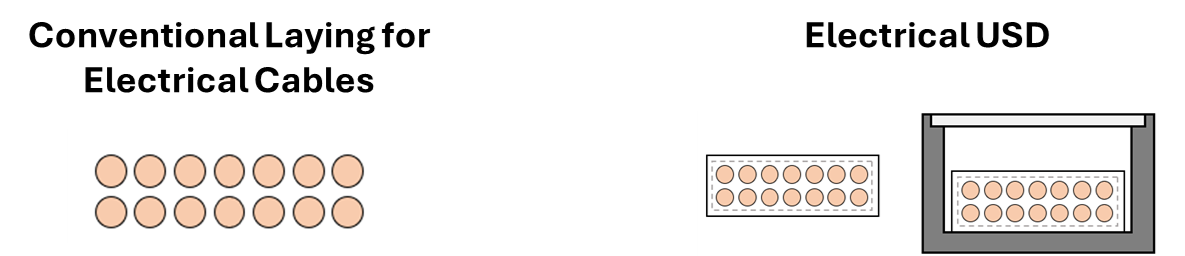
Conventional Laying for Electrical Cables | Electrical USD | |
|---|---|---|
Duct capacity sized based on customer’s request/demand -> | Capacity Planning | USD sizing to meet future development demand (including space ducts for leasing, repair and/or maintenance) |
Implementation timelines can bedifferent -> Higher road openings due to uncoordinated works leading to more public disamenities | Implementation | USD duct bank and manholes implemented upfront for easy access to inspection and maintenance via manhole |
PVC or HDPE pipes direct burial in trenches with sand bedding protection | Added Protection | Duct bank encased with reinforced concrete that enhanced structural protection and durability |
No manhole provision and excavation required for every inspection / maintenance works | Operation & Maintenance | Manholes added allow inspection and maintenance |
A comparison between existing conventional laying and USD for telecommunications cables
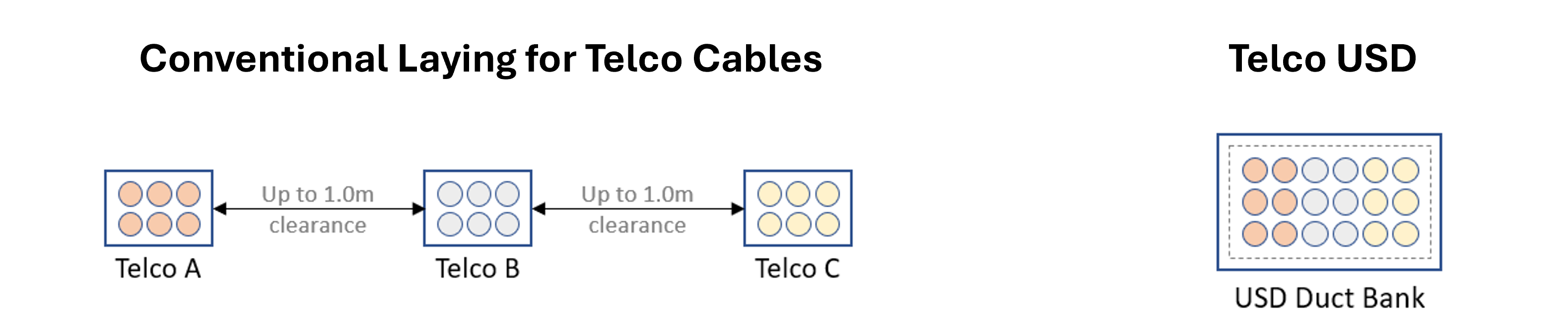
Conventional Laying for Telco Cables | Telco USD | |
|---|---|---|
Individual ducts and manholes -> Additional space usage compared to USD | Space Utilisation | Telecommunications ducts are bundled together with manholes consolidated into a single USD manhole |
Duct capacity sized based on customer’s request/demand -> Repeated road openings for future expansion due to no spare ducts / future-proofing | Capacity Planning | USD sizing to meet future development demand (including space ducts for leasing, repair and/or maintenance) |
Implementation timelines can be different -> Repeated road openings due works by different telecommunications companies leading to disamenities to the public | Implementation | USD duct bank with manholes implemented upfront for easy access for inspection and maintenance |
Duct bank encased with unreinforced concrete -> Higher risk of pipe/cable damage in the event of differential ground settlement and/or 3rd party damage | Added Protection | Duct bank encased with reinforced concrete. |