
Conserved Building
33 Erskine Road
Applicable Guidelines
Historic District Guidelines
Conservation Area
Chinatown - Telok Ayer Conservation Area
Historic address: 25 Erskine Road
About
Erskine Road was named in 1907, its gentle slope marked by a continuous row of two-storey shophouses and a taller 1924 Art Deco style building designed by Westerhout & Oman. Erskine Road derives its name from the Honourable J.J. Erskine, a member of Council in Penang and a government officer in Singapore in 1824.
The History
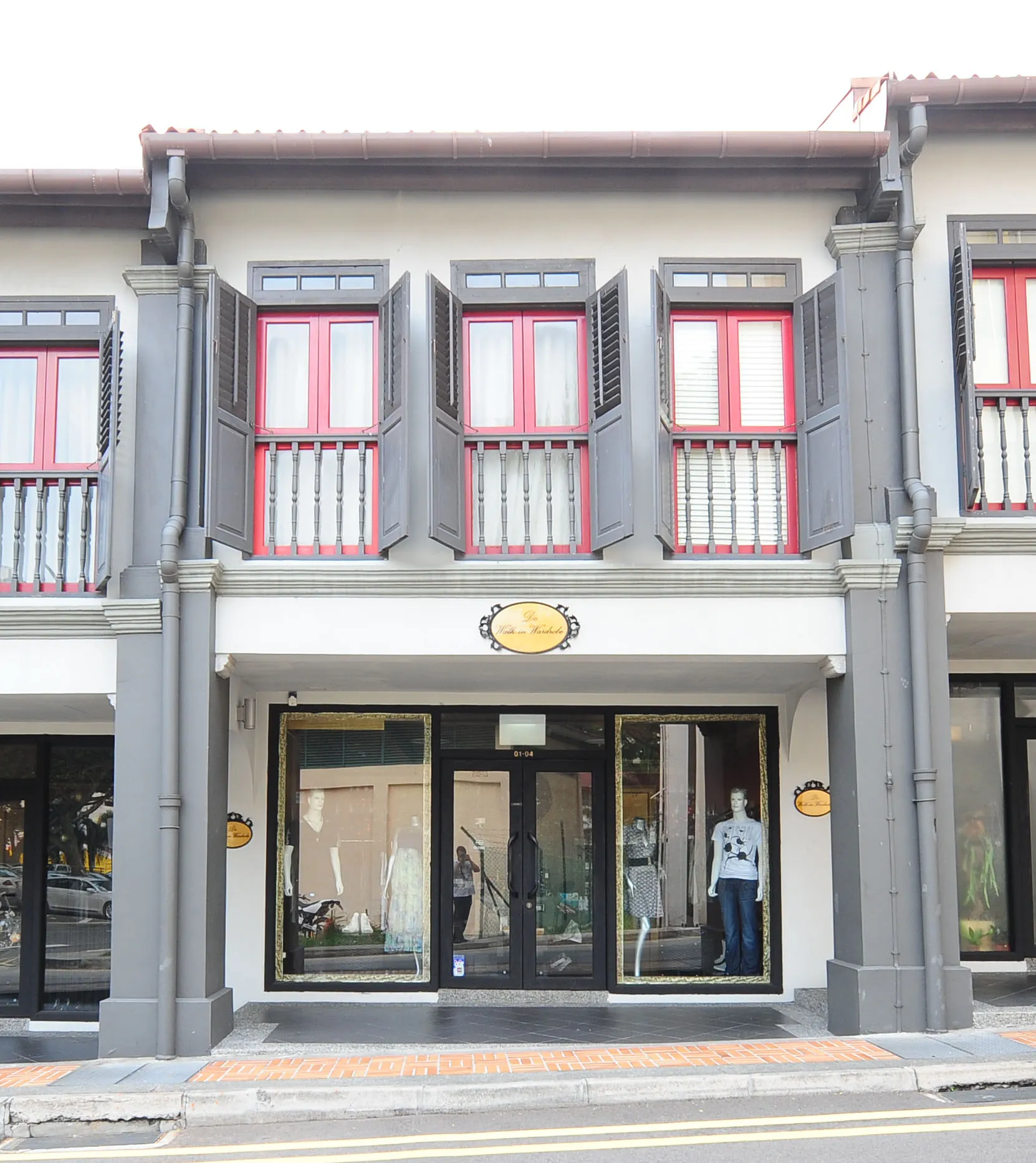
The fourteen 2-storey shophouses at Nos. 9 to 35 along Erskine Road were built in 1868, and the 4-storey concrete building at No. 37 was built later in 1924. The 2-storey shophouses were originally the shared living quarters for immigrant Chinese "black-and-white amah" women servants. Later, the ground floor frontage was used as shops. Up to the 1980s, the old women could still be seen staying at the premises.
In 1988, the fourteen shophouses were acquired by a Taiwanese developer who retrofitted the development into a 44-room boutique hotel — The Inn of Sixth Happiness — in a Chinese inn style. The 4-storey building at the junction with Kadayanallur Street was acquired in 1992 and provided additional suites to the hotel. While hotel rooms occupied the upper storey and the rear single-storey portion of the 2-storey shophouses, the ground floor units fronting the five-foot way were used for shops and restaurants. The striking red colour of the columns portrayed its Chinese theme.
No. 15 was rebuilt together with the Inn of Sixth Happiness as an infill development under URA guidelines. Its modern glass-and-aluminium frame façade was set back from the old shophouse façades, starkly expressing its reconstruction concept, while the odd shape of the plot resulted in a very narrow plot frontage.
The Inn of Sixth Happiness shut down its operations in the mid-1990s and was acquired by the present owners, Grace International, in 1997. A thorough redesign and redevelopment of the project was required by the new owners for the development to be operated as a top-grade boutique hotel.
The Building
The shophouses are of relatively squat proportion and have a very basic façade design. The lack of ornamentation on the front elevation is typical of the Early Shophouse style. The outstanding feature of the upper storey elevation is the repetitive pattern of full-height timber louvred windows with typical timber balustrades. Plain columns line the five-foot way at the ground floor, with simple capitals and cornices terminating at the first storey and continuing upwards as pilasters on the second storey façade.
The Legacy
The restoration and adaptive reuse of the shophouses at 9–13 & 17–35 Erskine Road won the 1994 Good Effort Award, the precursor of today's Architectural Heritage Awards. From 2002 to 2005, the development underwent another round of sensitive restoration, this time incorporating the taller building, which helped to reclaim its prominence as a landmark at the junction of Erskine Road and Kadayanallur Street. It obtained the 2005 URA Architectural Heritage Awards (Category A) for its good restoration work.
Guidelines and Procedures
All proposed works will need to comply with the Conservation Guidelines and the Specific Restoration Guidelines (SRG). Conservation Permission is required before all additions & alteration works and operations of new use can begin.
Residential Fronts are characterised by timber casement windows flanking a double-leafed timber door. All buildings with residential front which is existing and/or identified in the 'Specific Restoration Guidelines', regardless of land use zoning, shall be retained and restored.
Use Guidelines and Submission Process for Buildings in Historic Conservation Areas
Apply for Specific Restoration Guidelines (SRG) (opens in new tab)
Explore Street View
The building can be found at this street.