Signage Guidelines and Submission Process
The following outlines Signage Guidelines and Submission Process.
Last updated on 11 June 2026
Overview
Building signs have many functions. They are used for the identification and naming of places, buildings and tenant business names. They also add interest and character to a building particularly if it is designated part of a conservation area. Building signs are different from advertisement signs which are used for promoting a brand, product, service or event. Tenant business signs can incorporate small advertisements, up to one-third of the overall content of each sign.
Signs in Conservation Areas
Traditional Signs
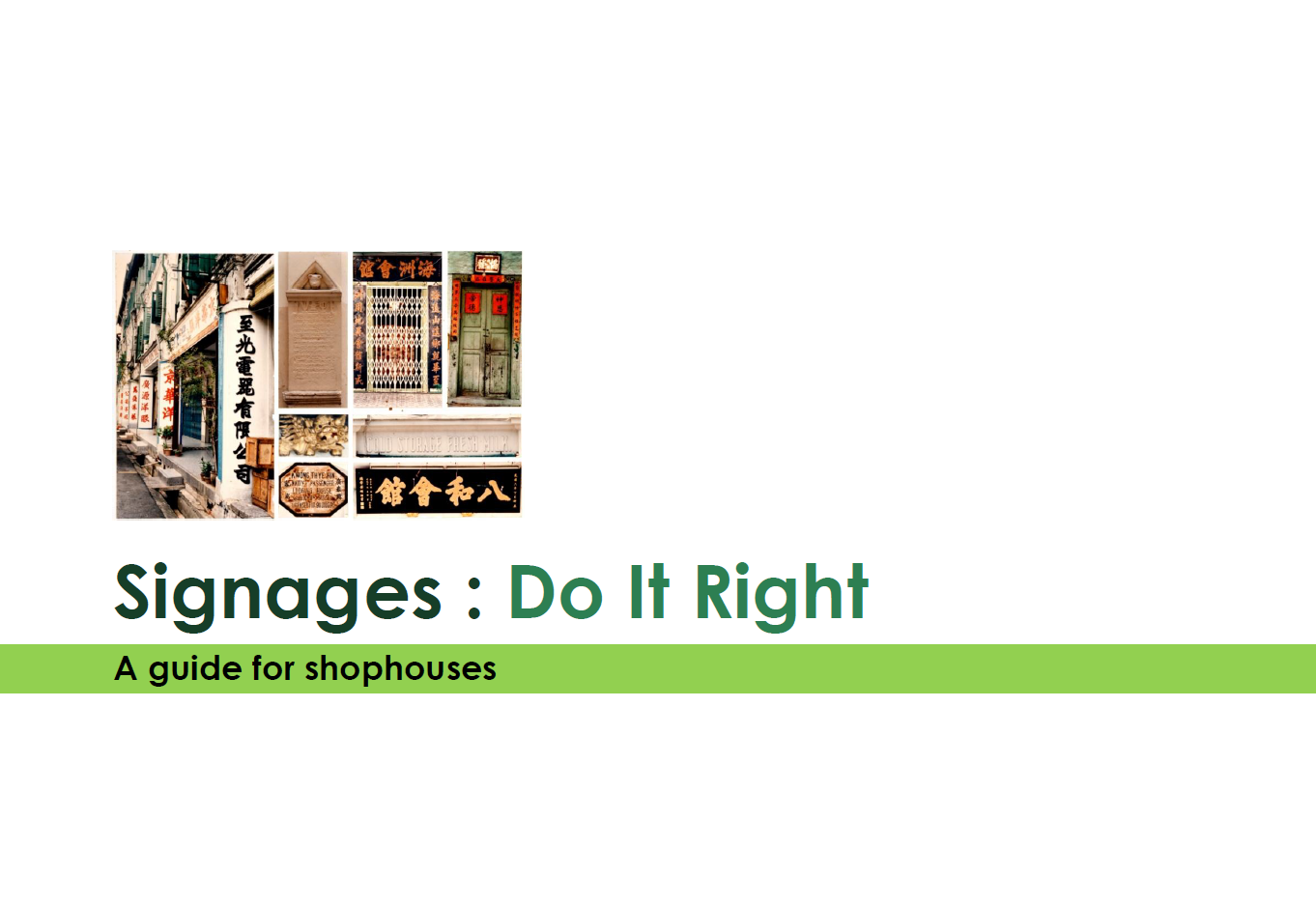
These take the form of carved timber panels with gold-painted Chinese characters sometimes combined with English translations, and letterings/characters formed in plaster relief or painted onto timber boards or metal panels. The degree of embellishment varies considerably. Traditional signs are not self-illuminating.
Owners are to retain existing traditional signs that have acquired significance e.g. plaster relief signs on the outer face of columns, beams, friezes and pediments. They are part of the cultural history of the building and cannot be removed. However, they can be covered over with a new sign panel, if necessary, without damaging the original plaster reliefs.
The original building date on the facade or pediment cannot be removed or replaced.
Contemporary Signs
These are made usually of plastic with characters or words formed in contrasting colours, and can be lit from within their casings, i.e. selfilluminating. Some contemporary signs include painted metal panels and cloth banners to publicise events or promote sale.
Design, Location and Size of Signs
Business signs are useful, interesting and attractive when thoughtfully and tastefully designed, and compatible with the character of the building and streetscape. As such, care is to be taken when designing such signs.
Signs are to be carefully positioned so that they are clear and easy to read from the street level and do not visually dominate the building. Most important of all, they do not cover or block any key architectural features.
A sensitively planned and designed sign will complement a building’s heritage. The incorrect use of signage can severely compromise the character and unity of a building and its setting.
The following guidelines are applicable to business signs which also have to comply with the requirements of the relevant technical departments. Variations can be considered based on the merits of each case.
Signage Guidelines
A. Forecourt Wall
Signs can be mounted on top or on the surface of a forecourt wall.
They are to be confined within the width or surface area of the wall, and do not cover or block any architectural features.
See Figure 1 [PDF, 1.8 MB] (opens in new tab)
B. Front Facade
B1. Shopfront & Residential Front
For a shopfront (either full-width or with side staircase entrance), signs can be mounted within the transom panel.
For an original residential front, signs can be mounted above the entrance door and are not to exceed the width of the door.
B2. Five-Foot Way
Signs can be suspended within the clear width between the column and the party wall. The underside of the sign is to have a minimum headroom clearance of 2500mm above the walkway level.
B3. First Storey Column
Signs can be projected from a column or mounted on the surface of column.
For signs projected from a column, the following are applicable :
(a) They are located at the left hand side of the building as viewed from the road.
(b) They do not exceed the height of the column shaft.
(c) They do not project beyond existing roadside drain at first storey.
(d) The width of the sign is not more than 600mm, and the width for brackets is not more than 200mm.
(e) The underside of the sign is to have a minimum headroom clearance of 2500mm above the walkway level.
For signs on the surface of column, individual letters or sign panel cannot be larger than the surface of the column and must follow the shape of the column.
B4. Frieze
Individual letters or sign panel can be mounted within a frieze or suspended from a frieze.
B5. Upper Storey Facade
Signs can be projected from an upper storey pilaster. They are to be located at the left hand side of the building as viewed from the road.
The following are applicable:
(a) The overall height of the sign (inclusive of the suspension brackets) cannot exceed the shaft of the pilaster.
(b) The width of the sign is not more than 600mm, and the width for brackets is not more than 200mm.
See Figure 6 [PDF, 935 KB] (opens in new tab)
For a building of Art Deco or Modern style, individual letters sensitively planned and designed, can be mounted on the facade. For a panel sign allowable at the 1st storey frieze, an alternative location is the wall space below the 2nd storey window. In this option, the 1st storey frieze is to be kept clear. The height of the panel sign is not to exceed 600mm and is to be placed just above the 1st storey frieze. They cannot cover or block any architectural features.
C. End Gable Wall
Sign can be mounted within the width of an entrance to a five-foot way and a door to the upper storey, where applicable.
Variations in the size and location can be considered on merits of the case if they meet the following criteria:
(a) The sign is attractively designed.
(b) It comprises mural painting on the wall, individual letters and graphics, or flat-mounted display panels. Projected sign is not allowed.
(c) The sign does not cover or block any architectural elements or features/ornaments.
(d) It does not overwhelm or adversely impact on the architectural character of the building.
See Figure 8 [PDF, 935 KB] (opens in new tab)
Signs are not allowed for gable walls which share a common boundary with a neighbouring property.
D. Rear Wall
Signs can be mounted above a rear door and not to exceed the width of the door. Variations can be considered based on the merits of the case.
See Figure 9 [PDF, 653 KB] (opens in new tab)
E. Envelope Control Sites
For Infill Developments in Historic Districts, and Type I Infill / Type II Infill Developments in Secondary Settlements which do not resemble conserved buildings:
Signboard / Business Sign
Height of the sign is not to exceed 15m or 3 storeys, whichever is lower.
The total coverage of the signboard on the façade is not to exceed 15sqm or 15% of the façade (excluding the first storey with covered walkway), whichever is lower.
Advertisements
Advertisements are allowed only on buildings located along designated advertising routes.
For Infill / Type I Infill / Type II Infill Developments along a designated advertising route, advertisements are allowed only on the façade that faces the route.
Height of the advertisement is not to exceed 15m or 3 storeys, whichever is lower.
The total coverage of the advertisement on the façade is not to exceed 30sqm or 30% of the façade (excluding the first storey with covered walkway), whichever is lower.
Advertisements must not cover ground floor openings and façade openings (e.g. windows, vents, etc).
Submission Process for Signs in Conservation Areas
Submission Process for Signs in Conservation Areas
All signage proposals within Conservation Areas are to be submitted directly to the Advertising Licensing Section of the Building and Construction Authority (BCA). Alternatively, you may submit and obtain URA’s clearance through our e-Services (Apply for Category 3 Works for Conserved Buildings) before you submit an application to the Advertisement Licensing Department of BCA.
Do-It-Right Guide for Signages
The Do-It-Right Guide for Signages features visual examples and diagrams to help better understand the requirements and processes for obtaining approval for signages on conserved buildings. Click here to find out more.