
Press Releases
Singapore Pavilion at the Venice Biennale 2025 returns home with RASA-TABULA-SINGAPURA
22 May 2026
- After welcoming 63,000 visitors from around the world, this multisensory exhibition invites Singaporeans to reflect on 60 years of city-making through the lens of dining, design and everyday life
- Open Call for Proposals launched for Singapore’s 10th presentation at the Venice Architecture Biennale 2027
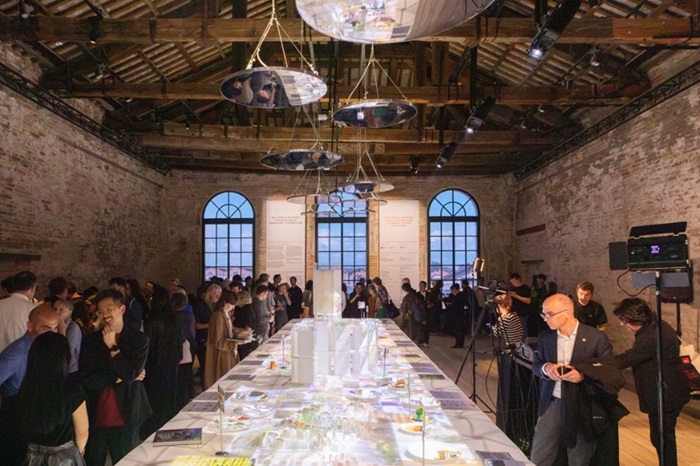
1 Following its presentation at the 19th International Architecture Exhibition of La Biennale di Venezia in 2025, the Singapore Pavilion returns home with RASA-TABULA-SINGAPURA, a multisensory exhibition that invites Singaporeans to reflect on how thoughtful planning and design have shaped the nation over the past 60 years.
2 The homecoming edition of the exhibition was officially opened today by Ms Indranee Rajah, Minister in the Prime Minister’s Office and Second Minister for Finance and National Development, at the National Museum of Singapore’s Stamford Gallery. Ms Indranee Rajah also announced the launch of an Open Call for Proposals, inviting multidisciplinary teams to submit compelling proposals for Singapore’s 10th presentation at the Venice Architecture Biennale 2027.
3 Commissioned by the Urban Redevelopment Authority (URA) and DesignSingapore Council (Dsg), organised by the Singapore University of Technology and Design (SUTD), with the National Museum of Singapore as venue supporter, the homecoming edition of RASA–TABULA–SINGAPURA examines Singapore through the lens of “superdiversity” as a form of “collective intelligence” – reflective of how the convergence of diverse cultures, communities, ideas and system has shaped Singapore’s distinctive identity over time.
RASA–TABULA–SINGAPURA: THE ESSENCE AND INGREDIENTS THAT UNIQUELY BIND OUR CITY AND PEOPLE
4 The title brings together two ideas: RASA, which refers to taste, feeling and lived experience; and TABULA, which means table, tablet or surface. Rather than presenting Singapore as a blank slate, RASA–TABULA–SINGAPURA presents the city as a place shaped by many layers of “flavours” – history, culture, nature and everyday experiences. It also reflects how Singapore continues to evolve through the daily lives of its people – through food, trade, movement, memory and the way we live.
5 Singapore’s compactness and strategic location are central to its story. As a small island and global crossroads, people from different backgrounds, together with diverse ideas and systems, interact closely here, creating a rich mix of “superdiversity” where nature, infrastructure and culture are closely connected and constantly influence one another. From this condition, new relationships and features distinctive to Singapore emerge — from food cultures and neighbourhood life to architecture and public space.
6 This exhibition invites visitors to explore how Singapore’s multicultural society and diversity have shaped the way we plan and design our city. It shows how different perspectives and needs are brought together to create shared solutions. RASA–TABULA–SINGAPURA thus frames Singapore as a living system — one whose future is shaped not only by long-term planning, but also by the countless everyday exchanges that take place across the many layers of our city, spaces, and society.
7 Conceptualised for the Venice Architecture Biennale 2025 to mark Singapore’s 60th year of independence, the exhibition is rooted in Singapore’s national pastime of dining together. The dining table is both the stage and a curatorial lens through which visitors can explore how architecture, policy, and participatory design intersect in everyday life. Through a curated “menu” of architectural and urban planning projects, the exhibition showcases how decisions around housing, greenery, mobility, infrastructure, and public space come together to support a city of many overlapping needs, identities, and aspirations.
8 “The table of plenty is a way of showing how Singapore’s diversity works — clear boundaries that bring people together and allow our collective intelligence to grow”, said Professor Khoo Peng Beng, Co-Curator of the Singapore Pavilion and Head of the Architecture and Sustainable Design Pillar at SUTD.
9 The heart of the showcase is a large-scale tablescape showcasing the concept of superdiversity in the Singaporean context, featuring “main courses” that illustrate Singapore’s approach to planning at multiple scales, complemented by “side dishes” that showcase how innovations in design, policy and community building contribute to Singapore’s strength as a multicultural society. Featured projects include Pinnacle@Duxton, the multiple award-winning public housing development that successfully reimagined high-density living; Tengah, Singapore’s first Housing & Development Board (HDB) town planned with sustainable initiatives and smart technologies from the outset; Changi Airport, our global gateway shaped through long-term infrastructural planning; and CapitaSpring, a mixed-use tower in the heart of the city that integrates greenery and multiple uses through progressive urban design policy.
10 Together, these projects demonstrate the ingredients that work in tandem to shape shared spaces and systems, building a city that is compact yet liveable, efficient yet diverse, and continually adapting to future needs.
11 Presented in Venice from 9 May 2025 to 23 November 2025, the Singapore Pavilion welcomed over 63,000 visitors from around the world, giving international audiences a glimpse into Singapore’s distinctive approach to planning, design, and nation building (see Annexes A to E for more information on the Pavilion). The homecoming edition of the Singapore Pavilion offers local audiences an opportunity to experience these ideas that represented the nation on a global stage, while considering how the spaces they inhabit every day — from neighbourhoods and parks to transport hubs and workplaces — are the result of deliberate and evolving design choices.
12 Dawn Lim, Co-Commissioner of the Singapore Pavilion and Executive Director of Dsg, said: “In Singapore, the act of dining is one that naturally draws people from different cultures and backgrounds together. And bringing RASA-TABULA-SINGAPURA home holds special significance — superdiversity is a way of life experienced every day. The exhibition shows how design, working alongside policy and constant innovation, continues to influence how we live together and keep Singapore liveable, loved, and evolving with the times.”
13 A series of public programmes will accompany the exhibition, including curatorial talks and guided tours, a curators’ roundtable seminar series examining superdiversity across urban, cultural, and social contexts, and architectural tours presented in conjunction with the Architours programme of Archifest. The public can sign up via links that will be posted on https://www.instagram.com/singapore.pavilion/ (opens in new tab).
14 The homecoming exhibition will run from 23 May 2026 to 2 August 2026 at the Stamford Gallery, National Museum of Singapore. Admission is free.
OPEN CALL FOR PROPOSALS FOR 2027 VENICE ARCHITECTURE BIENNALE
15 The Open Call for Proposals for Singapore’s 10th presentation at the Venice Architecture Biennale 2027 launched by URA and Dsg today provides a unique platform for architectural inquiry. It is also an opportunity for locally-based architects and designers to present Singapore’s experience of rapid transformation, innovative approaches to tropical urbanism, and integration of heritage with development, offering rich material to the rest of the world for investigating fundamental questions about architecture’s role in society.
16 “Since our first participation at the Biennale in 2004, each Singapore Pavilion has captured a distinctive phase in our urban narrative – from our early expressions of resilience and innovation in land use, to today’s explorations spanning the full spectrum of scale, from master planning to urban and architectural design. Two decades on, Singapore’s presentations have matured into multidisciplinary dialogues that invite the world to experience Singapore as a living system of design”, said Yap Lay Bee, Co-Commissioner of the Singapore Pavilion and Group Director (Architecture & Urban Design), URA. “We hope this Open Call will inspire more architects to come together to submit compelling proposals for our next Singapore Pavilion at the Venice Architecture Biennale 2027 and advance the Singapore story and presence within the global architectural conversation”.
17 Under the curatorial direction of Wang Shu and Lu Wenyu1, the 2027 Biennale will focus on the authenticity of architectural practices rooted in modern society, with thoughtful re(use) of materials. While responding to the Biennale’s curatorial direction, proposals should demonstrate how Singapore’s unique approach to adaptive reuse, vernacular modernism, and contextual design contributes to the global architectural discourse through deep investigation and critical examination.
18 For more information, visit https://singaporepavilion.sg/2027-open-call (opens in new tab).
Annex A to E
Annex | Title |
|---|---|
A (opens in new tab) [PDF, 10,052kb] | Design of the Singapore Pavilion, Venice Architecture Biennale 2025 |
B (opens in new tab) [PDF, 70kb] | Featured Projects in the Singapore Pavilion, Venice Architecture Biennale 2025 |
C (opens in new tab) [PDF, 145kb] | Commissioners and Organiser of the Singapore Pavilion, Venice Architecture Biennale 2025 |
D (opens in new tab) [PDF, 205kb] | Venue Supporter |
E (opens in new tab) [PDF, 247kb] | Curatorial Team of the Singapore Pavilion, Venice Architecture Biennale 2025 |
1 Appointed by La Biennale di Venezia, architects Wang Shu and Lu Wenyu are the co-founders of Hangzhou-based Amateur Architecture Studio and are celebrated for integrating traditional Chinese craftsmanship with salvaged building materials. Their work, which includes the Ningbo History Museum, emphasises cultural heritage over modern mass-standardisation. In 2012, Wang Shu received the Pritzker Architecture Prize — architecture’s highest honour — representing a shared practice with Lu Wenyu that has redefined contemporary global architecture.