
Press Releases
Heritage, nature and inclusive spaces to anchor new housing estate at Bukit Timah Turf City
23 May 2024
This article has been migrated from an earlier version of the site and may display formatting inconsistencies.
- Approximately 15,000 to 20,000 public and private homes planned; first time in almost 40 years that public housing is planned in Bukit Timah
- 27 heritage buildings and structures to be studied for retention; forested areas at Eng Neo Avenue Forest and Bukit Tinggi to be retained
- Heritage Impact Assessment and Environmental Impact Assessment to guide sensitive development of new housing estate
- Public invited to continue giving feedback on plans at exhibition as part of the Draft Master Plan 2025 public engagement
Bukit Timah Turf City is set to be transformed into a new housing estate where homes, heritage, nature and amenities are sensitively integrated to provide current and future residents with a highly liveable, inclusive and endearing living environment. Minister for National Development Mr Desmond Lee announced more details on the plans for Bukit Timah Turf City at the launch of an exhibition at the URA Centre. When fully completed in around 20 to 30 years’ time, the estate will comprise approximately 15,000 to 20,000 new public and private homes, marking the first time in almost 40 years where public housing is planned in Bukit Timah. Bukit Timah Turf City will be planned upfront to be car-lite, pedestrian-friendly and well-served by public transport, with good walking and cycling connections. The exhibition also presents plans to retain and incorporate significant heritage and nature assets into the new estate, following the completion of heritage and environmental studies.
2. This exhibition builds on URA’s “My City, My Home” exhibition held from November 2023 to February 2024, where the conceptual plans for new housing areas in more central locations were showcased1. The plans reflect the Draft Master Plan 2025’s (DMP2025) focus on “Shaping a Happy Healthy City” with more inclusive homes and accessible spaces as well as “Stewarding Nature and Heritage” by enhancing our natural capital and anchoring our sense of identity. See
Annex A [PDF, 69 KB] (opens in new tab)
[PDF, 69kb] for details of DMP2025.
3. These preliminary plans for Bukit Timah Turf City have also been shaped by extensive engagements with residents, heritage and nature groups over the last few years as well as feedback from the general public since the launch of the DMP2025 public engagements in October last year. Agencies will continue to engage widely to develop detailed plans for the area in the coming years to ensure that they meet the evolving aspirations and needs of Singaporeans.
Bukit Timah Turf City – home to Singapore’s second racecourse for 66 years
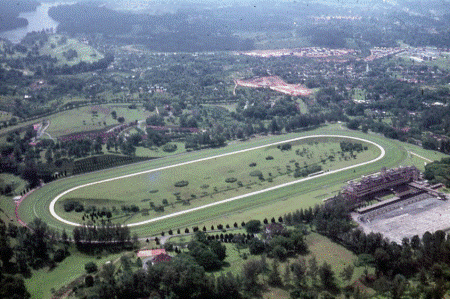
A photo of the racecourse in the 1960s (Source: Peter D. Huggett & Colin Philips)
4. Bukit Timah Turf City was home to Singapore’s second racecourse from 1933 to 1999 and a popular horse racing venue patronised by locals from a variety of backgrounds. In 1999, Singapore Turf Club relocated to Kranji to ease traffic congestion in the area. The land was also safeguarded for future uses. Since 1998, the 176-hectare site has been largely zoned under our Master Plan for residential use, to cater to future housing needs. In the interim, it was leased out for lifestyle and recreational uses until end-2023.
5. Given the scale and context of the site, a Heritage Impact Assessment (HIA) and an Environmental Impact Assessment (EIA) were conducted in consultation with heritage and nature groups, to comprehensively study the site and guide the development of plans that balance future housing needs with safeguarding the most significant heritage and nature assets.
27 heritage buildings and structures to be studied for retention and integration with future developments
6. The HIA attributed the heritage significance of Bukit Timah Turf City to its 66 years of history as one of Southeast Asia’s top racecourses and its association with the growth of horse racing in Singapore. The HIA therefore recommended retaining significant buildings and repurposing them for other suitable uses. Sensitive urban design strategies and heritage interpretation measures should also be integrated into future developments to highlight the architectural and social significance of the site’s buildings and landscapes and recall its equestrian history. See
Annex B [PDF, 82 KB] (opens in new tab)
[PDF, 82kb] for a summary of key findings and recommendations of the HIA.
7. Having carefully considered the HIA findings as well as feedback from the Heritage and Identity Partnership (HIP)2, residents of the surrounding estates and workers of the former Turf Club, agencies are adopting three strategies to sensitively integrate heritage and identity of the area with future developments:
i) A total of 27 buildings and structures, located in five different clusters and representing different facets of the former Turf Club’s history, will be studied for retention and repurposing to new uses that serve future and existing communities. An example is the North Grandstand, an iconic building that housed thousands of spectators and is a notable example of Modernist architecture completed in the 1980s. See
Annex C [PDF, 184 KB] (opens in new tab)
[PDF, 184kb] for a full list of the buildings and structures that URA is studying for retention, if feasible.
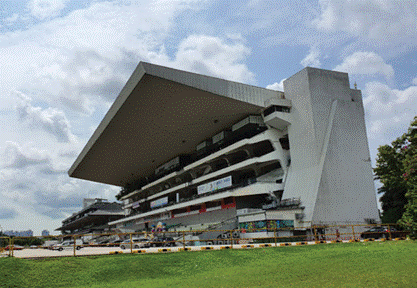
North Grandstand (Source: National University of Singapore)
ii) A new central open space in front of the Grandstands, which is about twice the size of the Padang, will pay homage to the site’s sporting heritage. Referencing the geometry of the historic racetracks, the new oval is envisaged as the centrepiece of Bukit Timah Turf City. It is intended for sports and recreational uses and will be surrounded by civic and community amenities to serve existing and future residents of this area.
iii) To further recognise the history of the former Turf Club, agencies will continue to actively document the heritage of the site and explore ways to tell the story of the racecourse, such as through storyboards and heritage trails.
Safeguarding and enhancing ecological habitats and connectivity
8. URA commissioned an EIA to better understand the existing flora, fauna, hydrology and topography of the area as well as assess the potential environmental impact of development to guide appropriate mitigation measures. Nature groups were also consulted throughout the course of the study.
9. The EIA recorded 177 plant species and 25 animal species of conservation significance including the globally-threatened Straw-headed bulbul and Sunda pangolin. Many of these species were found in two forested areas - Eng Neo Avenue Forest and Bukit Tinggi.
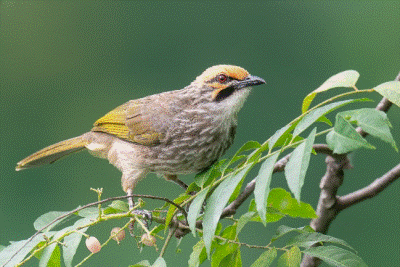
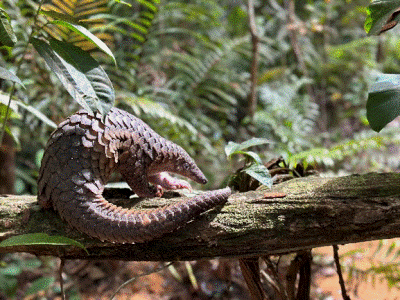
(Left) Straw-headed bulbul (Source: Francis Yap); (Right) Sunda Pangolin (Source: Maxine Tan)
10. In view of this, the EIA recommended retaining the two forested areas and connecting them to facilitate ecological connectivity. See
Annex D [PDF, 117 KB] (opens in new tab)
[PDF, 117kb] for a summary of key findings and recommendations of the EIA. Taking into account the findings and recommendations of the environmental study, agencies are adopting the following three strategies to mitigate the potential impact of the future developments and create opportunities for communal living and recreation amidst nature:
i) We will retain most of Eng Neo Avenue Forest and Bukit Tinggi and study how they can be integrated into our future park network.
ii) A new 100m-wide lushly planted connection will be established between Eng Neo Avenue Forest and Bukit Tinggi to link the two habitats and facilitate ecological connectivity
iii) Selected landscapes of the former Turf Club such as the Fairways Quarters courtyard will be adapted and enhanced as green recreational spaces for all to enjoy.
Shaping a liveable, inclusive and endearing home
11. The development of Bukit Timah Turf City presents opportunities to enhance the living environment for current and future residents. To this end, agencies have engaged residents in nearby estates to gather ideas for amenities that can better serve them and future neighbours. Many have shared that they look forward to more retail and community uses, and increased connectivity.
12. Taking onboard their views, Bukit Timah Turf City is planned to be people-centric, pedestrian-friendly and car-lite. It will be well-served by two MRT stations on the existing Downtown Line and upcoming Cross Island Line, with residents within 800m or a 10-minute walk from the MRT station, complemented by buses. A comprehensive pedestrian and cycling network will facilitate convenient access to key amenities and public transport nodes such as MRT stations. With less need to rely on private transportation, the estate will also be planned with reduced parking provision to prioritise space for public amenities, greenery and housing.
13. To accommodate the anticipated traffic from future developments at Bukit Timah Turf City, road improvement works will be implemented at Dunearn Road, Bukit Timah Road and Eng Neo Avenue. Agencies are also studying the technical feasibility and environmental impact of implementing a new exit ramp from PIE (towards Tuas), as an alternative access to the site and to facilitate the distribution of traffic in the area.
14. We are also studying the introduction of amenities that serve the social and physical wellbeing of the community, as the estate is developed. As part of planning for “10-minute neighbourhoods”, most amenities such as shops, community and recreational facilities and parks will be within a 10-minute walk for future residents, and conveniently located close to the MRT station to maximise convenience for all, including for existing residents living nearby. We will share more details on these amenities at a later stage, after considering public feedback on the development plans.
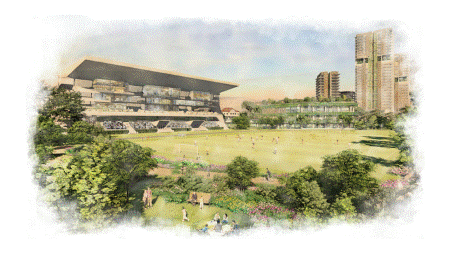
Artist's impression of a repurposed Grandstand and central open space in front of it (Source: URA)
15. To shape an endearing home, four distinctive neighbourhoods are proposed, each featuring new public spaces integrated with existing landscape and heritage buildings to reflect their unique characters while promoting community bonding. For example, the Racecourse neighbourhood will be anchored around the iconic Grandstands and new oval that references the historical racetracks. Residents can look forward to a variety of recreational spaces and sports facilities within a five-minute walk to the upcoming Cross Island Line MRT Station. The Saddle Club Knolls neighbourhood, on the other hand, will be defined by undulating terrain and surrounding forests. Here, the former Bukit Timah Saddle Club and Fairway Quarters could be repurposed to new uses and serve as gathering spaces for the community. See
Annex E [PDF, 152 KB] (opens in new tab)
[PDF, 153kb] for preliminary plans for the various neighbourhoods.
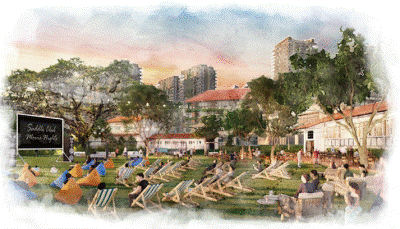
Artist’s impression of possible new community space in front of Bukit Timah Saddle Club Building & Fairways Bungalow (Source: URA)
16. Across all neighbourhoods, urban design guidelines will guide developments to respect the surrounding environment. For example, building heights will be kept lower where they are closer to key heritage buildings, green spaces and existing low-rise housing areas. In other areas, such as those more centrally located and nearer the MRT stations, agencies intend to develop high-rise housing to optimise land and enable more people to enjoy the convenience of living close to key transport nodes.
17. Bukit Timah Turf City will be developed progressively, starting with areas closer to existing transport nodes along Dunearn Road.
18. Mr Lim Eng Hwee, Chief Executive Officer of Urban Redevelopment Authority (URA), said, “The plans for Bukit Timah Turf City underscore our planning approach in land scarce Singapore and our commitment to realising the vision of the Draft Master Plan 2025 to make Singapore a more liveable, inclusive and endearing home for all. Despite its scale, we are not intensifying the site completely but will strive to protect and sensitively integrate significant nature and heritage elements with the new estate, to create a distinctive environment anchored on the area’s history and natural spaces. As we refine our plans in the years ahead, we encourage Singaporeans to continue contributing ideas to shape a vibrant home that reflects our collective aspirations.”
Partnering stakeholders to shape future plans
19. Since the early stages of planning, URA has been actively engaging various stakeholders to seek ideas on the plans and ensure that community needs and concerns are addressed effectively. For instance, as Malayan Colugos (also known as a flying lemur) have been spotted across the site and especially at Bukit Tinggi, URA collaborated with nature groups further to identify ways to improve connectivity for the Malayan colugos within the site.
20. As part of heritage documentation, URA engaged former workers and residents of the Singapore Turf Club to document their work experiences and living anecdotes. Focus groups discussions and dialogue sessions with residents yielded suggestions on desired amenities, improving connectivity and spaces for communal interactions. Most recently through the “My City, My Home” exhibition, URA also gathered public feedback on conceptual plans for Bukit Timah Turf City.
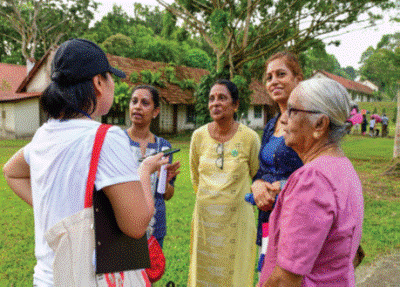
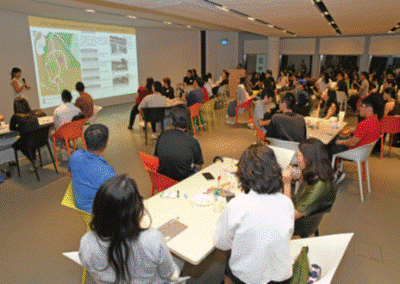
(Left) Former Turf Club workers and their families sharing stories of their time spent at Fairways Quarters as part of heritage documentation; (Right) Planners sharing conceptual plans with young Bukit Timah residents as part of engagements for the “My City, My Home” exhibition (Source: URA)
21. Agencies have taken onboard these ideas and feedback in developing the draft plans for Bukit Timah Turf City presented in the exhibition. We invite Singaporeans to continue sharing their views as we develop them in detail. Visitors to the exhibition, which runs till 23 July 2024, can also share their views through the
feedback form (opens in new tab)
. The
and
reports are also available for public feedback from now till 20 June 2024.
22. Members of the public can visit https://go.gov.sg/URADraftMasterPlan to stay updated on other initiatives under DMP 2025 and sign up for public engagement activities.
1 The "My City, My Home" exhibition presented conceptual plans for Bukit Timah Turf City, Pearl’s Hill, Mount Pleasant and Marina South.
2 The HIP serves as a platform for regular dialogue between URA and its members of diverse backgrounds, including individuals from the building industry, arts and heritage sector, journalism, business and property owners and academia. HIP provides feedback and suggestions on ways to sustain and manage built heritage and identity as well as to promote greater public understanding of built heritage.