
RC Flat Roofs
Check the guidelines relating to RC flat roofs for flats and condominiums.
Last updated on 20 July 2026
RC flat roofs shall remain inaccessible except for maintenance purposes only1. Activating the rooftop for uses such as roof terraces and landscaped gardens may be allowed depending on the merits of the proposal. No structures shall be allowed unless otherwise approved by URA. Where allowed, structures (including any safety barriers) shall comply with height controls2 and the following guidelines.
1 RC flat roofs that are accessible via ladders for maintenance purposes only are subject to agencies’ requirements for safety barriers to ensure the safety of maintenance personnel. Safety barriers shall not exceed 1m in height.
2 Height controls applicable, include:
Absolute technical height constraints (e.g. Aviation paths restrictions, military and telecommunications installations). The absolute technical height (Based on Singapore Height Datum [SHD]) shall take precedence if it is stricter than any of the other height controls.
Conservation guidelines (available at URA SPACE (opens in new tab))
Urban design height controls (available at URA SPACE (opens in new tab))
Communal Pavilions
Communal pavilions are small-scale, ancillary landscaping features that function as sheltered, open-sided resting points. Access to communal pavilions shall be from common areas only. The pavilions shall be computed as GFA unless they meet the following criteria:
Maximum 50sqm3 or 50% of roof coverage, whichever is lower.
For developments which have reached the allowable storey height control, the pavilions shall remain open-sided when viewed externally. This is to ensure that the pavilions do not form an additional storey.
For developments which have not reached the allowable storey height or are not located within areas subject to storey height control, maximum 50% perimeter enclosure of the rooftop pavilions may be allowed.
Communal pavilions shall be integrated with lush greenery. The greenery on the rooftop shall be both enjoyable by the building users and visible from the surroundings.
Plants shall be incorporated on permanent and preferably sunken planting, planned with sufficient soil depth based on the types of plants proposed. Some space shall be set aside for the provision of communal facilities and furniture to enhance the rooftop.
A Landscape Plan and relevant sections for ground/rooftop spaces containing communal pavilions, showing the proposed landscaping scheme, pavilion dimensions, planting palette, soil depth, communal facilities, shall be submitted with the Development Application.
3 The area is defined as the area of pavilion measured up to the roof eaves line. If attached to the main building, the area excludes the adjoining walls.
Solar Panels
The installation of solar panels on RC flat roofs may be considered if they do not result in the removal of any greenery approved under the Landscaping for Urban Spaces and High-Rises (LUSH) Programme.
Installation of solar panels and M&E equipment such as inverters for the solar panel system does not require planning permission except in locations and contexts described below.
Urban Design and Conservation Areas
Areas subject to urban design guidelines and Conservation Areas4 shall require planning permission due to their impact on the roofscape.
4 For Conservation Areas, installation of solar panels without any additional works are treated as localised works for the purpose of repair and maintenance and are considered Category 3 works for Conserved Buildings. Applications for such Category 3 works can be made by owners and contractors. Refer to the Conservation Guidelines and information on submission procedure.
Elevated solar panels
Elevated solar panels5 located in developments on the following land use zones shall require planning permission
Residential (landed housing, flats and condominium housing developments)
Residential with Commercial at 1st Storey
Mixed Commercial & Residential
Commercial
Hotel
White
Residential / Institution
Commercial / Institution
Educational Institution
Place of Worship
Civic & Community Institution
5 A solar panel is deemed to be elevated if it is raised more than 1m from the roof level for landed housing developments or 1.8m from the roof level for other developments.
Spaces under solar panels are enclosed or put to commercial use
Planning permission shall be required if the spaces under elevated or non-elevated solar panels are enclosed or put to commercial uses such as Outdoor Refreshment Areas. In such instances, the spaces shall be computed as GFA.
Assessment of Storey Height
Elevated solar panels that require planning permission may be assessed as an additional storey for storey height control purposes unless they comply with the guidelines below:
Table 1: Guidelines for Elevated Solar Panels
Parameter | Guidelines |
|---|---|
Extent | Within the 45-degree line from the springing line of the roof level |
Height | Maximum 5m above roof level |
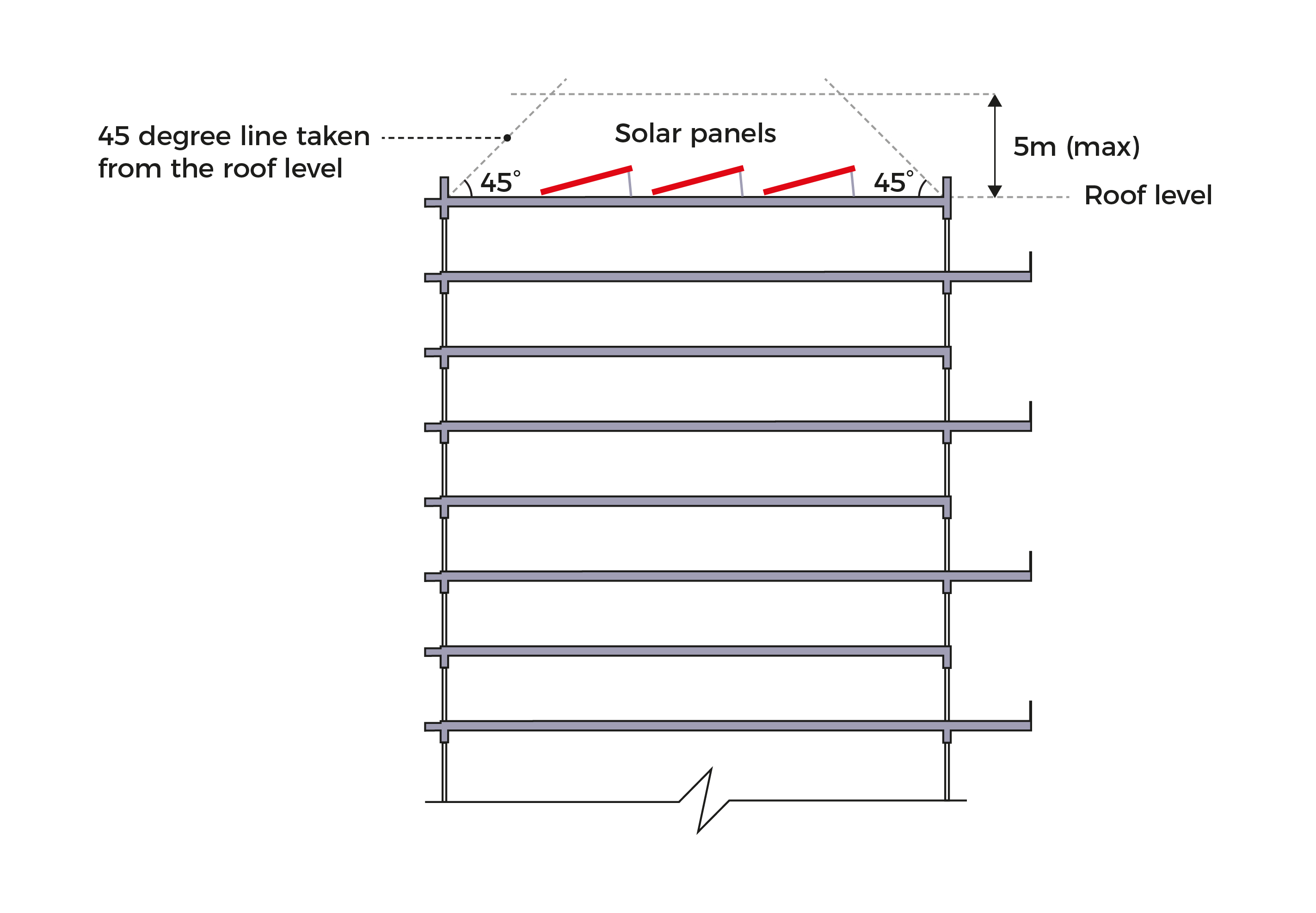
Extent and Height of Elevated Solar Panels