
Building Length
Check the guidelines relating to building length for flats and condominiums.
Last updated on 7 June 2026
The chart below illustrates the acceptable building height and building length of flats and condominium developments of at least 8 storeys. The objective is to minimise the creation of wall-like developments which would adversely affect the quality of our built environment. Each residential block shall be guided by the height and length ratio shown under the ‘Acceptable Zone’:
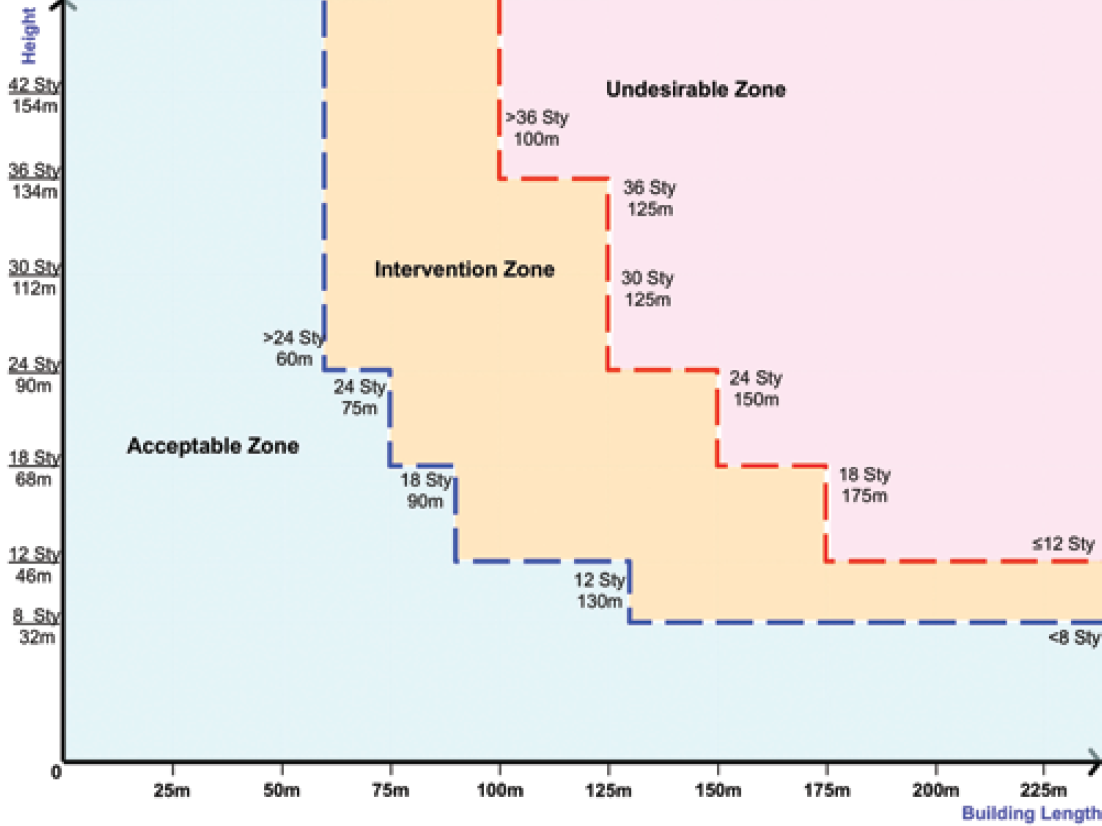
Framework for Building Height and Building Length
Where there are multiple building blocks, there shall be a minimum spacing between each block to visually break the massing of the development.
The minimum spacing standard is shown in the table below:
Table 1: Minimum spacing standard
Number of Storeys | Building Height | Minimum Building Spacing |
|---|---|---|
1 - 18 | ≤ 68m | 10m |
19 - 24 | > 68m - 90m | 12m |
>24 | > 90m | 15m |
If 2 or more blocks fall within different height bands, the height of the taller block shall be used to determine the minimum building spacing.
If 2 or more blocks are unable to meet the minimum building spacing, the blocks shall be treated as a single block.
The zones illustrated in the graph above are:
a. Acceptable Zone
Flats and condominium developments complying with the height and length ratio in an Acceptable Zone are unlikely to have an adverse impact on the surrounding environment.
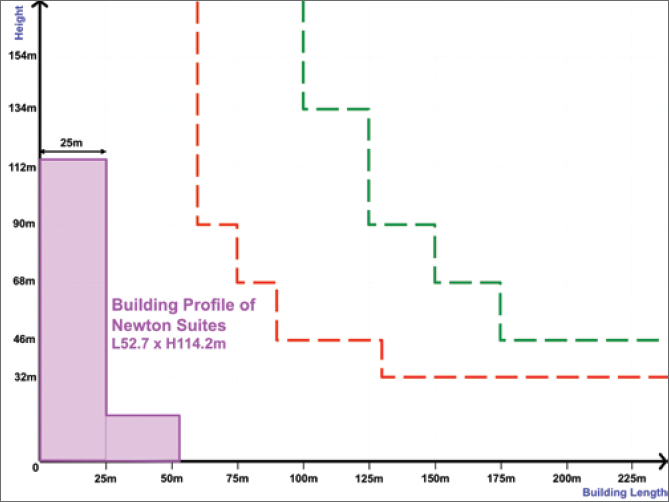
An example of a building height and length profile in the Acceptable Zone
b. Intervention Zone
Flats and condominium developments with the height and length ratio shown below may or may not pose severe impact on the surrounding environment, depending on the site context and the design measures adopted by the designers.
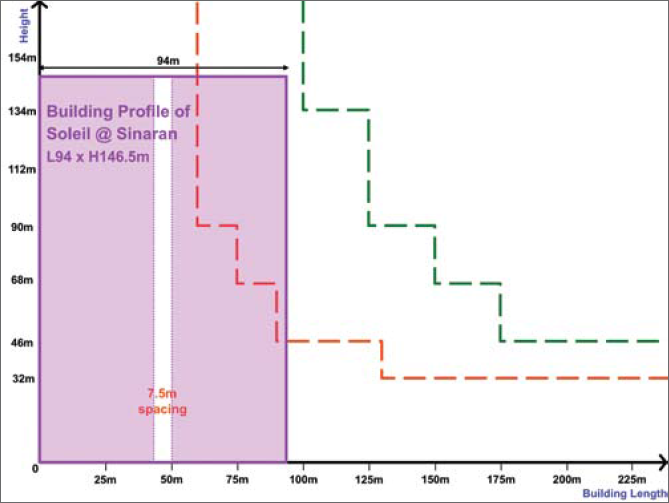
An example of a building height and length profile in the Intervention Zone
c. Undesirable Zone
Flats and condominium developments with the height and length ratio shown below are considered to be too massive in scale, and may adversely impact the surrounding environment. Apart from impeding wind flow, such buildings will block off views of the surrounding development and result in a congested skyline. Such developments are not likely to be supported.
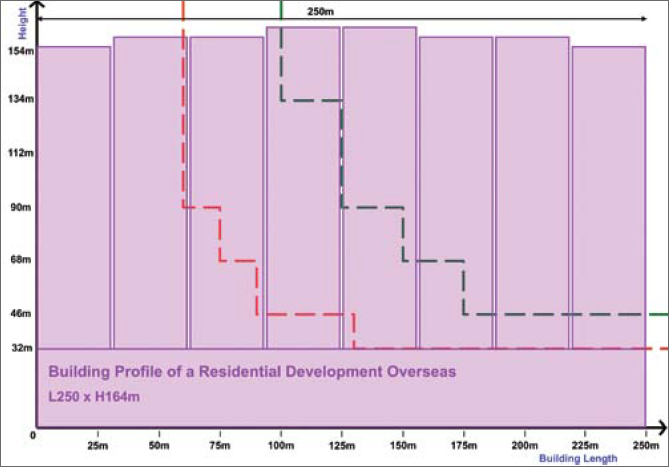
An example of a building height and length profile in the Undesirable Zone
Flats and condominium developments within the Intervention Zone shall be subject to detailed evaluation. For developments falling within the Intervention Zone, the following 3 performance criteria [refer to (a) to (c) below] shall be met. This may be achieved through the suggested measures listed below, or other alternatives that the QP may propose:
a. Whether the development enhances the streetscape
Blocks fronting roads shall be staggered at the foreground and background so that pockets of greenery are created along the street.
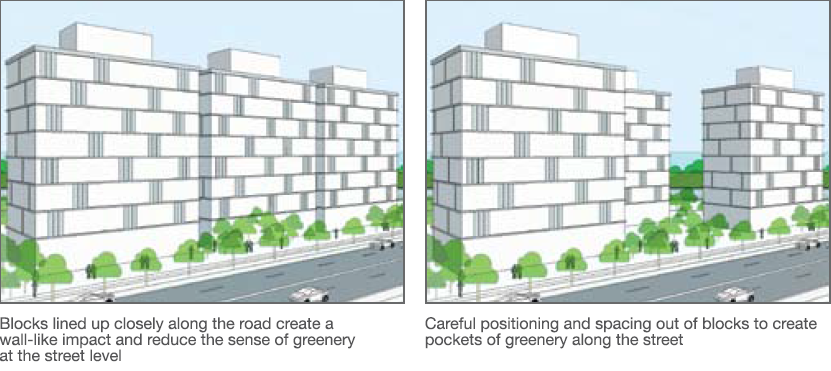
Positioning of blocks along the streetscape
b. Whether the surrounding developments can also view major green and blue public spaces
The placement and design of the blocks shall minimise blocking of views towards public assets such as waterbodies, parks, etc.
The design of the blocks shall provide permeability in the form of sky terrace floors or fenceless boundaries so as to promote visual relief and wind movement.
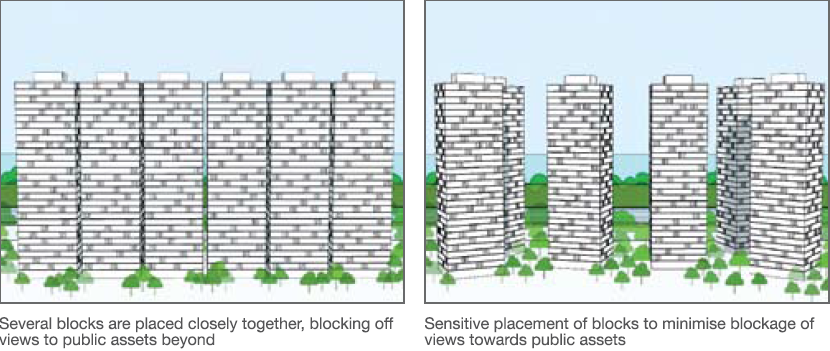
Spacing between blocks
c. Whether effective mitigating measures have been adopted to break down building massing
Building heights may be varied.
More interesting building ‘crowns’ may be proposed as opposed to flat roofs.
Landmark blocks may be strategically located within the development to provide a focal point.
The façade shall be well articulated with visually interesting patterns.
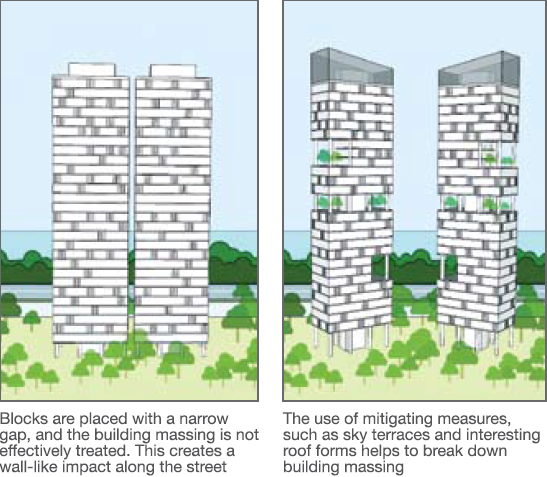
Facade articulation
For further information on Building Height and Building Length, refer to the following link.