
Greenery
Check the guidelines relating to greenery for hotels
Last updated on 9 June 2026
Landscaping for Urban Spaces and High-Rises (LUSH)
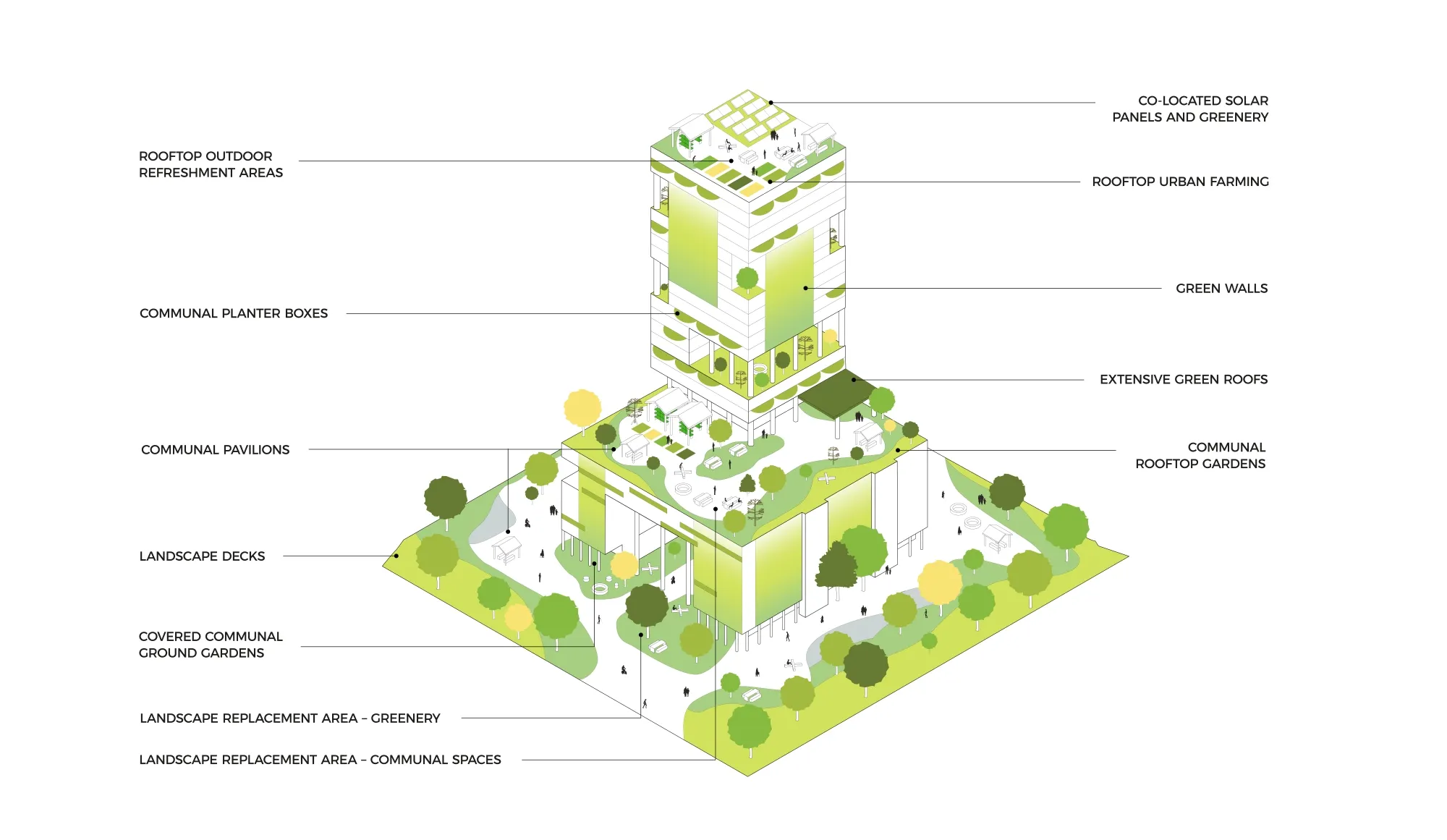
LUSH is a comprehensive urban and skyrise greening programme comprising both Landscape Replacement Areas (LRA) requirements and incentives to provide greenery and communal spaces.
The LRA requirements are calibrated by location, GPR and development type. A development may count Sky Terraces, Communal Planter Boxes and Covered Communal Ground Gardens (see Greenery sub-tabs) amongst other features, towards meeting the LRA requirement.
Applicants may refer to the following self-help checklists for the applicable greenery requirements and information to be submitted for assessment:
Landscape Replacement Areas
Landscape Replacement Areas (LRA) Guidelines in Strategic Areas
Developments in identified Strategic Areas shall provide LRA that is minimally equivalent to the development’s gross site area, as shown in the table and diagram below. At least 40% of the LRA requirement shall be reserved for softscape (permanent planting) areas. The remaining LRA requirement may be provided as hardscape.
The Green Plot Ratio (GnPR) provides an objective measure of the density of greenery within a site. The formula for computing GnPR and the minimum GnPR requirement is as follows:

The Total Leaf Area shall be computed based on the Leaf Area Index (LAI) for each plant species, canopy area (for trees and palms) and the quantity planted. The plant species sub-categories and LAI values may be obtained online from NParks’ Flora Fauna Web (opens in new tab) by searching the common or scientific names of plants.
Table 1: LRA Requirements for Developments in Strategic Areas
Location | Developments in Strategic Areas | Developments in Strategic Areas Outside Central Area, with Height Control ≤80m1 |
|---|---|---|
LRA (as a % of Site Area) | 100% | 70% |
Minimum softscape requirement | 40% | 40% |
Minimum GnPR requirement | 4.0 | 4.0 |
1 Building height is based on Singapore Height Datum (SHD).
The Strategic Areas are as follows:
Within Central Area: Downtown Core (part), Straits View (part), Marina South, and Orchard (part) Planning Areas, as well as 2 mixed-use parcels along Orchard Boulevard in Paterson Hill Subzone (see Plan 1-1);
Outside of Central Area: Regional Centres and Growth Areas including the Jurong Lake District, Kallang Riverside, Woodlands Regional Centre, Punggol Creative Cluster, Tampines Regional Centre and Paya Lebar Central as well as commercial and commercial/residential developments within Town Centres (see Plans 1-2 to 1-26).
Table 2: List of Strategic Areas
Plan | Location |
|---|---|
1-1 | |
1-2 | |
1-3 | |
1-4 | |
1-5 | |
1-6 | |
1-7 | |
1-8 | |
1-9 | Choa Chu Kang Planning Area [PDF, 278 KB] (opens in new tab) |
1-10 | |
1-11 | Geylang Planning Area (Paya Lebar Central) [PDF, 178 KB] (opens in new tab) |
1-12 | |
1-13 | |
1-14 | |
1-15 | Marine Parade Planning Area [PDF, 155 KB] (opens in new tab) |
1-16 | |
1-17 | |
1-18 | |
1-19 | |
1-20 | |
1-21 | |
1-22 | |
1-23 | |
1-24 | |
1-25 | |
1-26 |
The LRA requirement is not applicable to conserved buildings in historic conservation areas. URA may exercise flexibility on LRA requirements when evaluating individual developments affected by specific constraints.
The table below shows the guidelines for computation of LRAs in Strategic Areas. LRA in Strategic Areas is the sum of:
Horizontal surface area of the softscape eg permanent planting beds;
Horizontal surface area of the hardscape eg communal facilities, urban farm; and
Vertical surface area of green walls and extensive green roofs (if any).
The LRA requirement is not applicable to conserved buildings in historic conservation areas. URA may exercise flexibility on LRA requirements when evaluating individual developments affected by specific constraints.
The table below shows the guidelines for computation of LRAs in Strategic Areas. LRA in Strategic Areas is the sum of:
Horizontal surface area of the softscape e.g. permanent planting beds;
Horizontal surface area of the hardscape e.g. communal facilities, urban farm; and
Vertical surface area of green walls and extensive green roofs (if any).
Table 3: Guidelines for LRAs in Strategic Areas
LRA in Strategic Areas | Definition/Guidelines |
|---|---|
General Guidelines | To qualify as LRA, all horizontal areas shall be:
All LRA shall be designed taking into account safety and maintenance considerations. |
Softscape Areas | These are permanent, sunken planting areas which shall be designed with sufficient soil depth to accommodate a variety of plant types. |
Hardscape Areas | These are communal facilities (e.g. event plazas, playgrounds and water features), surrounded by lush landscaping. Fire engine accessways may be considered as hardscape areas if they are communally accessible in times of non-emergency and are surrounded by lush landscaping.
|
Vertical Greenery & Extensive Green Roofs | May count towards either softscape or hardscape under the LRA requirement, up to 10% of site area.
2 For vertical green proposing support systems, planter boxes of minimum 500mm depth are encouraged to be provided at every storey for dense plant growth. |
Areas that do not qualify as LRA | Service facilities, e.g. vehicular drop-offs, driveways, etc, and its ancillary greenery. |
Ownership | In strata subdivided developments, the LRAs shall be part of common property. |
Clearance Process and Requirements | URA’s clearance of the completed Landscape Replacement Areas provided by developments within Strategic Areas is required before the Commissioner of Building Control issues the Temporary Occupation Permit (TOP), or Certificate of Statutory Completion (CSC) (when TOP is not required). |
LRA Guidelines outside the Strategic Areas
Outside of the Strategic Areas, all sites zoned Commercial, Residential with Commercial at 1st storey, Commercial and Residential, Hotel and White shall be required to meet minimum greening standards, tiered according to the development’s GPR as shown in the table below.
Table 4: LRA Requirements for Developments Outside Strategic Areas
LRA Requirements | GPR ≤ 1.4 | 1.4 < GPR < 2.8 | GPR ≥ 2.8 |
|---|---|---|---|
Overall Greenery Provision | 30 | 35 | 40 |
Green Plot Ratio | 3 | 3.5 | 4 |
The Green Plot Ratio provides an objective measure of the density of greenery within a site. The formula for computing GnPR and the minimum GnPR requirement is as follows:

The Total Leaf Area shall be computed based on the Leaf Area Index (LAI) for each plant species, canopy area (for trees and palms) and the quantity planted. The plant species sub-categories and LAI values may be obtained online from NParks’ Flora Fauna Web (opens in new tab) by searching the common or scientific names of plants.
The general guidelines of LRA are shown in the table below. The computation of the LRAs outside the Strategic Areas is the sum of:
Horizontal surface area of the softscape eg permanent planting beds; and
Vertical surface area of green walls (if any).
Table 5: Guidelines for LRAs in Outside Strategic Areas
LRA Outside Strategic Areas | Definition/Guidelines |
|---|---|
General Guidelines | To qualify as LRA, all horizontal areas shall be:
The LRA may be located on any storey of the development, and shall be accessible to the public and building occupants during normal operating hours. |
Softscape Areas | These are permanent, sunken planting areas which shall be designed with sufficient soil depth to accommodate a variety of plant types. |
Vertical Greenery & Extensive Green Roofs | May count towards either softscape or hardscape under the LRA requirement, up to 10% of site area.
3 For vertical green proposing support systems, planter boxes of minimum 500mm depth are encouraged to be provided at every storey for dense plant growth. |
Areas that do not qualify as LRA | Service facilities, e.g. vehicular drop-offs, driveways, etc. and its ancillary greenery. |
Ownership | In strata subdivided developments, the LRAs shall be part of common property. LRAs for hotels within mixed-use developments, however, may be attributed to the hotel strata should they be contiguous to other hotel uses and be adequately segregated from other uses. |
Plan Presentation Requirements for Landscape Replacement Areas
A Landscape Plan for all Landscape Replacement Areas shall be submitted together with the Development Application, as illustrated below.
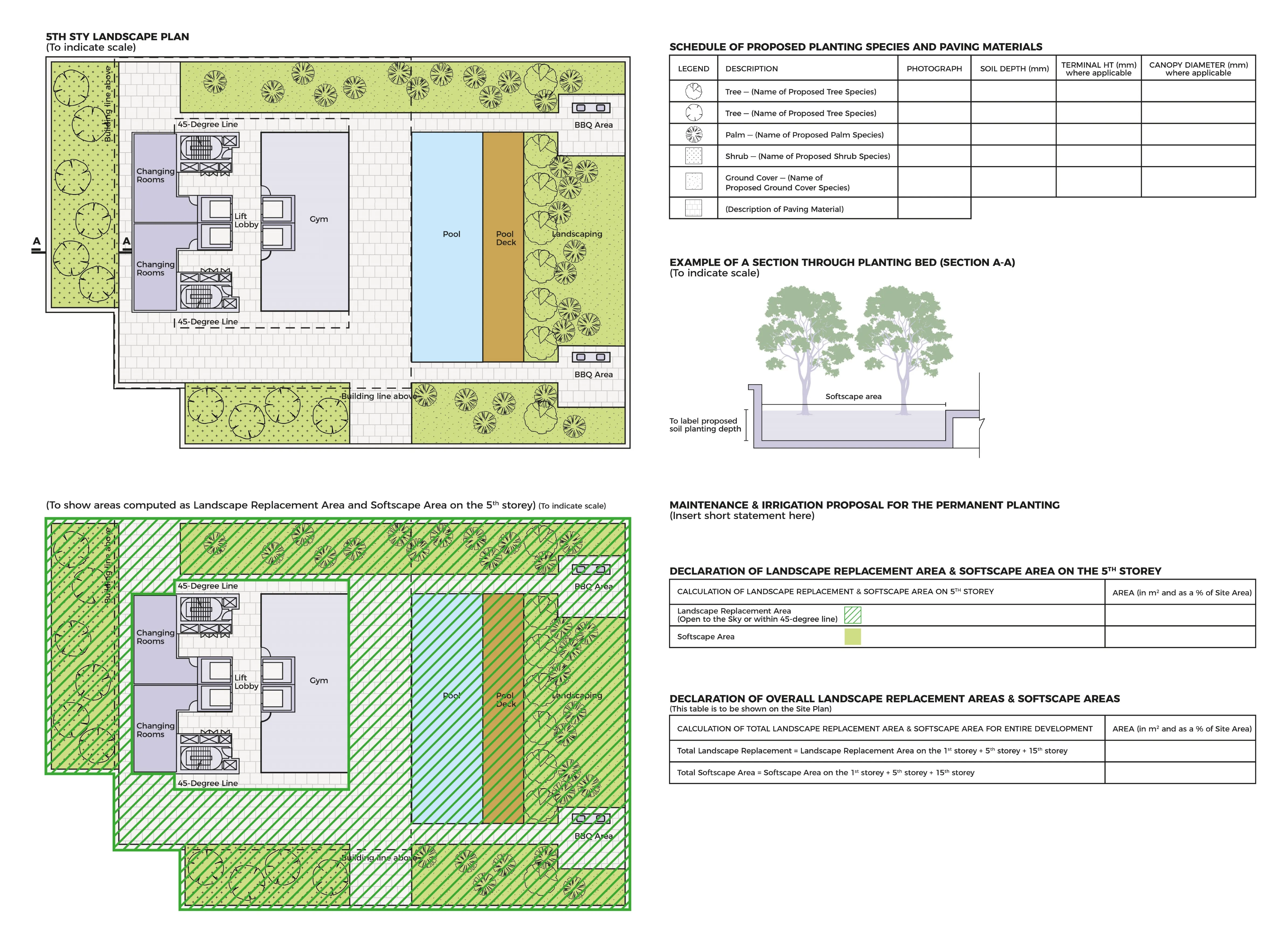
Landscape Plan template
The plans shall include:
Relevant plans, cross sections and perspectives with layouts of the softscape and hardscape areas. The softscape and hardscape areas shall be visually differentiated on plans with the following details:
Computations of the overall LRA, softscape areas and Green Plot Ratio;
Proposed schedule and annotation of plant species and paving materials;
Where relevant, annotations of ancillary uses e.g. Swimming Pool, BBQ Area, etc.;
Where relevant, annotations of the 45-degree line;
Short statement on the proposed maintenance and irrigation methods for the planting.
Label and package the landscape plans and sections separately from the rest of the floor plans, and separate the softscape and hardscape areas into different layers.
URA’s approval is required if there are changes to the softscape areas (e.g. planting and structure of the planting beds) and hardscape areas that result in an overall reduction in area for the required LRAs.
URA’s approval is not required for changes to the planting species as long as the softscape and Green Plot Ratio requirements are complied with.
The table for GnPR computation [PDF, 200 KB] (opens in new tab) shall be filled in and submitted together with the landscape plans.
Good Practices to Adopt in Landscape Design
Beyond the various LUSH requirements, building owners and developers are strongly encouraged to adopt the following good practices in their landscape designs to further integrate nature into the urban environment:
Table 6: Good Practices to Adopt in Landscape Design
Provide more softscape than minimum standards | More greenery in the urban environment brings benefits, such as cooling of surroundings, improving air quality, etc. With more softscape provision, a larger variety of greenery (e.g. on-ground greenery, vertical greenery, rooftop greenery) can also be provided to benefit building occupants. | ||
Select planting palette with at least 50% of species native to the South-east Asia region | Native planting helps increase populations of native plants within the urban environment. This also reduces the risk of introducing invasive species that may compete with native species in our ecosystems. 5 The “advanced search function” can be used to refine search options for possible species to be included, such as by their native regions, eventual sizes, etc. | ||
Provide contiguous, multi-tiered planting4 within the green buffer and peripheral planting verge | |||
Building owners and developers should also continue to exercise care in their landscaping design, including the curation of the planting palette. For example, selection of specific plant species that minimises attraction of pests.
LUSH Incentives
The following incentive schemes can be used throughout the development to provide greenery and communal spaces.
Sky Terraces
Sky terraces are communal garden spaces provided at the intermediate storeys of a building.
To qualify for GFA exemption, sky terraces shall comply with the criteria in the following table.
Table 7: GFA Exemption Criteria for Sky Terraces
Item | Sky Terrace | Predominant Sky Terrace |
|---|---|---|
Sky terrace area as % of floor plate | Not applicable | The sky terrace area within the 45-degree line occupies equal to or more than 60% of the floor plate. |
Perimeter openness | At least 40% of the perimeter of the sky terrace is to remain open6 and unenclosed. | At least 60% of the perimeter of the sky terrace is open6 and unenclosed. |
6 Parapet walls shall not exceed 1.3m in height to be considered open. | ||
Depth of sky terrace | The proposed depth of the sky terrace shall be minimally 5.0m throughout. | |
Landscaping | Plants shall be incorporated on permanent and preferably sunken planting, planned with sufficient soil depth based on the types of plants proposed. | |
Accessibility and ownership | The sky terrace shall be accessible to all occupants of the building and there shall be at least one set of communal access via a lift or staircase serving the sky terrace. Secondary access to the sky terrace from strata units can be supported. | |
Drop panels | Where proposed, drop panels at the perimeter shall be visually transparent and may be in the form of louvers, fins, transparent glass, or other sun shading/weather protective devices. The panel shall not exceed one third of the height of the external opening. The area of GFA exemption7 as defined by a 45-degree line shall be taken from the underside of any permanent or opaque structure, and not from the underside of a drop panel. | |
Additional height | Not eligible | Refer to Additional Height for Predominant Sky Terrace Storey sub-section. |
GFA exemption | For sky terraces occupying less than 60% of the floor plate, the maximum area for GFA exemption of sky is defined by the area covered by a 45-degree line taken from the edge of the overhead projection. | URA may grant additional GFA exemption for residual areas beyond the 45-degree line (capped at 20% of the floor plate area), if such areas form an integral part of the sky terrace or are part of the barrier-free/fire escape corridors. |
Unenclosed BFA and fire escape corridors may be exempted from GFA computation for all sky terraces regardless of size subject to the following criteria:
8 Parapet walls shall not exceed 1.3m in height to be considered open. | ||
Submission requirements | A Landscape Plan [PDF, 395 KB] (opens in new tab) and relevant sections for the sky terrace showing the proposed landscaping scheme, planting palette, soil depth and communal facilities shall be submitted as part of the Development Application. | |
Communal Planter Boxes
To qualify for GFA exemption, communal planter boxes shall comply with the following criteria:
Maximum width of 1m;
Minimum depth of 500mm (for planting purpose);
To be sufficiently externalized.
Communal planter boxes which are more than 1.0m wide may be allowed if the wider planter boxes are part of an overall scheme with design merit.
Details of the communal planter boxes, including planting palette, spot sections showing soil depth, and dimensions shall be provided as part of the storey plans.
Communal planter boxes shall be designed with safety and maintainability provisions in mind.
Covered Communal Ground Gardens
Covered Communal Ground Gardens (C2G2) are on-ground greenery spaces at the 1st storey. The garden should flow seamlessly between the covered and uncovered spaces of the 1st storey and designed to be bright and airy with quality landscaping. There are two types of C2G2:
Predominant C2G2s shall occupy at least 50% of the first storey building footprint. Within the covered garden area, a minimum of 60% shall be lushly landscaped, while the remaining 40% can be set aside for meaningful communal gathering and activity spaces, and unenclosed communal facilities. These spaces may include garden paths, playgrounds, and covered pools. Covered drop-off points may be considered as part of the C2G2 if well-integrated, paved with appropriate material and integrated with lush landscaping.
Secondary C2G2 are communal landscaped areas on the 1st storey which are shaded by a structure or a floor or overhang above. These may be exempted from GFA computation up to a maximum area defined by a 45-degree line taken from the edge of the overhead projection. The GFA-exempted communal areas within the 45-degree line shall contain quality lush landscaping with a variety of vegetation.
All areas of C2G2 spaces shall be easily accessible to the public and/or building users during normal opening hours for the development. The communal ground garden shall not be easily enclosed and converted to any other uses in the future.
For GFA exemption for C2G2, refer to the GFA handbook. URA will assess the C2G2’s design, spatial quality and overall integration with the wider landscaping scheme in considering the proposal’s eligibility for GFA exemption.
A landscape plan shall be submitted as part of the Development Application for the predominant covered ground garden proposal, showing the proposed landscaping scheme.
Communal Pavilions
Communal pavilions are small-scale, ancillary landscaping features that function as sheltered, open-sided resting points. Access to the pavilions shall be from the common areas only.
In addition to being sited within lushly landscaped areas, they shall satisfy the criteria below to qualify for GFA exemption:
Table 8: Guidelines for Communal Pavilions
Location | Guidelines |
|---|---|
Ground Level |
|
Rooftop | Rooftops shall remain open-to-sky unless otherwise approved by URA.
|
9 The area is defined as the area of pavilion measured up to the roof eaves line. | |
A Landscape Plan and relevant sections for ground/rooftop spaces containing communal pavilions, showing the proposed landscaping scheme, pavilion dimensions, planting palette, soil depth, communal facilities, shall be submitted with the Development Application.
Bonus GFA for Rooftop ORA on Landscaped Roofs
Table 9: Guidelines for Bonus GFA for Rooftop ORA on Landscaped Roof
Eligible Developments | Applicable to existing as well as new developments and redevelopment proposals approved for commercial and mixed use. |
Locational Criteria | Applies to developments in Downtown Core, as well as parts of Orchard and Singapore River Planning Areas as shown here [PDF, 962 KB] (opens in new tab). |
Landscaping Provision and Extent of ORA | The rooftop garden shall occupy a significant portion of the roof space, supported by small scale ORA activities. |
Bonus GFA for ORAs allowed over and above Master Plan Gross Plot Ratio | Rooftop ORAs shall not take up more than 50% of the overall roof space or 200sqm, whichever is lower. |
Allowable Structures and Extent of Enclosure | Not more than 50% of the bonus GFA shall be enclosed (e.g. kitchen, serving areas) while the remaining bonus GFA areas shall be retained for ORA. |
Submission Requirements | A Landscape Plan and relevant sections showing the proposed landscaping scheme, pavilion dimensions, planting palette, and soil depth shall be submitted with the Development Application. The plan shall also include:
Refer to the Landscape Plan example in the Sky Terrace section. |