
Bonus GFA Incentive Schemes
Check the bonus GFA incentive schemes applicable to hotels
Last updated on 24 June 2026
Hotel developments are eligible for bonus GFA if they satisfy the requirements of the following incentive schemes:
Balcony Incentive Scheme
The GFA of balconies in hotel developments may be computed over and above the Master MP allowable GPR, subject to a cap of 10% inclusive of planter boxes, if any. The additional GPR may only be used for balcony GFA and shall not form the future development potential of the site upon redevelopment. The additional balcony GFA may be subject to SLA levying Land Betterment Charge, where applicable. When submitting development proposals with balconies, the QP is required to demarcate the balcony area clearly on the Calculation Plan and declare the total balcony area that exceeds the MP allowable GPR.
Existing developments whose GPR have exceeded the Master Plan intensity may qualify for the additional balcony GFA, subject to a cap of 10% of the existing and approved GPR inclusive of planter boxes, if any. This does not apply to existing developments whose building form, height or use are not in accordance with the planning intention of the Master Plan, Building Height Plan or Special and Detailed Control Plan.
Balcony designs shall adhere to the following guidelines and submission requirements:
Location
Balconies shall be located away from M&E areas to safeguard the quality and usability of these spaces.
Openness
Balconies shall have a continuous perimeter opening of at least 40%.
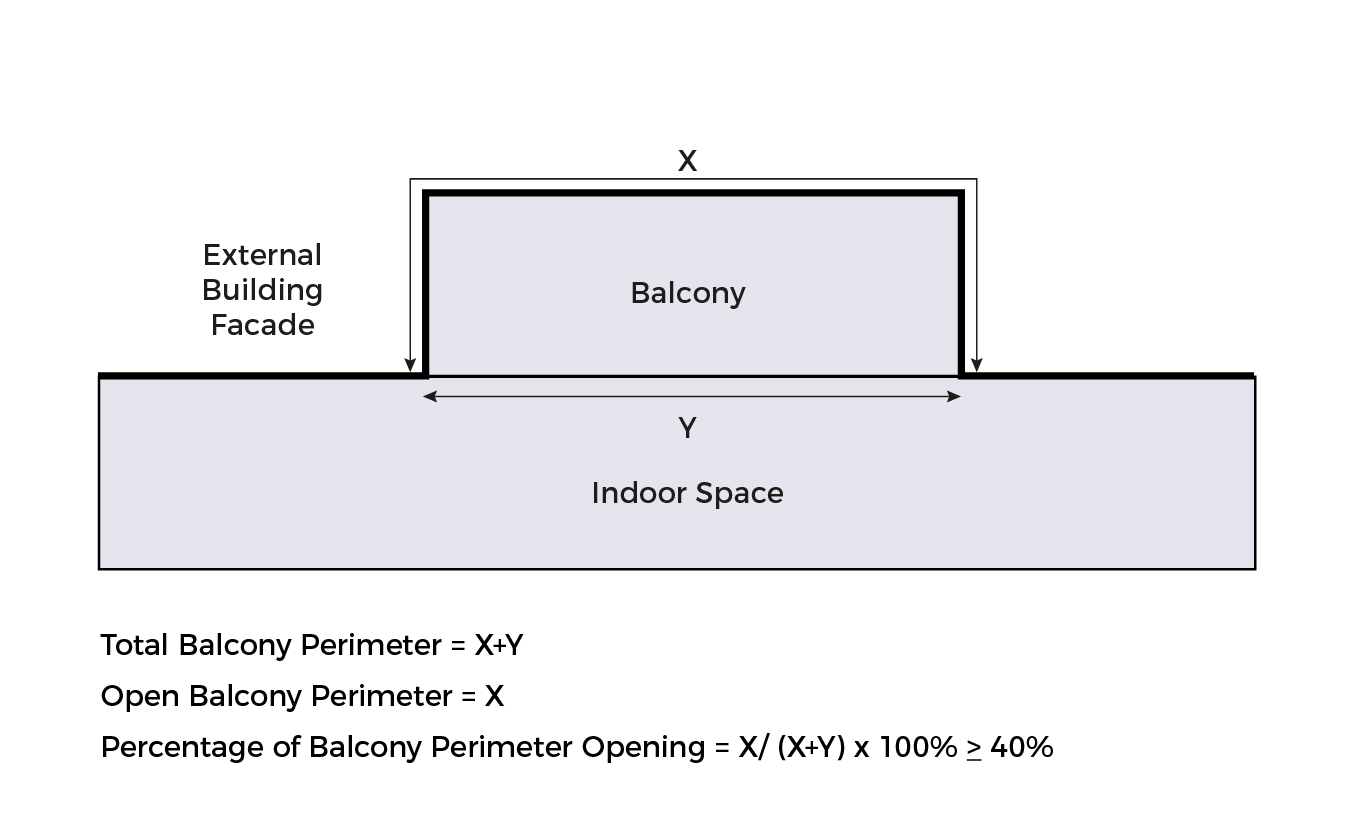
Balcony Perimeter Opening
The portions of a balcony that face a parapet wall (e.g. a wall between the balconies of two adjoining units) not exceeding 1.3m in height are considered “open”.
The QP shall show the computation of perimeter opening for the proposed balconies on the floor plans.
Screen
Balconies shall not be enclosed with walls or glass panels as balconies are meant to be semi-outdoor spaces. Balcony screens may can be allowed provided:
The balcony screens can be drawn open or retracted fully; and
The balcony screens allow for natural ventilation/air flow within the balcony at all times, even when the screens are fully drawn.
Balcony screens shall be designed upfront and approved as part of the Development Application process for all new hotel developments with proposed balconies (including the hotel component of mixed-use developments). Developers may propose a single screen design or a few designs.
Developers shall provide a Letter of Undertaking to be submitted at the Development Application Stage, downloadable via the following link [PDF, 360 KB] (opens in new tab).
The plans shall show the balcony screens in elevation view; one view fully retracted and another view fully closed with a fully retracted view in a plan view. The porosity of the balcony screen shall be annotated, and if the screening is louvred, the individual slats shall be fixed (i.e. not adjustable). Section cuts of the louvres shall be provided to show that the screening is naturally ventilated at all times, even when closed.
For existing developments without balcony screens, screens may be installed provided they fulfil the performance criteria above. Safety grilles are not considered as balcony screens, and such installation does not require planning approval.
Rooftop ORA on Landscaped Roofs
Refer to the section on Greenery.
Built Environment Transformation Scheme
The Built Environment (BE) Transformation GFA scheme aims to encourage adoption of higher tier Construction Industry Transformation Map (ITM) outcomes in areas of digitisation, productivity and sustainability. The incentive scheme is jointly administered by BCA and URA. Applicants may qualify for the scheme by adopting stipulated ITM outcomes as part of the development proposal.
Eligibility
The incentive is applicable for new erection or major Addition & Alterations to private sites of at least 5000sqm GFA1. Sites launched under the Government Land Sales (GLS) programme prior to 31 March 2022 may also be eligible for the incentive scheme.
The types of developments eligible for the incentive scheme are as follows:
Table 1: Types of development
Residential2 | Condominium and Flats development |
Non-Residential | Commercial, Industrial and Institutional developments, such as office, retail, business parks, community building, hotel, hospital or white site developments |
Mixed use | Combination of the above |
1 Smaller developments of less than 5,000 sqm GFA may be considered on a case-by-case basis if agencies determine that sizeable productivity and sustainability outcomes relative to the development proposal can be achieved based on BE ITM measures proposed by the developers.
2 The maximum allowable number of dwelling units for residential developments located outside of Central Area is derived from the Master Plan permissible intensity, which excludes any bonus GFA the site is eligible for.
Quantum of bonus GFA allowed
Private sites may be granted up to 3% bonus GFA under the scheme3. The scheme is applicable for new proposals till 23 November 2026.
GLS sites are eligible up to 2% bonus GFA. The scheme is applicable for new GLS launched prior to 31 March 2022.
The cumulative bonus GFA shall be kept within the overall budget of 10% above the Master Plan Gross Plot Ratio (GPR), or the maximum allowable GFA of the development. It shall not form the future development potential of the site upon redevelopment.
The quantum of allowable bonus GFA under the BE Transformation Scheme is based on the proposed uses, use quantum that complies with the Master Plan zoning, and any additional requirements imposed as part of the endorsement for the bonus GFA.
Should development proposals fall within areas with specific planning considerations (e.g. storey height controls) or are unable to fully accommodate the additional intensity due to on-site conditions (e.g. areas with traffic concerns), the bonus GFA under the BE Transformation Scheme that can be approved may be lower than the endorsed quantum, and/or the bonus GFA may be limited to a particular use or uses.
3 Applications submitted under the Strategic Development Incentive (SDI) and Central Business District (CBD) incentive schemes will have to comply with stipulated outcomes in the areas of digitalisation, productivity and sustainability.
The required ITM outcomes will be separately assessed in relation to the context of the proposal, upon submission of the outline application for the SDI/CBDI development proposal.
ITM outcomes will be imposed as conditions for planning approval for redevelopment proposals via the SDI/CBD Incentive scheme. SDI/CBDI proposals will not qualify for the additional GFA under the BE Transformation Gross Floor Area Incentive Scheme.
Submission
Applicants are to submit an application to BCA with supporting documents on the proposed ITM outcome concept plan and detail the proposed ITM outcome to be adopted for the development proposal. The submission can be made at this link (opens in new tab).
Following BCA’s grant of letter of acceptance, applicants shall submit the development proposal with the proposed quantum and use group of the proposed bonus BE Transformation GFA to URA, for detailed assessment. The development application shall be submitted within 6 months from BCA’s grant of Letter of Acceptance, and shall include a copy of the Letter of Acceptance, and the BE Transformation GFA computation form [PDF, 450 KB] (opens in new tab). The submission process and verification of ITM outcomes is summarised at this link [PDF, 192 KB] (opens in new tab).
Requirements on ITM Outcomes for Bonus BE Transformation GFA
Applicants are to comply with BE ITM outcomes for the bonus scheme based on the building type [PDF, 809 KB] (opens in new tab). The specific requirements for the development proposal will be shared in detail as part of the application process to BCA for the Letter of Acceptance.
ORA within Privately-Owned Public Spaces (POPS)
Refer to section on POPS.
District Cooling System (DCS) or Centralised Cooling System (CCS) scheme
The scheme aims to encourage building owners to adopt either DCS or CCS for their building. This could be by collaborating with other building owners to establish new DCS or CCS networks, or tapping onto an existing DCS or CCS network in the area.
Host Developments
Host buildings in DCS and CCS networks will need to set aside spaces for the district cooling plant and chiller plants respectively to serve the larger network. Such Mechanical and Electrical (M&E) spaces needed to support the DCS/CCS network will be allowed as bonus Utility GFA, over and above the Master Plan allowable GFA for the site. The additional Utility GFA may be subject to payment of Land Betterment Charge (LBC), if any.
For CCS networks:
If the host building’s original in-building chiller plant (IBCP) spaces are computed as GFA, these can then be computed as bonus Utility GFA. The freed up GFA from the original IBCP can be put to other uses in the development.
If the host building’s original IBCP spaces are exempted from GFA4, bonus GFA equivalent to the size of the IBCP room will be allowed over and above the Master Plan allowable GFA for the site. Bonus GFA may be subject to payment of LBC based on its proposed use.
The DCS/CCS-related M&E spaces may also be considered for GFA exemption if the spaces fulfil the respective criteria of the prevailing M&E-related GFA exemption schemes.
4 Applies to IBCP spaces within the building envelope that were previously granted GFA exemption based on the relevant GFA exemption provisions. Does not apply to open-to-sky IBCP spaces (e.g. on the rooftop)
Submission requirements
The following information / documents are to be furnished to URA as part of the development application (DA):
Table 2: Documents to be furnished for host developments
DCS Host Development | CCS Host Development | |
Network plan | Plan showing the overall proposed DCS/CCS network including the developments that are planned to be onboarded to the network | |
Service provider | Supporting documents showing that a DCS/CCS service provider for network has been identified, with the new network or connection found to be feasible (e.g. feasibility study by service provider, service agreement) | |
Provision of cooling-related M&E spaces | The necessary DCS/CCS cooling-related M&E spaces to be clearly reflected on the submission plans (see examples below) | |
Examples:
| Examples:
| |
Capacity of host plant | Proposed capacity of host DCS plant / CCS host chiller plant and service provider’s assessment on the sufficiency to serve the overall network | |
Proposed use of bonus GFA / | - | To indicate clearly on the submission plans how the bonus GFA / freed up GFA from the existing IBCP spaces will be put to use. |
Receiving Developments
Developments receiving chilled water from the host building(s) in a DCS/CCS network benefit from not having to provide their own in-building chiller plant (IBCP) systems.
The following GFA incentives are applicable for such receiving developments:
Table 3: GFA incentives for receiving developments
Scenario | GFA incentives |
Decommissioning of the IBCP space in an existing building, as part of Addition & Alteration (A&A) works | Where the existing IBCP space is computed as GFA
Where the existing IBCP space is exempted from GFA6
5 Owners should first consider converting the decommissioned IBCP space to other uses in situ, as opposed to demolishing the floor slab of the IBCP space to decant the GFA / deploy bonus GFA elsewhere within the development. Proposals to demolish the floor slab will be subject to evaluation, with justifications to be provided (e.g. whether there are constraints faced in retrofitting the original IBCP space for other uses) 6 Applies to IBCP spaces within the building envelope that were previously granted GFA exemption based on the relevant GFA exemption provisions. Does not apply to open-to-sky IBCP spaces (e.g. on the rooftop) |
Building requires the provision of M&E spaces to support the connection to the DCS/CCS network (e.g. heat exchanger room) |
|
Submission requirements
The following information / documents are to be furnished to URA as part of the development application (DA):
Table 4: Documents to be furnished for receiving developments
DCS/CCS Receiving Development | |
Network plan | Plan showing the existing DCS/CCS network that the development is intending to connect to |
Service provider | Supporting documents showing that a DCS/CCS service provider for network has been identified, with the new network or connection found to be feasible (e.g. feasibility study by service provider, service agreement) |
Provision of cooling-related M&E spaces | The necessary DCS/CCS cooling-related M&E spaces to be clearly reflected on the submission plans (e.g. heat exchanger room) |
Proposed use of decommissioned IBCP spaces (as part of A&A works) | All existing IBCP spaces are to be decommissioned. To clearly show the location of all the existing IBCP spaces on the submission plans, and the proposed use of the decommissioned IBCP spaces. If GFA from the decommissioned IBCP space is proposed to be decanted to other parts of the development, to provide justifications why the original IBCP space could not be converted for other uses in situ |
Eligibility
The following types of developments will not be eligible for the GFA incentives:
Existing buildings that are already connected and part of a DCS/CCS network, as the GFA incentives will not retroactively apply to such buildings.
Where it is a mandatory requirement for the development to adopt DCS/CCS (e.g. as part of conditions of tender in Government Land Sales sites).
Specific to receiving developments who wish to tap onto an existing DCS/CCS network, the following criteria are to be met before the GFA incentives will apply:
The receiving development was originally approved at a time when there was no operational DCS/CCS network in the area; or
The receiving development shall be a minimum age of 10 years7 (from date of original TOP).
Where necessary, the bonus GFA may be approved on temporary basis for monitoring purposes of this new scheme.
7 This is the average lifespan of an IBCP system. The intent is to discourage the premature decommissioning of IBCP systems of newly completed buildings. Owners of newer buildings can instead consider switching to DCS as part of their planned IBCP replacement cycles (i.e. after 10 years).
Hotel developments may make use of any combination of the bonus GFA incentive schemes (ie Balcony Incentive Scheme and Rooftop ORA on Landscaped Roofs), as long as the cumulative bonus GFA does not exceed the overall cap of 10% above the MP GPR.
The bonus GFA allowed under the bonus incentive schemes is over and above the MP GPR and is subject to a maximum of 10% of the MP GPR. When the site is redeveloped in future, the additional GFA already used under the bonus GFA incentive schemes cannot be carried over. In other words, the GPR for the site shall revert to the GPR specified in the prevailing MP.