
Parking
Check the guidelines relating to parking for business parks.
Last updated on 23 June 2026
LTA prescribes the parking provision standards and requirements for motor vehicles and bicycles. The requirements are usually based on the quantum of the gross floor area or the number of units of the development uses.
Separately, to enhance commuter experience and reduce congestion at Pick-up and Drop-off Points (PUDOs), LTA and URA collaborated with the industry to develop a design guide for PUDOs [PDF, 4.8 MB] (opens in new tab) containing best practices that building owners and professionals can consider applying to new and existing PUDOs.
Car and Motor-Cycle Parking
Under LTA’s Range-based Parking Provision Standards (RPPS), developments are subject to car and motor-cycle1 parking provision requirements.
Unless explicitly approved as private parking lots in the approved plans, all car and motor-cycle parking lots shall be treated as common property.
1 Motor-cycle parking provision is mandatory in all non-residential developments.
Range-based Parking Provision Standards (RPPS)
The RPPS allows developments to provide any level of car and motor-cycle parking provision within a specified range, defined by a lower bound and an upper bound – see figure below. The range varies according to location zones and land uses. Details may be found in LTA’s Code of Practice for Vehicle Parking Provision in Developments [PDF, 4.5 MB] (opens in new tab).
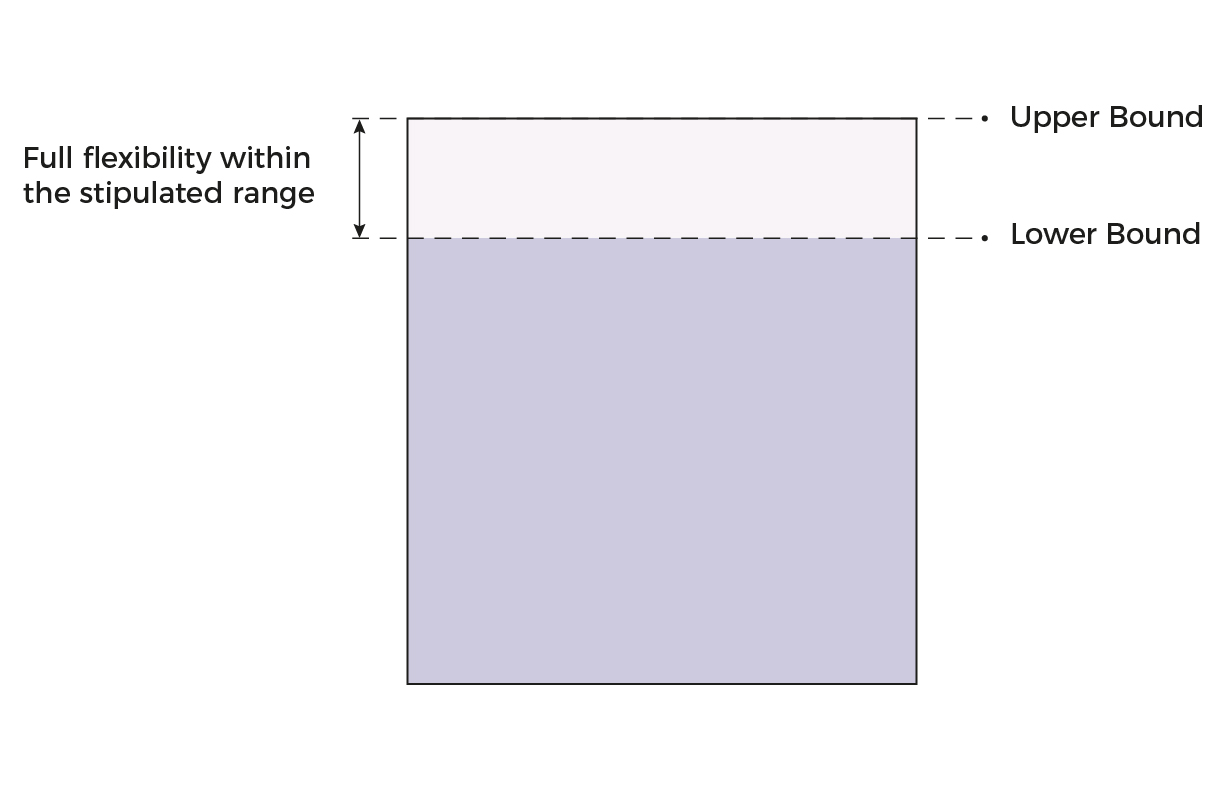
Range-based Parking Provision Standards
Provision of Surplus Parking in New Developments
New BP developments shall be subject to a process of waiver evaluation by LTA, if one wishes to provide surplus car and motor-cycle parking lots, ie parking provision above the upper bound based on the new RPPS.
If LTA approves the waiver, surplus parking spaces in new BP developments within 400m of MRT and LRT stations shall be computed as GFA. Each surplus car parking lot shall be computed as 35sqm GFA, that being the average area of a car parking lot inclusive of circulation space. Each surplus motor-cycle parking lot shall be computed as 12sqm GFA.
SLA may levy Land Betterment Charge for the additional GFA arising from the surplus car and motor-cycle parking lots, where applicable.
Conversion of Surplus Car Parking in Existing Developments
Existing BP developments within 400m of MRT and LRT stations may be allowed to permanently convert their surplus car parking spaces2 to other uses.
2 With the RPPS, surplus car parking lots in existing developments may arise if the upper bound for the development type is revised downward and/or if developments choose to reduce car parking provision to the lower bound set out by the RPPS.
LTA may consider conversion of car parks up to the lower bound as stipulated in the RPPS. Interested building owners are to arrange for a pre-application consultation with LTA before submitting a development application to URA.
The conversion of surplus car park may be allowed subject to compliance with ALL of the following:
The proposed uses shall be in line with the Master Plan zoning for the site and the planning intention for the surrounding area. The detailed uses and any changes to the building form and design shall be subject to evaluation by URA and the relevant agencies.
The existing infrastructure and traffic network shall be able to support the increase in GFA and uses, and take into consideration proposed measures to mitigate traffic generation.
The resultant car parking provision shall be able to support the additional GFA and proposed uses.
SLA may levy Land Betterment Charge for the additional GFA arising from the conversion, where applicable. The additional GFA arising from the conversion of surplus car parking, detailed uses and any changes to the building form and design shall be subject to evaluation by URA and the relevant agencies.
Requests for conversion of surplus car parks may not be supported for sites where there are specific conditions imposed in planning approval or the government land sale that restrict the conversion of the surplus car parking spaces, or sites located within or adjacent to Conservation Areas where additional car parking spaces are needed to support the uses within the conserved buildings.
Additional GFA gained via the conversion of surplus car parking spaces shall not be taken into consideration in determining the maximum permissible intensity that may be allowed for the re-development of the site.
Where surplus car parking spaces were allowed by LTA through a waiver application to exceed the upper bound of the Range-based Parking Provision Standards (RPPS) after 1 Feb 2019, the development will not be allowed to convert any of the surplus car parking spaces to other uses.
Bicycle Parking
To promote a car-lite society, BP developments may be required to provide bicycle parking facilities within the developments. Refer to LTA’s Code of Practice for Vehicle Parking Provision in Developments [PDF, 4.5 MB] (opens in new tab) for the list of requirements.
Unless explicitly approved as private parking lots in the approved plans, all bicycle parking lots shall be treated as common property.
Bicycle parking lots provided according to LTA’s new standards are exempted from GFA computation. Surplus provision of bicycle parking lots may be exempted from GFA computation depending on merits and context of the development.