
Conservation Area
Nassim Road And White House Park Conservation Area
Applicable Guidelines
Bungalow Guidelines
Conservation Area
Nassim Road And White House Park Conservation Area
Find out more about Nassim Road And White House Park Conservation Area.
Important Information
All proposed works will need to comply with the Conservation Guidelines and the Specific Restoration Guidelines (SRG). Conservation Permission is required before all additions & alteration works and operations of new use can begin.
Owners, architects and engineers intending to carry out restoration works or development within conservation areas are required to comply with the conservation principles, planning parameters and restoration guidelines for conserved shophouse and bungalow building typologies, as well as planning parameters and envelope control guidelines for new buildings within conservation areas accordingly.
For other building types, which do not conform to the standard shophouse or bungalow typology, these will be evaluated on a case-by-case basis in accordance with conservation principles. [1]
About
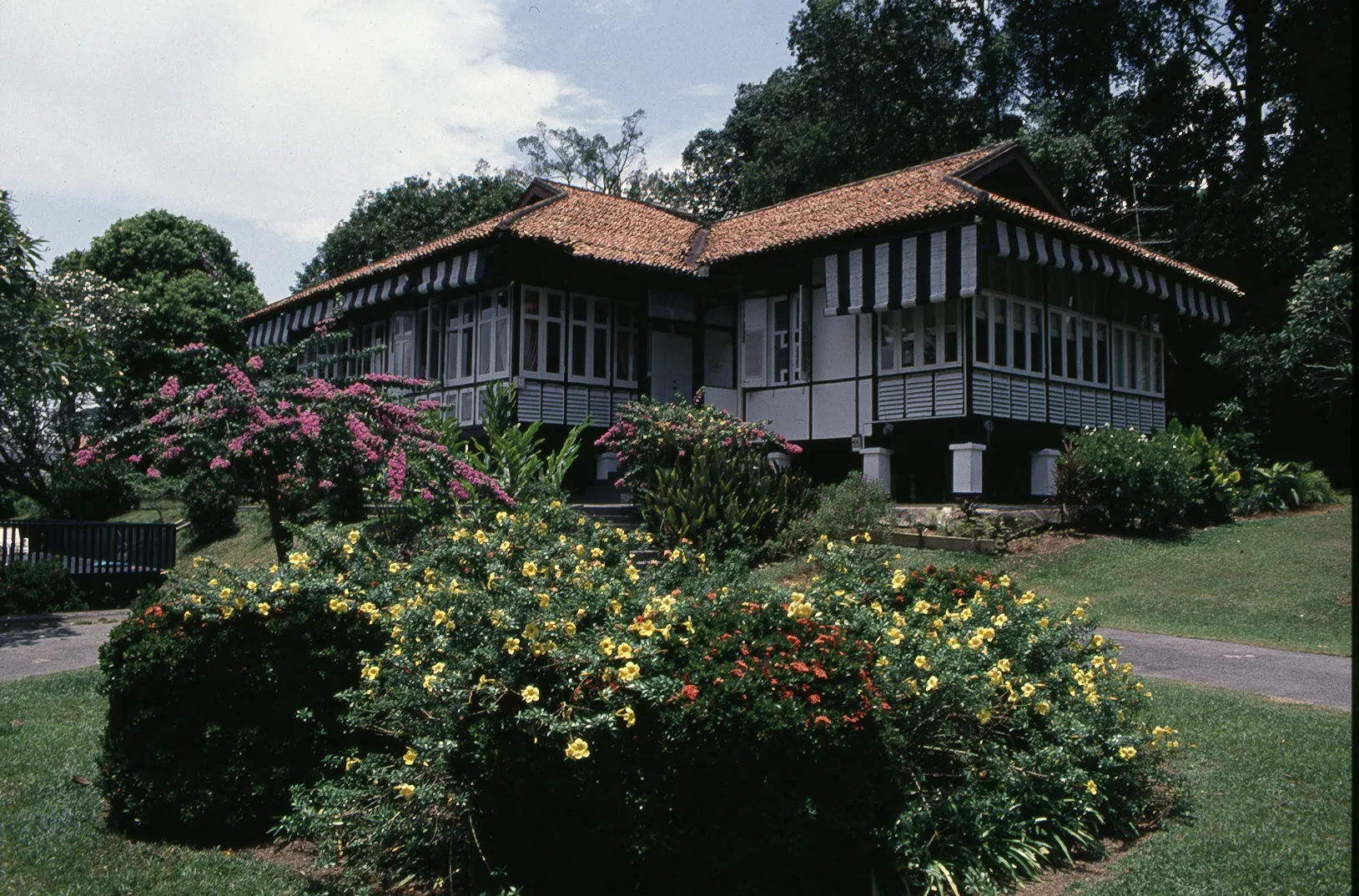
Extending from Cluny Road that borders the Botanic Gardens to Stevens Road to the east, and Bukit Timah Road to the north and Nassim Road to the south, the Nassim Road/White House Park Good Class Bungalow Area is an expansive residential area that boasts 14 conserved bungalows mainly of Victorian, Art Deco and Black and White Bungalow styles.
The History
Nassim Road evokes much of Singapore’s past splendid environmental qualities: rich landscape, sweeping lawns and grand mansions. Now, a number of these fine houses are occupied by Embassies, High Commissions and private companies. Nassim Road runs between Dalvey Road near the old Bukit Timah University campus and Tanglin Road.
White House Park once stood on a vast 54-acre nutmeg and betel nut plantation owned by Gilbert Angus (1815-1887) who started off as a bookkeeper but ventured on his own into business as an auctioneer. By 1862, he had sold the White House Park area to Reme Leveson & Company, a firm of insurance agents. The next known proprietor was John Fraser of Fraser & Neave who was involved in many diverse businesses – such as a company formed with James Cumming to make bricks and carry out development in the White House Park area.
Originally, there were four houses in the White House Park estate, all of which were built in the 19th century. Whitehouse had existed in 1862 and was possibly built by Gilbert Angus. Fraser built the other three houses: Cree Hall and Sentosa between 1875 and 1880 and Glencaird in 1897. John Fraser himself had lived in Cree Hall. In 1908, Mansfield and Company purchased one or two of the houses and in the 1920s erected a few more houses as staff quarters. It was not known when Whitehouse and Sentosa were demolished but Cree Hall was demolished sometime after 1967 when the Housing and Development Board acquired the land. In 1947, the Government of Australia bought Glencaird and it became the official residence of the Australian High Commissioner.
The Architecture
The earliest purpose-built accommodation for civil servants seems to have been the estates at Goodwood Hill, Nassim Road and Seton Close, which were developed around 1910. Evidently, the government architects who designed these houses for the officers in Singapore’s burgeoning colonial administration were influenced by the new Black and White style which was just reaching the height of fashion at this time. However, it is equally likely that these early Black and White houses designed by the Public Works Department were also inspired by the ‘plantation houses’ of the mid-19th century – large country mansions, square in plan, with broad eaves and verandahs on all sides. Typically, the upper storey is extended outwards over a forward-projecting carriage porch or porte cochère.
Glencaird and Cree Hall were two late-Victorian houses commissioned by John Fraser on the White House Park estate between Stevens Road and Whitley Road. They were designed by R.A.J. Bidwell of Swan and Maclaren and departed radically from the typical late-19th century house in Singapore, in their rejection of classical symmetry in favour of an asymmetrical plan, accentuated by a dramatic, turret-like, three-storey stair hall to one side. Glencaird and Cree Hall were also unusual in Singapore at that time in their eclectic use of materials and architectural elements which included expanses of unrendered brickwork, quoins and rusticated archways with huge, white-stuccoed voussoirs, favourite devices of Bidwell.
Of the original four houses in the White House Park estate, only Glencaird at No.15 White House Park remains standing today. Uniquely asymmetrical, the residence entrance was placed at a corner instead of the centre of the house. The placement of the living room was also unconventional so as to take advantage of the pleasant views. The Glencaird bungalow was conserved in 1991 and later incorporated as part of a 12-unit development called the Glencaird Residences that was completed in 1999. Exemplary restoration efforts of Glencaird as part of this new development received the URA Architectural Heritage Award in 2000.
The residence of the French ambassador, a two-storey Black and White house in Cluny Park Road, was designed by Frank W. Brewer, an English architect who designed some of the most prominent buildings in Singapore in the mid-20th century including the first modern high-rise, the Cathay Building. This two-storey residence was originally built for Messrs. Sandilands Buttery & Co. Ltd in 1923. Distinctive Brewer-esque elements featured in this unique house are buttressed walls, oriole windows, exposed brick voussoirs around the arches and roughcast plasterwork.
No.1 Dalvey Estate, another Frank W. Brewer masterpiece, was commissioned by E.A. Barbour & Co. in 1927. This residence has all the classic Brewer hallmarks: flared eaves, buttressed walls, oriole windows, bay windows with flared base and exposed brick voussoirs. This impression of robustness and solidity was another characteristic of Brewer’s residential work. In recent years, No.1 Dalvey Estate belonged to the late Mr Ong Teng Cheong, Singapore’s first elected President and himself an architect. Renovations and extensions to the house by his own practice, Ong & Ong Architects, won the URA Architectural Heritage Award in 2001.
Eden Hall at 28 Nassim Road was built in 1904 for Ezekiel Saleh Manasseh on a four and a half-acre plot which used to be part of a nutmeg plantation. Manasseh did not initially live in Eden Hall on its completion, but rented it to Mrs Campbell, who ran it as a boarding house. In 1916 Ezekiel Manasseh married an English widow, Elsie Trilby Bath, and they moved to Eden Hall with Trilby's two children Molly and Vivian. During the Second World War, Eden Hall was occupied by the Japanese who used it as an officers' mess. However, they took good care of the house and furniture, and left intact the wrought-iron staircase which has the initial "M" incorporated into its design.
Vivian Bath, the step-son of Manasseh, on his return to Singapore after the war, regained possession of Eden Hall, which had been requisitioned for use by the British forces. When Vivian Bath decided to retire to Australia, he sold Eden Hall to the British Government in 1957 for a nominal sum, with the stipulation that a plaque be installed at the bottom of the flagpole, which reads "May the Union Jack fly here forever". Eden Hall is presently the residence of the British High Commissioner.
The Legacy
The Nassim Road/White House Park Good Class Bungalow Area has an exquisite stock of period bungalows that represent the culture and lifestyle of a particular time in Singapore's history.
No.2 Dalvey Estate, a Black and White single-storey bungalow, is testimony of how painstaking restoration work has effortlessly blended gracious modern living with old world charms. The project received the URA Architectural Heritage Award in 2003.
No.24 Nassim Road is a two-storey Victorian-styled bungalow built in the 1920s. The main building was restored and the internal layout was reconfigured to cater for comfortable modern living. This project received the URA Architectural Heritage Award in 2001.
Gazetted on 29 November 1991 for conservation
Guidelines and Procedures
[1] The conservation guidelines for shophouses and bungalows will generally be applied by URA in the consideration of a development application. However, if the circumstances or planning considerations relevant to a case warrant it, URA may in its discretion decide to depart from these general guidelines. The guidelines, principles and illustrations found in the guidelines are not exhaustive in covering all possible site conditions and variations in building type. Persons intending to carry out a development are advised to take this into consideration and check with URA through enquiries or development applications to confirm if their proposals can be allowed.