
Conservation Area
Singapore Botanic Gardens Conservation Area
Applicable Guidelines
Bungalow Guidelines
Conservation Area
Singapore Botanic Gardens Conservation Area
Find out more about Singapore Botanic Gardens Conservation Area.
Important Information
All proposed works will need to comply with the Conservation Guidelines and the Specific Restoration Guidelines (SRG). Conservation Permission is required before all additions & alteration works and operations of new use can begin.
Owners, architects and engineers intending to carry out restoration works or development within conservation areas are required to comply with the conservation principles, planning parameters and restoration guidelines for conserved shophouse and bungalow building typologies, as well as planning parameters and envelope control guidelines for new buildings within conservation areas accordingly.
For other building types, which do not conform to the standard shophouse or bungalow typology, these will be evaluated on a case-by-case basis in accordance with conservation principles. [1]
About
This is Singapore’s most important and historic public gardens and has been a well loved place for many who continue to enjoy a slice of ‘English’ landscaping in the tropics. On 4 July 2015, the Singapore Botanic Gardens was inscribed on the UNESCO World Heritage List.
The History
Founded at its present site in 1859, the Singapore Botanic Gardens was part of a long colonial tradition of creating European-style botanical gardens in the tropics. The Gardens were used to study native plants, useful or revenue-earning crops and ornamental plant cultivation. Within the gardens, are a range of buildings that showcase the history of the development of residential architecture in Singapore.
Besides offering visitors a glimpse into the lifestyle of the early Directors of the Gardens, the conserved buildings serve as key identity markers for the generations of Singaporeans and visitors to our island, who have strolled across the scenic grounds.
9 buildings within the Gardens, including Ridley Hall, Burkill Hall, Holttum Hall and E J H Corner House, were given conservation status on 23 May 2008, adding to 4 buildings that were part of the Former Bukit Timah Campus, which were conserved on 20 Oct 2006.
2 heritage structures, The Bandstand and Swan Lake Gazebo, were conserved on 3 December 2009 and 2 additional buildings, i.e. the former Field Assistant’s house and the Garage, were given conserved status on 6 June 2014.
The Architecture
Ridley Hall
Built in 1883, Ridley Hall is a one-storey building of brick and plaster construction with pitched tiled roof. The generous overhanging roof eaves protect the walls and interiors from the tropical sun and rain. The large timber framed windows with louvres are typical of the period as a means to allow for light and good ventilation.
Its modest appearance belies its historical significance not just for the Gardens, but for Singapore and the world. It is one of the oldest structures in the SBG and was used by Henry Nicholas Ridley as his office and laboratory. Ridley was the first director of the SBG from 1888-1912, and is most well-known for successfully domesticating the wild rubber plant. This led to the birth of the modern rubber industry that transformed the economic landscape of Malaya and industry of the modern world. It brought prosperity to the region and led to the spread of rubber plantations around the world.
Burkill Hall
Burkill Hall, built in 1868, is the last known surviving two-storey Anglo-Malay plantation style bungalow. The distinctive design, with verandahs on the upper floor and a central forward-projecting entrance porch, was influenced by the local “plantation house”, so called because it usually formed the focus of an agricultural estate.
Burkill Hall was named in honour of two former Directors of the Singapore Botanic Gardens, Isaac Henry Burkill, and his son Humphrey Morrison Burkill. The former was the Director of the SBG from 1912 to 1925. His research led to the publication of the “Dictionary of the Economic Products of the Malaya Peninsular (1935)”, still one of the most comprehensive texts on the historical uses of tropical plants. His son, Humphrey Morrison Burkill was the Director of the SBG from 1957 to 1969. He was instrumental in establishing a scheme to attract foreign research botanists to Singapore.
Holttum Hall
Built in 1920, Holttum Hall is a symmetrical 2-storey building set in the midst of lush greenery. It has a compact form that is topped by a hipped gable roof. The entrance to the house has a unique porch of timber frame with a pitched tile roof that is more reminiscent of the lych gates that are sometimes seen at the entrance of English church compounds.The design appears to have been influenced by the British vernacular style with Classical elements.
Holttum Hall once served as the office and laboratory of Eric Holttum, Assistant Director of the Gardens from 1922-1925, and then Director from 1925-1949. An eminent botanist and an expert on ferns, orchids and gingers, he was later appointed the first Professor of Botany at the University of Malaya from 1949-1954.
E J H Corner House
Buit in the 1920s, E J H Corner House is a two-storey symmetrical “Black and White” bungalow nestled among lush vegetation at the top of a slope. Its compact form and more intimate scale give it a charming air that blends in well with the garden setting.
The building was named after Eldred John Henry Corner, the Assistant Director of the Gardens from 1929 to 1945. He specialized in mycology, mainly in the collection and study of local fungi, and the ecological study of swamp forests. He was also known as the author of the book “Wayside Trees of Malaya”.
Former Field Assistant’s house
This was competed in 1919. It is however unclear how long it was used for the above purpose as the Field Assistant position became redundant with the replacement of most of the Economic Gardens with the Raffles College.
It is a two–storey, five–bay house with a hipped tiled roof and rendered finish. Plaster string courses run beneath and above the windows, extending into shade canopies over the windows. There is a porch at the centre with half–round arches to the side and front. The windows on the front and side elevations are side–hung casements. The front door, up five steps, is a modern replacement with a narrow window to either side. On the rear elevation the central staircase tower projects out.
The Garage
This was completed sometime between 1924 and 1928 and originally used by a number of college professors to park their vehicles.
It is a well–proportioned building, executed in a distinctly Art Deco style. It is a seven–bay, two–storey service building with a rendered finish and a hipped–tiled roof. The ground floor is formed of a plinth with half–round arched entrances to the garages. The first floor is set back from the front and sides and accessed by a staircase from either side.. The rear elevation is glazed with long strips of casement windows intercepted by structural columns. The ground floor is made up of individual garage spaces. The first floor is a single open space with an exposed timber truss roof.
Heritage Structures
To complement the historic character of the Gardens, 2 heritage structures, ie the Bandstand and Swan Lake Gazebo, were also conserved on 3 December 2009.
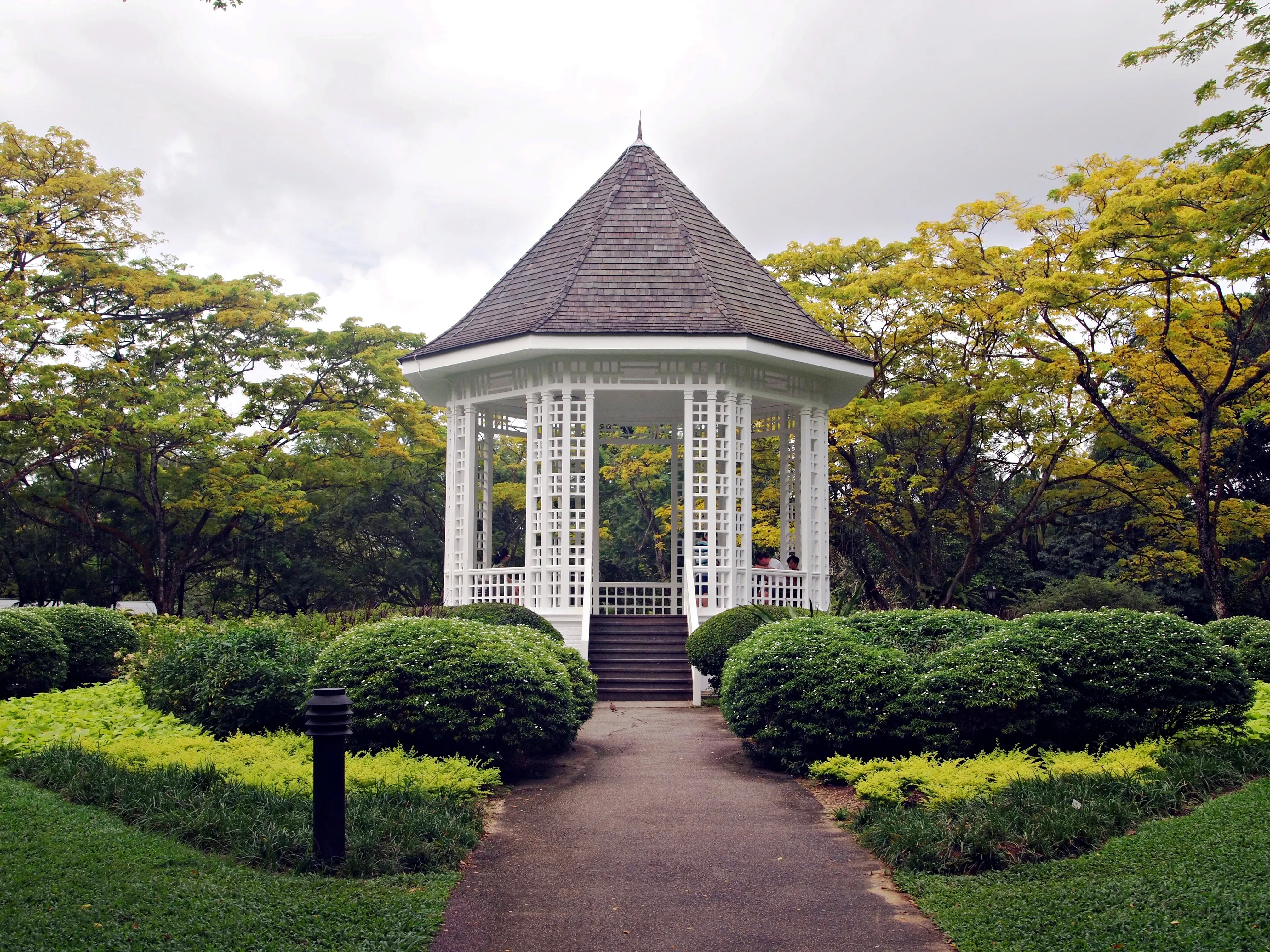
The present octagonal Bandstand was built in 1930 and staged early evening performances by military bands for many years. Though no longer used for music, the Bandstand continues to be one of the best-known features of the Gardens.
The Swan Lake Gazebo is a Victorian cast-iron shelter. It was built in the 1850s and stood for many years at an old house in Grange Road. In 1969 it was dismantled and transported to the Botanic Gardens.
Former Bukit Timah Campus Buildings
Also conserved and within the Singapore Botanic Gardens Conservation area are 5 bungalows and the former Raffles Hall that were part of the development of the former University of Malaya (Singapore Bukit Timah Campus). These are described elsewhere.
The Legacy
The protection of the wide range of buildings adds to the historical ambience of the gardens and illustrate the development of architecture in Singapore. At the same time, these buildings will continue to play a part in sustaining the memories of many who have visited the gardens and who have seen the buildings over the decades.
Guidelines and Procedures
Resources
[1] The conservation guidelines for shophouses and bungalows will generally be applied by URA in the consideration of a development application. However, if the circumstances or planning considerations relevant to a case warrant it, URA may in its discretion decide to depart from these general guidelines. The guidelines, principles and illustrations found in the guidelines are not exhaustive in covering all possible site conditions and variations in building type. Persons intending to carry out a development are advised to take this into consideration and check with URA through enquiries or development applications to confirm if their proposals can be allowed.