
Conserved Building
72-13 Mohamed Sultan Road
Applicable Guidelines
Other Building Guidelines
Conservation Area
Robertson Quay Conservation Area
Historic address: 72-13 Mohamed Sultan Road
Bank Of China No. 3 Warehouse
About
Named after Dr J. Murray Robertson, a prominent Municipal Councillor, Robertson Quay is the largest and most upstream of the three main historical quays on the Singapore River, the other 2 quays being Boat Quay and Clarke Quay.
The History
In the 1890s, the land up-stream of today’s Clarke Quay was still relatively undeveloped. This area was originally swampy tidal land. As a result of rapid growth in trade and population of the settlement of Singapore, development spread upstream along the Singapore River.
The tidal swamps was reclaimed in the 19th century to cater to demand for the warehousing of goods that came through Singapore. By the beginning of the 20th century, buildings catering to our entrepot trade were built at Robertson Quay, Havelock Road and as far up stream as Jiak Kim Street. By early 1930s, these areas were fully developed with warehouses – commonly known as ‘godowns’, while the river itself was filled with bumboats that brought goods in and out of Singapore via the river and the harbour.
These places and streets bear names of prominent figures who played key roles in the social, economic and political life of the colony, or were key figures of the then British Empire. Robertson Quay is named after Dr. J Murray Robertson, a prominent Municipal Councillor. Havelock Road is named after Major-General Sir Henry Havelock (who distinguished himself in the suppression of the India Rebellion of 1857) while Jiak Kim Street is named after Tan Jiak Kim, the grandson of Tan Kim Seng (the adjacent main road is named after him). Tan Jiak Kim was a Municipal Commissioner and member of the Legislative Councillor. Tan Kim Seng was a well-known philanthropist who donated generously to the building and maintenance of the first school in Singapore, the Chinese Free School or Chui Eng Institution (the gateway which is conserved at Amoy Street). However, he is best known for his donation in 1857 towards building Singapore’s first public waterworks to ensure a better supply of water to the town. For this, Kim Seng is commemorated by a cast-iron fountain (now a National Monument) that can be seen today at the Esplanade.
The Building
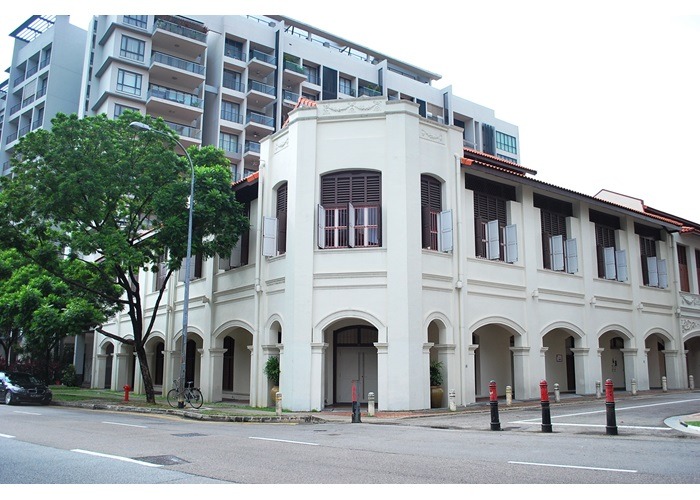
This is a 2-storey building measuring about 30m wide and 20m deep. This was well known for many years as the landmark ‘Bank Of China No. 3 Warehouse’ to those in the import-export trade along the Singapore River.
Like the building at Merbau Road, the building has repetitive bays of arched openings at the 1st storey. However, the upper floor timber windows showcase rare remaining example of cross-work timber lattice panels. This used to be a common design in the rough and ready early days of Singapore where glass was a luxury and electric fans non-existent. The lattice work allows for air-flow, lighting and security.
A significant architectural feature of the building is the corner façade treatment which has a roof pediment with decorative moulded plaster festoons. It is unlike the other facades of the building where the roof overhangs and projects beyond the building line.
At the ground level, look out for the original large timber framed windows that still retain the original iron security bars. These bars were common in the early years to provide protection for the valuable goods stored within such warehouses.
Also retained in this warehouse are the original floor timbers, structural bracing and granite corbels that supported the upper floor. Take note of the ‘grand staircase’ – this is one of the two original timber staircases which would have seen countless coolies toiling up and down carrying heavy loads on their back. These nameless coolies contributed to the wealth of today’s Singapore with their sweat and blood. The timber ‘slide’ at one side of the stairs helped to ease part of their heavy work by allowing for an ‘easier’ way to bring goods down.
The Legacy
These former industrial buildings illustrate the role and importance of trade in the development of our city. Their construction styles and techniques are evidence of how building in Singapore has been influenced by cultures and change from around the world. Their continued presence, together with the other buildings already conserved at Boat Quay, Clarke Quay and Riverside Village, provides a window into the style and taste of the past . Integrated into newer developments, they provide a historic layer to an ever evolving Singapore River. As part of the whole river, they form an important link to our history and showcase how Singapore has been built up into a port of international standing over a span of 2 centuries.
Gazetted for conservation on 6 June 2014.
Guidelines and Procedures
All proposed works will need to comply with the Conservation Guidelines and the Specific Restoration Guidelines (SRG). Conservation Permission is required before all additions & alteration works and operations of new use can begin.
Residential Fronts are characterised by timber casement windows flanking a double-leafed timber door. All buildings with residential front which is existing and/or identified in the 'Specific Restoration Guidelines', regardless of land use zoning, shall be retained and restored.
Any proposed additions and alterations to this conserved building are subject to evaluation. Please submit your proposal for URA's review.
Urban Design Guidelines applicable to the Singapore River Planning Area
Apply for Specific Restoration Guidelines (SRG) (opens in new tab)
Explore Street View
The building can be found at this street.