
Conserved Building
238 Balestier Road
Applicable Guidelines
Secondary Settlement Guidelines
Conservation Area
Balestier Conservation Area
Historic address: 240 Balestier Road
About
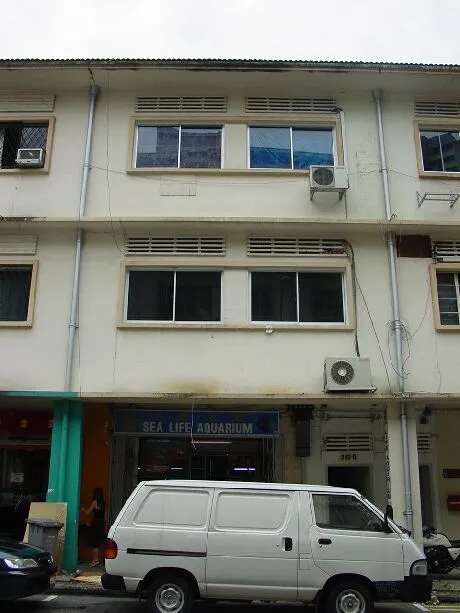
The high-rise flats at 328–342 and 224–250 Balestier Road are good examples of the move towards Modern architecture in terms of styles and materials that took off on a large scale after the Second World War. Such apartments were quite sought after by a growing middle class at the time.
The History
Of reinforced concrete construction and with accommodation in the form of individual self-contained flats with modern services such as flushing toilets, these buildings were seen as a significant improvement over the traditional housing of shophouses and village houses. Unlike pre-war mixed-use shophouses, the commercial and residential uses did not share the same staircase, though the five-footway was retained as a design feature and the ground floor continued to serve as commercial space for shops and services.
The Building
328–342 Balestier Road exemplifies the Modernist approach, where no unnecessary ornament was used. Visual interest is instead created through functional details such as sun-shading ledges, precast ventilation blocks, and steel-framed windows arranged in a well-balanced composition of solid, void, and shadow.
224–250 Balestier Road is somewhat unusual for this style, as effort has been taken to treat the pair of splayed corners with greater flair. Full-height vertical fins spanning three storeys terminate at the top floor to create a shallow pediment at each corner, lifting the eye of the viewer upwards. These two corners can be seen as an echo of the more ornate corners of the Chinese Baroque buildings of the 1920s, and similarly present an attractive visual terminus as one proceeds along the curve of Balestier Road.
Guidelines and Procedures
All proposed works will need to comply with the Conservation Guidelines and the Specific Restoration Guidelines (SRG). Conservation Permission is required before all additions & alteration works and operations of new use can begin.
Residential Fronts are characterised by timber casement windows flanking a double-leafed timber door. All buildings with residential front which is existing and/or identified in the 'Specific Restoration Guidelines', regardless of land use zoning, shall be retained and restored.
Apply for Specific Restoration Guidelines (SRG) (opens in new tab)
Street Block Plan Control (Balestier Road Between Thomson Road and Moulmein Road)
Explore Street View
The building can be found at this street.