
Conservation Area
Armenian Street And Loke Yew Street Conservation Area
Applicable Guidelines
Secondary Settlement Guidelines
Conservation Area
Armenian Street And Loke Yew Street Conservation Area
Find out more about Armenian Street And Loke Yew Street Conservation Area.
Important Information
All proposed works will need to comply with the Conservation Guidelines and the Specific Restoration Guidelines (SRG). Conservation Permission is required before all additions & alteration works and operations of new use can begin.
Owners, architects and engineers intending to carry out restoration works or development within conservation areas are required to comply with the conservation principles, planning parameters and restoration guidelines for conserved shophouse and bungalow building typologies, as well as planning parameters and envelope control guidelines for new buildings within conservation areas accordingly.
For other building types, which do not conform to the standard shophouse or bungalow typology, these will be evaluated on a case-by-case basis in accordance with conservation principles. [1]
About
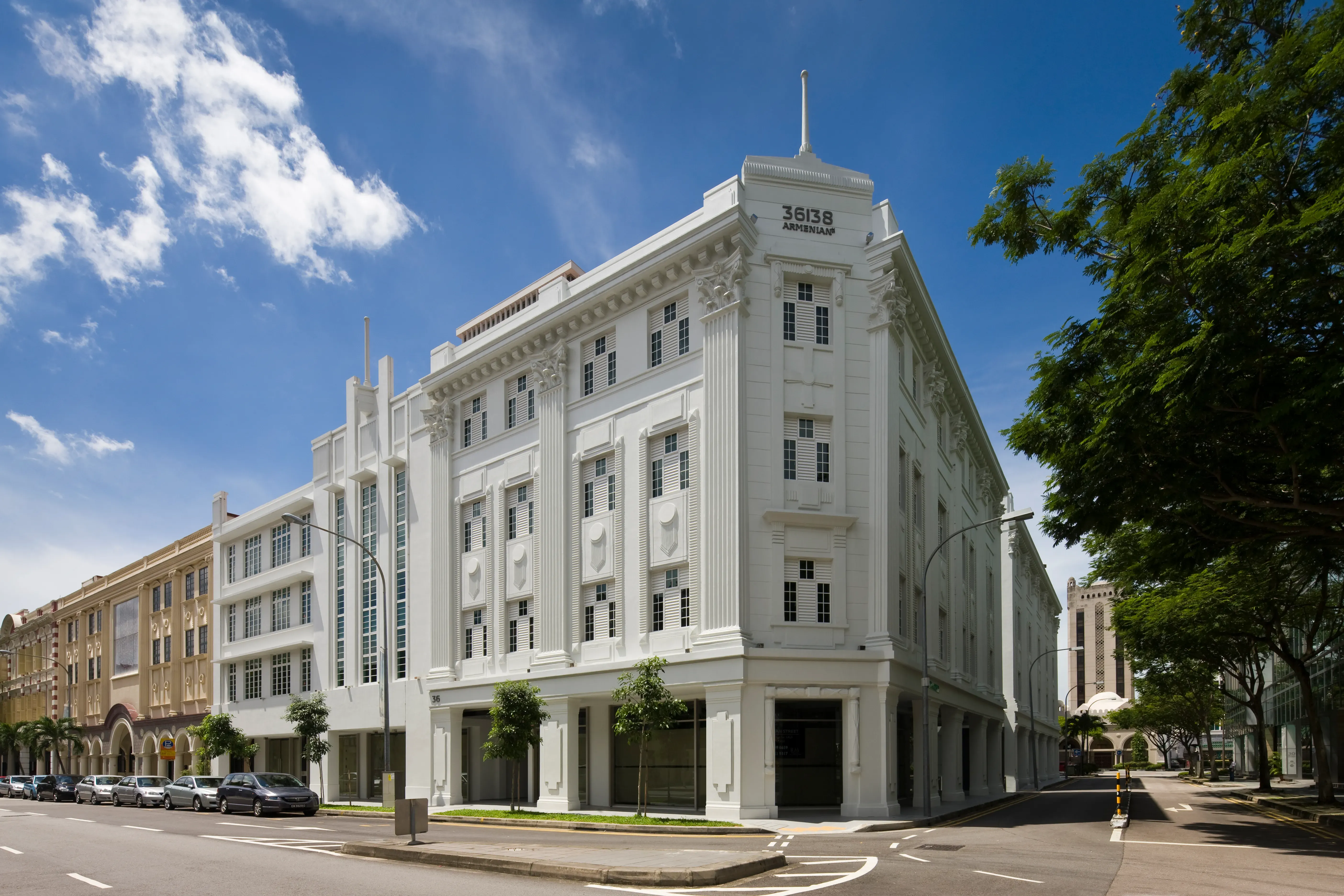
Located at the crossroads of Armenian Street and Loke Yew Street, the Armenian Street and Loke Yew Street Conservation Area received conservation status on 13 October 2001 under the voluntary conservation scheme. The area comprises 7 units of four-storey Art Deco buildings skillfully designed as a cohesive development, with a specially treated splayed corner responding to the road junction.
The Architecture
Also within the area are two notable landmarks along Armenian Street — the former Mayfair Hotel, built in the late 1940s in the unified Art Deco style, and the former MPH Building, a well-known landmark at the corner of Stamford Road and Armenian Street, built in 1908 by Swan & MacLaren in an Edwardian style with red facing brick and alternating bays of decorative semicircular pediments. Both buildings were given conservation status on 1 December 2003.
Guidelines and Procedures
[1] The conservation guidelines for shophouses and bungalows will generally be applied by URA in the consideration of a development application. However, if the circumstances or planning considerations relevant to a case warrant it, URA may in its discretion decide to depart from these general guidelines. The guidelines, principles and illustrations found in the guidelines are not exhaustive in covering all possible site conditions and variations in building type. Persons intending to carry out a development are advised to take this into consideration and check with URA through enquiries or development applications to confirm if their proposals can be allowed.