
20 Under 45: Fourth Edition
Think outside the box: Designing beautiful, sustainable homes for the future
22 January 2026
“Don’t be confined to what you have learnt in school and in the profession. Think outside the box,” shares Rene Tan and Koh Sock Mui of RT+Q Architects. Constantly pushing boundaries, the duo reimagines how homes can be more beautiful, adaptable and sustainable for the future. Both are recognised in the second and fourth editions of the ‘20 Under 45’ programme, which celebrates exceptional Singapore architects.
What are people looking for these days in terms of living spaces?
Sock Mui: People are looking for more multi-purpose and adaptable spaces that can have live, work and play spaces, arising from our new interests and demands from the COVID-19 pandemic.
Homeowners come to us with much more detailed briefs now. Because of Pinterest and Instagram, they know more specifically what they want, though sometimes they've seen so much they don't know what they want. Our job becomes figuring out their underlying desires.
What is one memorable project that both of you have worked on?
Rene: The house at Gallop Park is important because it brought us beyond the box, literally. It's an elliptical house, the first and only we've done to date. Geometrically, the form was a challenge to resolve in every direction. The fact that it's an elliptical house, not even circular, is important because it was the best form for an owner who wanted to appreciate the extent of her land. Because of the elliptical form, you get almost 360-panoramic views.
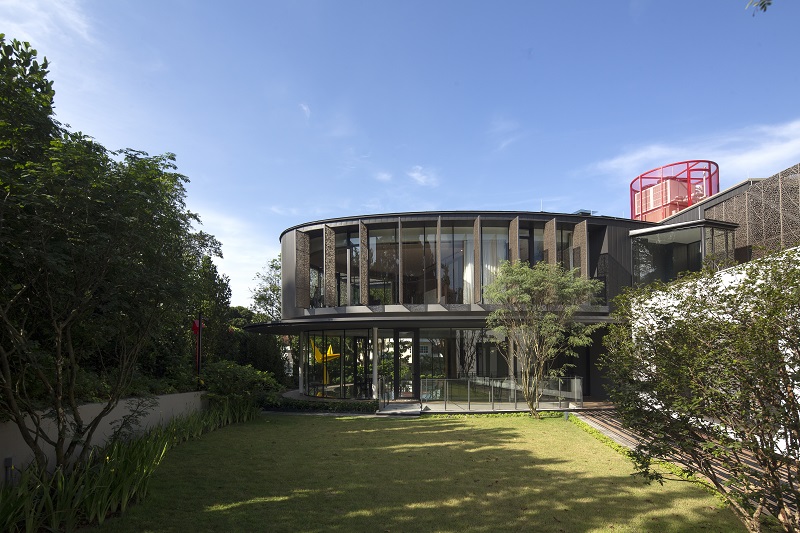
House with a Sanctum. Image: RT+Q Architects.
In terms of responding to the environment, is there any direction you're heading?
Rene: It boils down to sustainability. Air conditioning is the most important invention of the twentieth century, but it's been overused. We need to go back to fundamentals, to designing for natural ventilation, light and comfort.
Sock Mui: Many projects now incorporate more shaded outdoor spaces where you can enjoy the tropical climate. I hope more people can wean themselves off this reliance on air conditioning and feel the breeze.
How else can we design more sustainable homes?
Rene: We want to extend the notion of sustainability beyond the environment. It is also about how we can create more interesting living spaces that people feel constantly engaged in.
The COVID-19 pandemic has taught us a few things. We should design homes with flexible spaces and fewer dead ends. Instead of just having singular entrance and exit points, we could create multiple ways of entering and exiting. Spaces should also be designed for a greater sense of discovery and exploration.
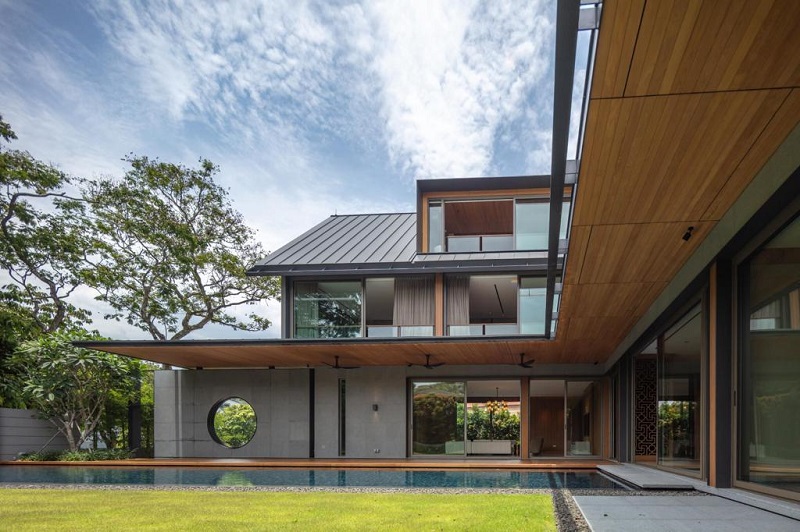
House of Harmony. Image: RT+Q Architects.
In addition, we should design adaptable spaces for multi-use. The living room could become a home office, or the bedroom could become the living room. In designing the various spaces, owners should have the flexibility to repurpose their spaces into something else in future to meet their changing needs.
Rene, you developed the theme “Don’t think like an architect” for the Singapore Archifest 2025. Why is this theme significant to you?
Rene: It served as a reminder and inspiration to architects and others to not be confined or limited to what they have learnt in school or in the profession.
When you don't think like an architect, a window is just a means of bringing in ventilation and light – it can be of many other shapes and forms. A door is only a means of moving from one space to another, so it can come in any form.
But if you think like an architect with hinges, frames and ironmongery, you might be constrained by what you were taught or how you should approach things.
Can you recall your first encounters with each other? What were your impressions?
Rene: Sock Mui has always struck me as someone who can design and project manage well. When she joined us in 2011, the timing was perfect. We were still building up our team, and she was exactly what the office needed.
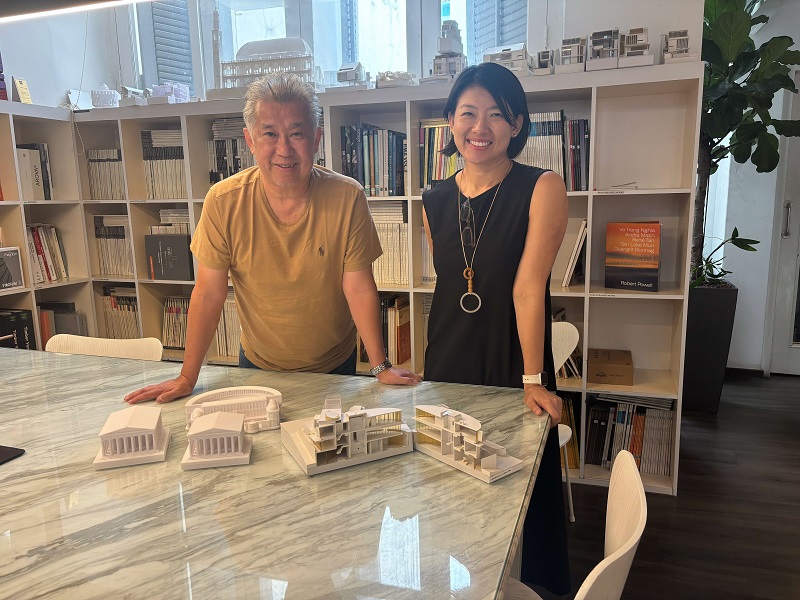
Rene Tan (left) and Koh Sock Mui (right).
Sock Mui: My first encounter with Rene was when I was a student. He was a guest critic for our year two project. I remember him talking about scale, proportion, and the importance of drawing by hand — things that remain important today. After working at RT+Q for so many years, I've seen how he practises what he preaches.
I believe Rene is one of the more prolific sketchers in the industry.
How do you keep learning and growing as architects?
Sock Mui: We're always dealing with different projects, which allows us to study different approaches and iterate constantly. You are regularly learning how to improve from your past projects.
Rene: Getting better is important. Our firm has completed close to 200 houses, but the number isn't what matters. What matters is that even after 200 houses, you're still getting better with every project.
Why should one be an architect today?
Sock Mui: Architecture is a profession with many intangible rewards. It's demanding, but when you finally deliver your project and see people happily using it, that makes it very fulfilling. When they tell you, “I love my house, my grandchildren love to visit because the house is so nice”, you feel that your labour of love has brought great pleasure to people's lives.
Rene: Architecture is a noble profession. At its core, it is a convergence of disparate elements — structure, function, beauty, human need — into one coherent whole. Whether designing a house, a museum, or a library, architects must orchestrate complexity with both precision and vision.
I would encourage young people to consider this path. Yes, it demands sacrifice —long hours, many challenges, and often intangible rewards. But the journey is profoundly worthwhile. You will grow in ways you cannot yet imagine, developing skills that allow you to see the world differently, to think systemically, to create beauty from constraint. Most importantly, you will have the opportunity to contribute to meaningful change.
Table caption
‘20 Under 45’ architects from RT+Q Architects across generations Ar. Rene Tan (‘20 Under 45’ Second Edition) Ar. Jonathan Quek (’20 Under 45’ Third Edition) Ar. Koh Sock Mui (‘20 Under 45’ Fourth Edition) Year founded Selection of works |
|---|
About the ‘20 Under 45’ programme
First launched in 2004, the ‘20 Under 45’ programme by Urban Redevelopment Authority recognises young emerging Singapore-registered architects for their design excellence, ideas and leadership and the positive impact of their works on the built environment and communities. Across its three previous editions in 2004, 2010 and 2017, the programme has spotlighted 60 architects, many of whom have gone on to deliver impactful works locally and internationally, strengthening Singapore’s architectural standing.
The '20 Under 45': Fourth Edition exhibition is at the URA Centre from 23 January to 31 March 2026, with the accompanying publication for sale at all major bookstores soon. Join the public talks on the architects’ journeys, works and creative solutions in addressing larger urban challenges for the future.