
Master Plan 2025
Growing plants in the sky
14 July 2025
This article has been migrated from an earlier version of the site and may display formatting inconsistencies.
Seeing plants and trees growing out of buildings is sometimes a strange and yet familiar sight that we take for granted. The idea of skyrise greening originated in the 1990s and gained momentum from the 2000s. We trace its evolution and impact over the years.
“…Singapore belongs to the league of cities that have actively pushed for the addition of green spaces into the vertical dimensions of the built environment. …Given the high-density and compact development character of Singapore, the intensity of skyrise greenery installed in Singapore should rank as amongst the highest worldwide,” shared National University of Singapore’s Professor Dr Tan Puay Yok on Singapore’s skyrise greenery efforts in a 2012 essay on Singapore as a vertical garden city1.
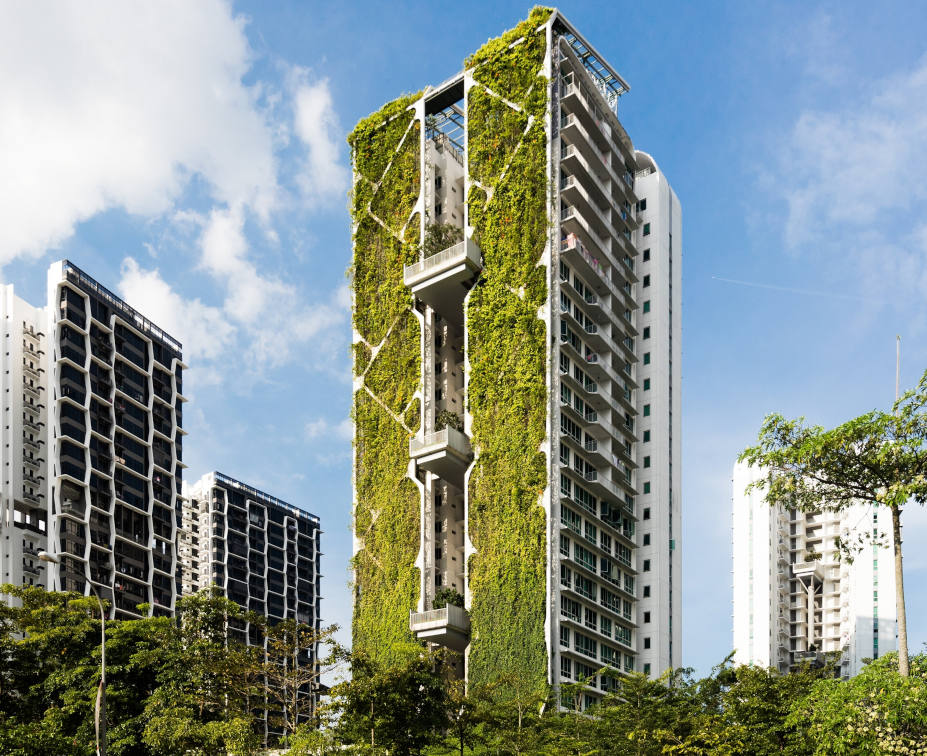
The Tree House condominium built in 2013 has the world’s largest vertical garden, based on the Guinness World Records. A biodiversity impact assessment found 99 species of animals inhabiting the original site, of which 12 species are considered threatened. Image: Finbarr Fallon.
Skyrise greenery is a term coined that is unique in its usage in Singapore. It refers to greenery that is incorporated into buildings or structures above the ground level. It has found its way into government documents, popular literature and even in the first encyclopedia in Singapore. It is befittingly a Singapore invention that reflects the national attention on greenery in the city.
1990s: Origins of skyrise greenery
With the increasing dominance of vertical spaces, greening of the high-rise environment proposals emerged in the 1990s on how Singapore’s Garden City character can be maintained. The term skyrise greenery can be traced back to a series of Skyrise Gardens Exhibition first organised by the National Parks Board (NParks) in 1992, conceived as an outreach effort to encourage Singaporeans to take up gardening in high-rise apartments. There were already initial shifts in this direction where sky terraces on intermediate floors of buildings were encouraged2.
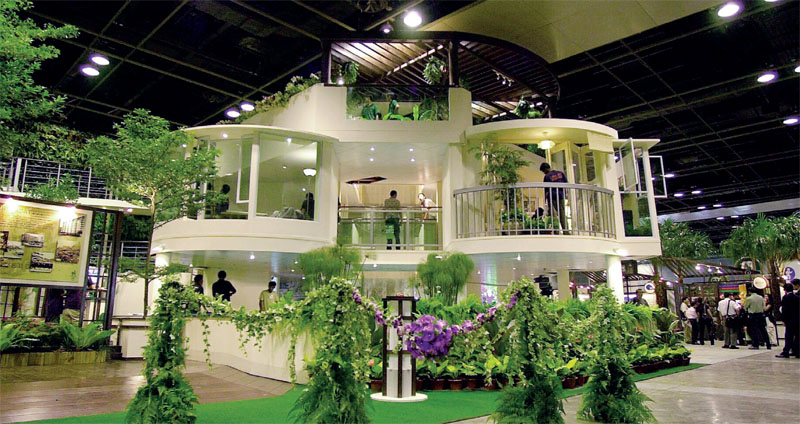
The Singapore Pavilion at the Skyrise Greenery Gardens Exhibition held in conjunction with the International Federation of Landscape Architects World Congress in Singapore in 2001.
Table caption
Early efforts The greening of buildings was a new and challenging frontier then. Although the intention was conceptually simple, the technical requirements, maintenance considerations and issues of private versus public spaces were far more considerable than just the greening of low concrete walls and columns. Early efforts were limited to high-rise home gardening, usually in balconies or common access corridors. Except for a few pioneering examples of rooftop gardens incorporated into commercial buildings and planters on facades of buildings, the idea of greenery on buildings remained uncommon between the 1970s and 1990s. |
|---|
2000s: Gaining momentum
In the 2000s, a more coordinated adoption of “Skyrise Greenery” by URA and NParks further pushed the momentum towards a form of green architecture feature that provided means to mitigate the impacts of the building on its environment.
Introduced in 2009 as a consolidated urban and skyrise greening scheme comprising incentives and requirements, URA’s Landscaping for Urban Spaces and High-Rises (LUSH) programme is a key initiative that capitalises on development to inject more greenery into the city. The programme has encouraged and inspired a greater adoption of vertical greening over the years, by replacing greenery which has been taken away from a building site onto the multitude of vertical and horizontal spaces in a building that can be used to accommodate plants.
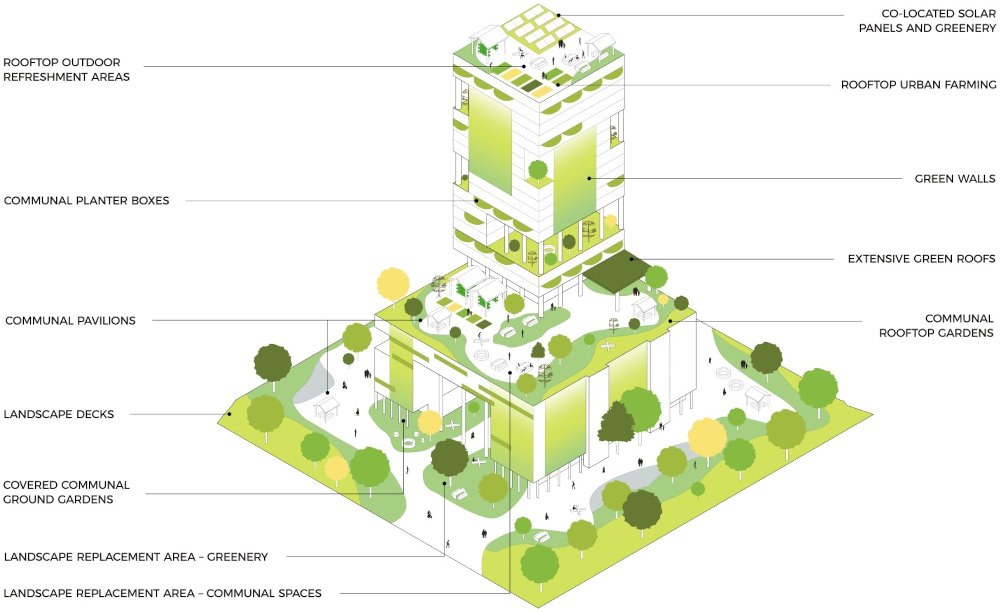
The key landscape replacement areas as part of LUSH.
Over the years, LUSH has been updated and revised, refining the incentives and expanding its focus to more areas and types of developments, including green roofs and rooftop urban farms, in response to emerging challenges and new innovations. It is a collaborative effort with the industry, where LUSH revisions consider industry feedback. As of December 2024, it has supported over 440ha of greenery island-wide – this is equivalent to about 610 football fields.
LUSH has also contributed significantly to increasing greenery in high density clusters. For example, more than 100,000 square metres of greenery has been injected into developments within the Central Area since its inception.
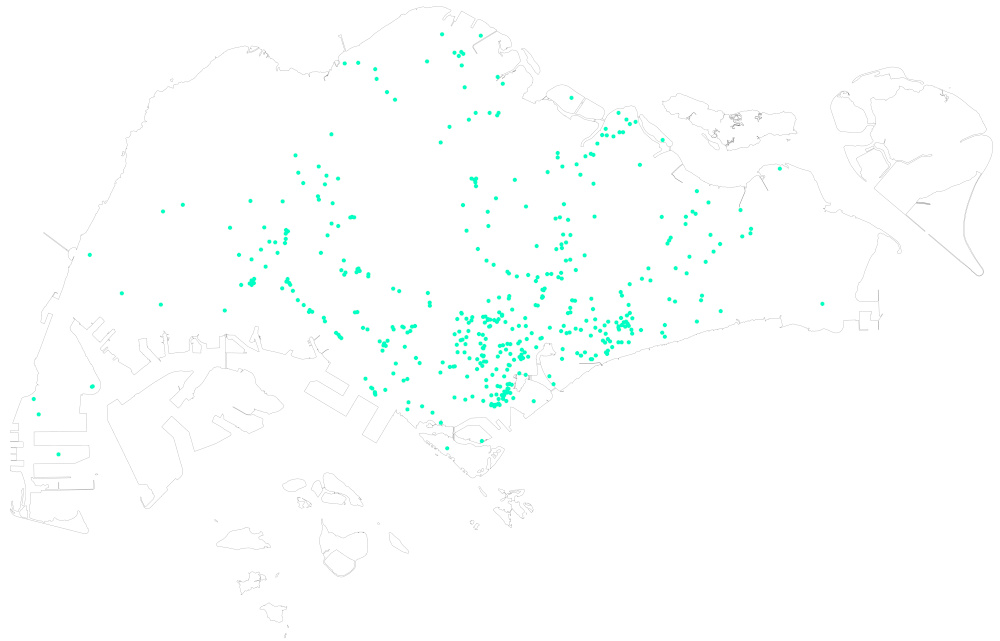
An island wide map showing the key developments with skyrise greenery.
Impact of skyrise greenery
Apart from creating visual relief, the injection of greenery into the high-rise environment also brings benefits such as mitigating the urban heat island effect, supporting biodiversity and creating communal spaces for people’s enjoyment. Rooftop greenery also helps to lower the temperature of buildings, thus reducing the energy needed to cool a building.
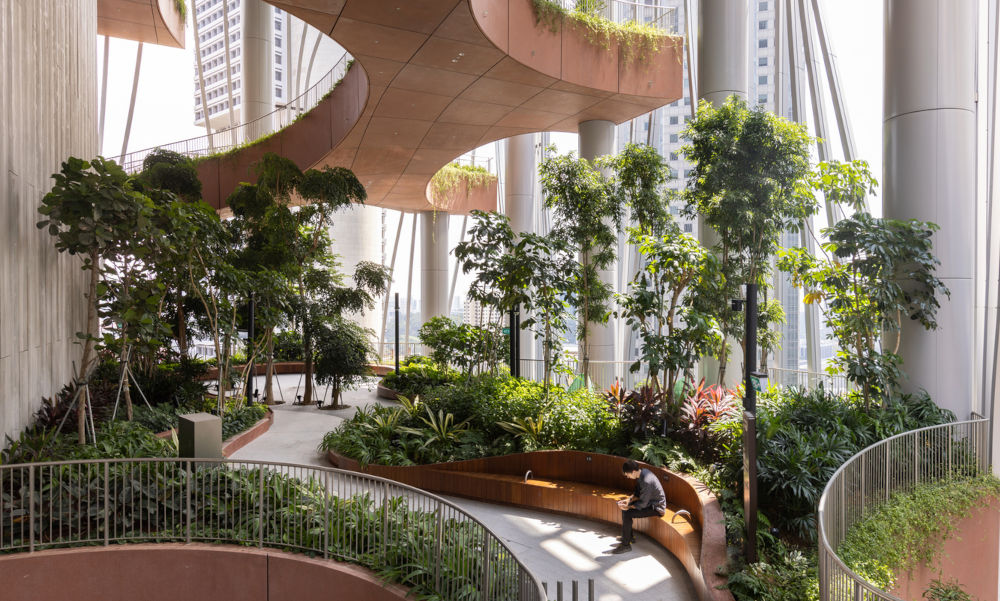
CapitaSpring has over 80,000 plants across 130 species in its key spaces and gardens, creating a green oasis in the heart of the city. Image: Finbarr Fallon.
Research studies have shown that tropical urban roof gardens have the potential to support urban wildlife populations such as birds and butterflies3. Reflecting on the potential value of skyrise greenery, Wong Mun Summ, Co-founder of WOHA Architects, shares: “Beyond just reducing our energy consumption, we have learnt that integrating greenery within our buildings has a much bigger impact in creating better microclimates within our buildings and reducing the overall urban heat island effect than we imagine.
The plants help to regulate and cleanse pollutants in the air. They contribute a lot more oxygen to our environment, producing up to 20 to 30 per cent more oxygen. In a way, the building is almost performing like a rainforest. If we continue to create more of such green buildings, imagine what they can do for our city collectively in not just replicating nature but helping to regenerate it as well.
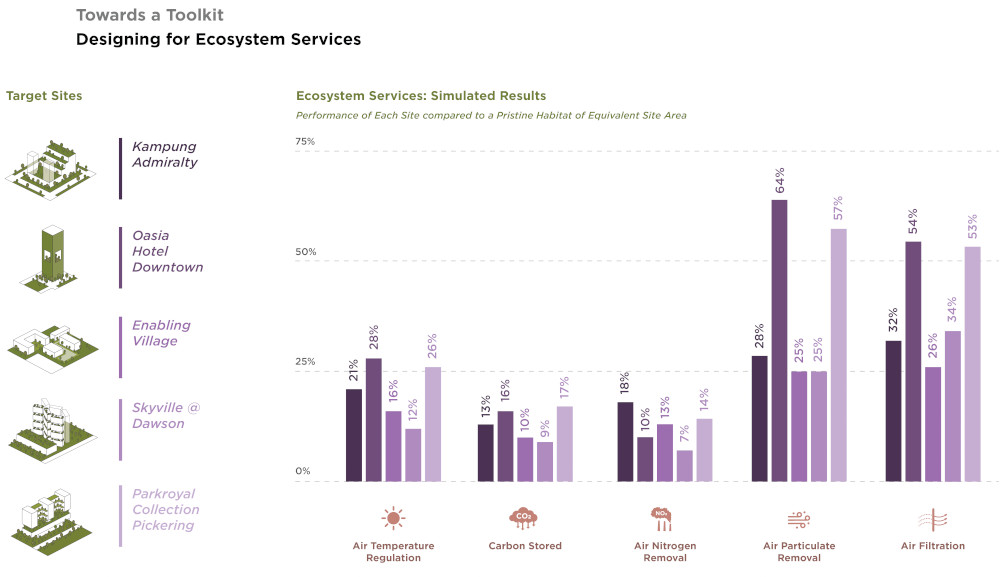
Insights from WOHA Architects’ research, “Designing for Biodiversity, the Value of Nature-Centric Design”, on the simulated performance and benefits of ecosystem services for various key buildings designed by WOHA Architects. Image: WOHA Architects/BioSEA.
I believe we are only beginning to appreciate the science and potential impact of green buildings on our environments as our understanding of nature’s ecosystem services is still new. There is much more for us to learn and discover.”
Learn more about LUSH here.
1 Tan Puay Yok, Essay: Singapore, a Vertical Garden City in the Making. Singapore Capital City for Vertical Green, Architecture and Urbanism Special Edition magazine, A+U Publishing, 2012, pp 138. Puay Kok cited a brief comparison in the essay: the 30 ha of skyrise greenery installed in Singapore between 2009 and 2012 can be contrasted with the amount of green roof installations in North America (175 ha between 2008 and 2012 – this is spread out over a wider area).
2 Sky terraces are communal sheltered public spaces provided at intermediate levels of a building that are open sided and naturally ventilated. Under the Gross Floor Area (GFA) incentive, these covered spaces are not counted as GFA. The sky terrace guidelines were introduced in 1997. Sky terraces are now a common feature in many condominiums, office and mixed-use developments, providing communal spaces to gather with elevated views of the city in a garden setting.
3 Wang, J. W., C. H. Poh, C. Y. T. Tan, V. N. Lee, A. Jain, and E. L. Webb. 2017. Building biodiversity: drivers of bird and butterfly diversity on tropical urban roof gardens. Ecosphere 8(9):e01905. 10.1002/ecs2.1905.