
20 Under 45: Fourth Edition
Future-proofing architecture: Building liveable cities in the age of AI
22 January 2026
This article has been migrated from an earlier version of the site and may display formatting inconsistencies.
Going beyond buildings’ site boundaries, Wong Mun Summ and Alina Yeo of WOHA Architects share how a systems approach to design — from green façades that filter air pollution to sky gardens that foster community — can transform buildings into catalysts for more liveable cities. Both are recognised in the first and fourth editions of the ‘20 Under 45’ programme, which celebrates exceptional Singapore architects.
Beyond just designing individual buildings, your firm has advocated for a more systems-thinking approach. Why is this important?
Mun Summ: Everything in our city is interconnected – whether it is our underground spaces, how we move around, the air we breathe, the greenery around us or the public spaces we enjoy. The systems approach encourages us to design buildings beyond their site boundaries, to look at how we can optimise and maximise our building designs to further enhance the city’s systems and its environment.
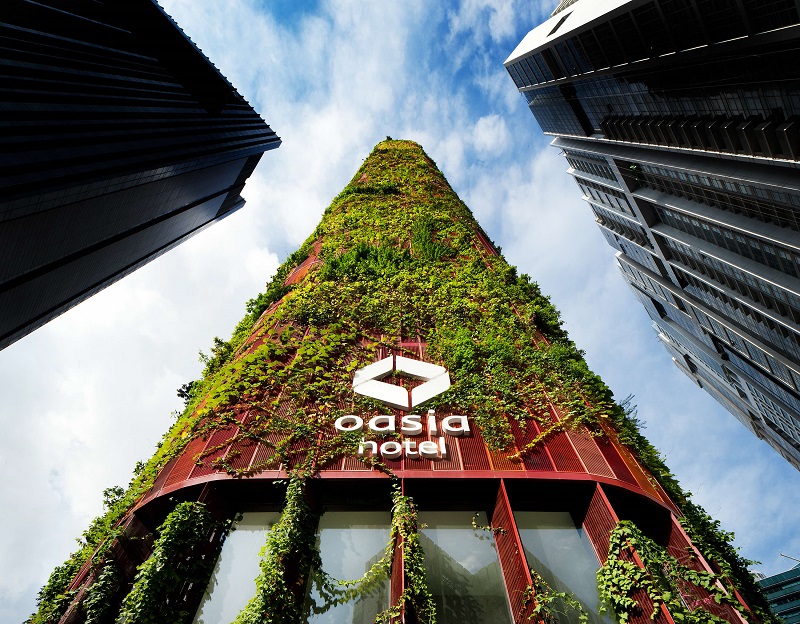
Oasia Hotel Downtown. Image: WOHA Architects.
Oasia Hotel Downtown is a good example of this systems-approach. In looking at the different layers and trying to maximise greenery, we designed its green facade to perform like a rainforest to help regulate air quality. During the transboundary haze, the building helps to produce cleaner air. It also lowers the Urban Heat Island effect with its surface temperature being only 25 to 30 degrees Celsius as compared to a building made up of mainly steel, glass and concrete, which has a surface temperature of 50 to 55 degrees Celsius.
Alina: Another example is Punggol Digital District. In planning and designing the district, we looked at many interconnected layers and systems and how to bring them all together – from infrastructural systems to ecological layers, underground spaces, mobility networks and shared public spaces.
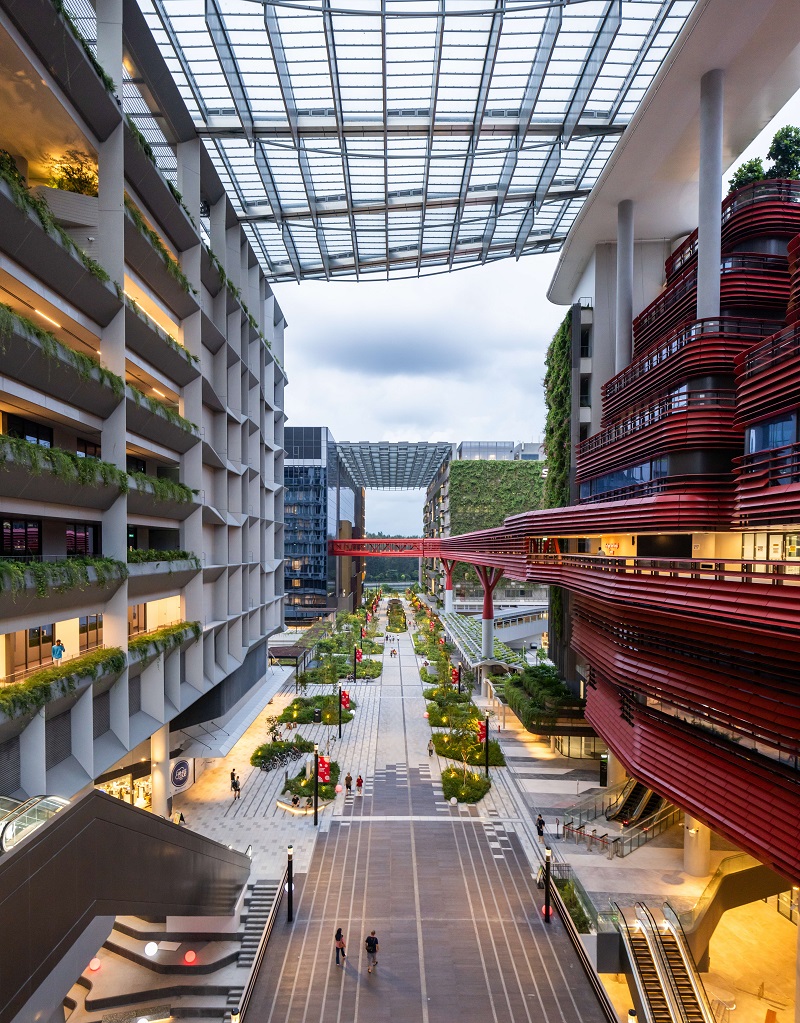
Punggol Digital District. Image:Finbarr Fallon.
We had planned for infrastructure, services and vehicles to be underground, thus freeing up the ground levels as public spaces for people and nature. At mid-level, we introduced a 2km long Collaboration Loop that seamlessly connects the district and fosters synergy between industry and academia.
As part of the systems thinking approach, we are also always asking ourselves how standard building elements can do more to contribute to the environment. Take for example a roof or a façade – beyond being a protective element, we often look for opportunities to turn them into productive elements such as generating solar energy or harnessing wind or integrating with greenery/urban farms.
Your firm developed a community plot ratio that measures the amount of community space within a development’s site area. What was the rationale for introducing this?
Mun Summ: We’re always interested in creating more public spaces for social interactions. For many of the buildings that we design, we try to ensure that the ground floor spaces are open and accessible to the public and not just for its building occupants to enjoy.
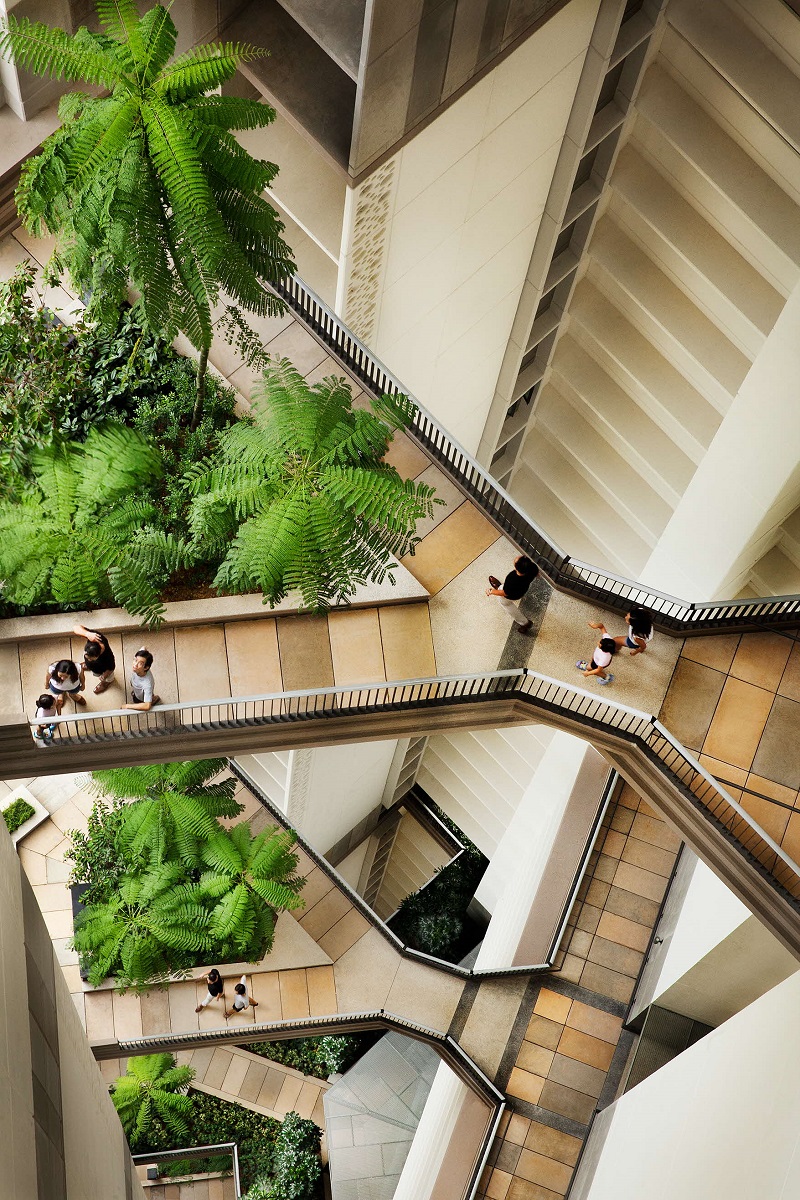
Skyville@Dawson. Image: Patrick Bingham-Hall.
We also try to introduce other communal spaces like sky gardens and terraces on the upper floors. For Skyville@Dawson, which is a high-density public housing development with 960 homes, we achieved 180 per cent community plot ratio by having sky gardens, terraces, and sky streets on every 11th floor.
How do you balance public and private spaces?
Mun Summ: We do this by designing varying gradients of public, semi-public and private spaces with different access controls. For the School of the Arts, while the ground floor is open to all, the school access is restricted at the escalators and lifts for security management.
For Kampung Admiralty, the ground floor is open to the public, but the sky park on the podium roof is semi-public because of the separation from the ground floor and it is accessible only via the lift. This makes it safer and more secure for seniors and residents to use it while still making it accessible for all.
What lessons have you learnt in balancing density and liveability?
Mun Summ: What we have learnt is when you increase density, you need to also increase the quantity and quality of communal spaces and amenities. It is about ensuring that we have sufficient public and community spaces that offer breathing spaces for people to enjoy. It is also about creating a diverse variety of such communal spaces, where we can access both vibrant and quieter spaces within and around our buildings.
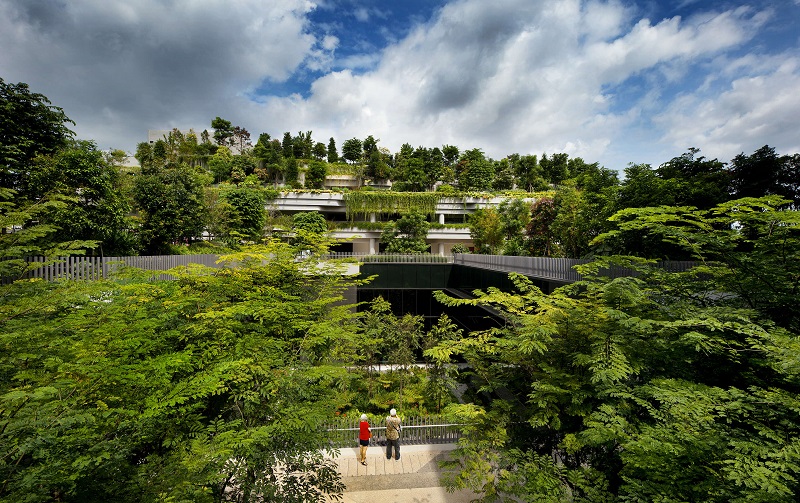
Kampung Admiralty. Image: Patrick Bingham-Hall.
Alina: We have also realised that the higher we go in our buildings, the more horizontal connections we need to create across multiple levels. This enables people to come together, interact and feel a sense of belonging to the place. The multiple ground levels also help to humanise the building scale. Without these connections, tall towers can be very cold and isolating.
How does AI influence your work? What are important skills architects should have?
Alina: Technology and AI can certainly help to improve our productivity such as in producing quick visuals or generating meeting records or doing technical checks, but fundamentally, it cannot be a substitute for an architects’ critical design thinking skills.
Mun Summ: AI is a good learning tool that we can harness to do our work better, but on its own, it is not necessarily inventive. If you are just copying other people’s designs or focusing on stylistic aspects only, then AI might replace your job in future. However, if you constantly try to be creative and innovative in finding new solutions and ideas as an architect, then you will always remain relevant.
Alina, you started as an intern with the firm with WOHA Architects, and SOTA was your first local project after you graduated.
Alina: Yes, both Hong Wei and I started out as interns and grew with the firm. We had about 20-30 staff in 2005 when I joined as a graduate compared to around 100 now. Our projects have also increased in scale and complexity over the years.
What is the way of working within the firm for architects to stay connected and curious?
Mun Summ: We have deliberately created larger community and social spaces within the office to encourage greater collaboration and interaction. Every studio is an open plan with shared discussion areas. We also have a large gallery space on the second floor that we use for regular in-house sharings, meetings, presentations and social events.
On the roof, we have a garden and outdoor terrace that can host more informal gatherings. Such get-togethers are important for us to listen to one another, to exchange ideas and to understand the firm’s larger strategies. I also encourage staff to attend the crit sessions of my Integrated Sustainable Design studio at the National University of Singapore for greater exposure to systems thinking.
Alina: Our office itself is also used as a test bed for ideas that we implement at a larger scale in our projects. Some examples include the vertical greenery system in our air well, solar panels and nature totem poles on our rooftop, dry mist fans on our outdoor terrace, etc.
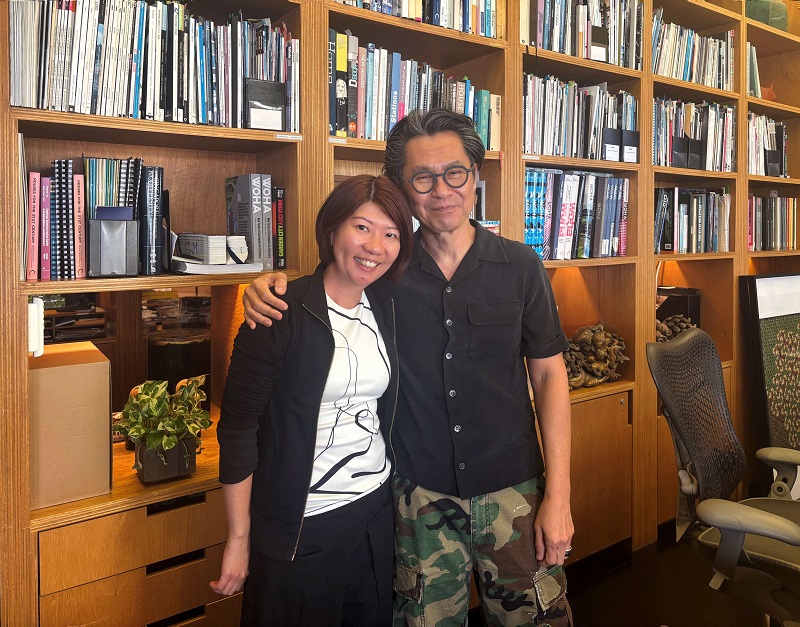
Alina Yeo (left) and Wong Mun Summ (right).
Why should one be an architect today?
Alina: Architects are strategically positioned to be agents for change in the way we think and implement good designs. With a systems thinking approach, we can become catalysts for change in creating better neighbourhoods and districts that improve the liveability of our cities and the quality of our lives.
Mun Summ: Fundamentally, there will always be a need for architects because we're basically responsible for putting roofs over people’s heads. We also help to shape and contribute to the larger environments and cities that we inhabit, creating lasting experiences and memories. This makes being an architect very rewarding.
Table caption
‘20 Under 45’ architects from WOHA Architects across generations Ar. Wong Mun Summ (‘20 Under 45’ First Edition) Ar. Richard Hassell (‘20 Under 45’ Second Edition) Ar. Phua Hong Wei (‘20 Under 45’ Third Edition) Ar. Alina Yeo (‘20 Under 45’ Fourth Edition) Year founded Selection of works |
|---|
About the ‘20 Under 45’ programme
First launched in 2004, the ‘20 Under 45’ programme by Urban Redevelopment Authority recognises young emerging Singapore-registered architects for their design excellence, ideas and leadership and the positive impact of their works on the built environment and communities. Across its three previous editions in 2004, 2010 and 2017, the programme has spotlighted 60 architects, many of whom have gone on to deliver impactful works locally and internationally, strengthening Singapore’s architectural standing.
The '20 Under 45': Fourth Edition exhibition is at the URA Centre from 23 January to 31 March 2026, with the accompanying publication for sale at all major bookstores soon. Join the public talks on the architects’ journeys, works and creative solutions in addressing larger urban challenges for the future.