
20 Under 45: Fourth Edition
From China's mountains to community hearts: A mission to make architecture accessible for all
22 January 2026
This article has been migrated from an earlier version of the site and may display formatting inconsistencies.
From barrier-free mountain walkways in China to shared spaces, Look Boon Gee and Chua Liang Ping of LOOK Architects share how their designs prioritise accessibility, nature integration and communal spaces that bring people together. Both are recognised in the first and fourth editions of the ‘20 Under 45’ programme, which celebrates exceptional Singapore architects.
The firm has designed various infrastructures that connect people to nature. Why is this important to you?
Boon Gee: I love nature. When I walk in a park or forest, I feel happier. It's not just about appreciating the beautiful sceneries; there are so many things we can learn from nature that show us how to survive and thrive.
In designing infrastructures that integrate with nature, we want to be responsible designers to ensure that we are protecting and enhancing nature — even while we create opportunities for people to experience and enjoy our forests.
The Fuzhou Trans-Urban Connector in China gave citizens intimate access to their natural terrain. Tell us more about its significance.
Boon Gee: In China, where development focuses on vertical high-rises, it was a unique opportunity to bring people closer to nature through horizontal connections. Inspired by Singapore's Alexandra Arch but ten times larger in scale, it involved opening up a historical mountain in the city centre.
The site presented complex challenges: navigating around military grounds, ancient graves and undulating terrain whilst connecting the mountain to two major nodes —West Lake in the city centre and the Min River across the mountain.
Fudao walkway in Fuzhou, China. Image: Zhou Yue Dong.
We observed that locals enjoyed morning and evening walks, so we brought barrier-free access to the mountain. In China, steps are everywhere. We achieved almost 90 per cent barrier-free access with gentle slopes meandering through the topography, allowing people to bring their grandparents or strollers. When it fully opened during Chinese New Year, it was packed. You could hardly see the footpath.
We weren't bringing in new nature but giving back views, proximity to tree canopy and lookout opportunities to observe local biodiversity.
What were some interesting innovations done during this project?
Liang Ping: One key innovation was using steel structure for the elevated walkways, a first in China. Steel is lightweight and minimises the impact towards existing vegetation. We limited the contractor's access to within two metres of the walkway, so they couldn't bring excavators around. This protected the existing native trees during construction. The contractor creatively used a lifting crane that ran on the steel itself as a track.
Boon Gee: They combined new and old methods: robotic modular metal launching and cable hoisting alongside traditional donkeys and mules to carry materials to the forest areas.
Having designed many different residential developments, how do you see living spaces evolving?
Liang Ping: Providing common areas for chance encounters and social interaction has become more important when designing residential developments. People look forward to enjoying more breakout spaces, sky terraces, and sky gardens.
Commual space at St George's Towers. Image: LOOK Architects.
Such spaces are now expected as extensions of our living environments, where you can step out and enjoy parks and gardens nearby and use multipurpose amenities for sports and other recreational activities.
How does this influence your designs?
Liang Ping: In design and site planning, there is greater emphasis and attention given to how we position and locate shared communal spaces. We need to consider how different spaces fit into other facilities and support how people move around.
For example, we will consider co-locating childcare and senior care centres close to each other for more multi-generational interactions and experiences that can enhance our wellbeing. This interplay of programmes becomes quite important in our residential developments.
What would you like to see more of in future residential environments?
Boon Gee: I like the accessibility of the amenities and public spaces in our public housing. It's open 24/7 — you can walk to the playground with your grandchildren without being told "You're not a resident here". It is important to continue to have this sense of openness for our living spaces.
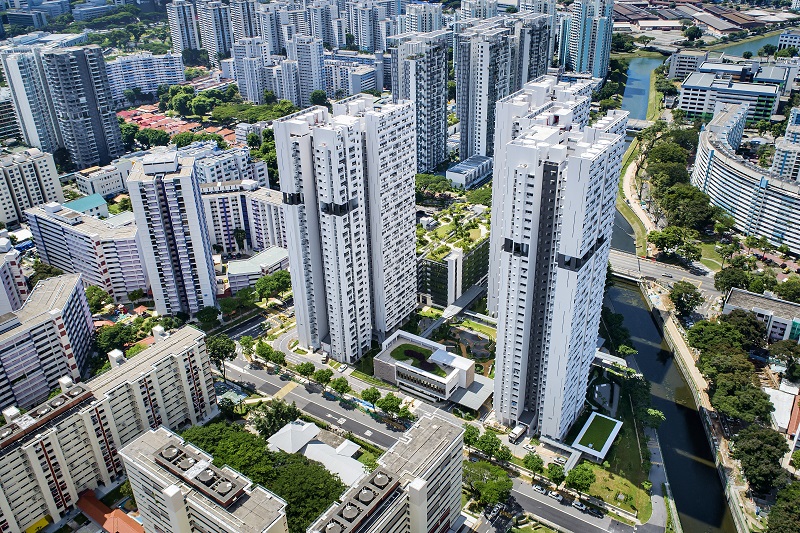
St George's Towers. Image:Joseph Goh.
Even for private residential developments, there are other ways to explore a sense of openness through a more fenceless setting. We designed a condominium, Bliss@Kovan, where the perimeter wall is set behind the drop-off porch. This makes the entire frontage with its paved driveway look like it belongs to the street, even though it belongs to the condominium. We also employed very porous fencing all around so that the condominium's landscaping can be visually enjoyed from the outside.
Why should one be an architect today?
Liang Ping: There is never a dull moment in being an architect. There are so many intricacies and complexities to manage and tackle each day. This could be working on future designs, ensuring building designs comply with requirements or working with contractors to realise your visions. What is most fulfilling is having your design visions realised and seeing how people experience the physical buildings and spaces that you designed.
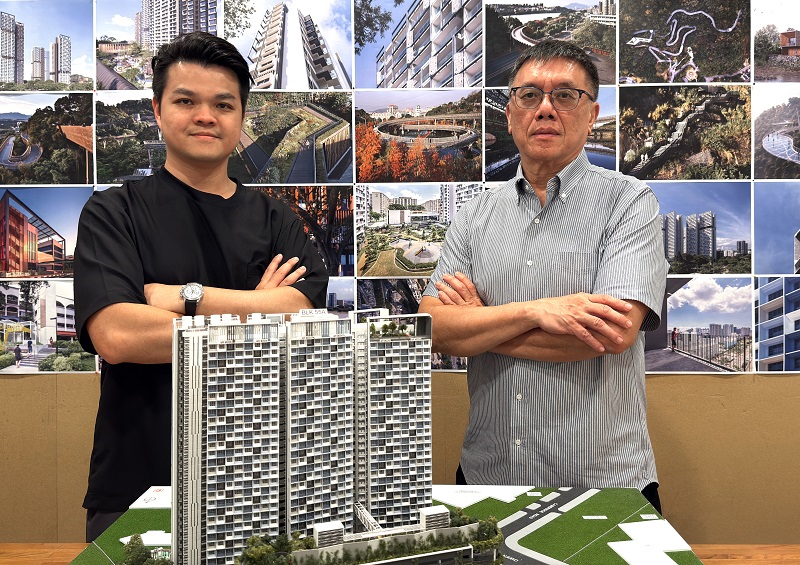
Chua Liang Ping (left) and Look Boon Gee (right).
Boon Gee: Being an architect is like being a conductor, where you are creating a wonderful symphony. What excites me the most is orchestrating all the different elements, collaborating with many stakeholders, to create something beautiful, functional and sustainable for all to enjoy.
Table caption
‘20 Under 45’ architects from LOOK Architects across generations Ar. Look Boon Gee (‘20 Under 45’ First Edition) Ar. Chua Liang Ping (‘20 Under 45’ Fourth Edition) Year founded Selection of works |
|---|
About the ‘20 Under 45’ programme
First launched in 2004, the ‘20 Under 45’ programme by Urban Redevelopment Authority recognises young emerging Singapore-registered architects for their design excellence, ideas and leadership and the positive impact of their works on the built environment and communities. Across its three previous editions in 2004, 2010 and 2017, the programme has spotlighted 60 architects, many of whom have gone on to deliver impactful works locally and internationally, strengthening Singapore’s architectural standing.
The '20 Under 45': Fourth Edition exhibition is at the URA Centre from 23 January to 31 March 2026, with the accompanying publication for sale at all major bookstores soon. Join the public talks on the architects’ journeys, works and creative solutions in addressing larger urban challenges for the future.