
Master Plan 2025
Why ecological corridors are important for high-density cities
14 July 2025
This article has been migrated from an earlier version of the site and may display formatting inconsistencies.
With cities increasingly functioning as living ecosystems, Professor Thomas Schroepfer1, Singapore University of Technology and Design (SUTD) and Srilalitha Gopalakrishnan2, Singapore-ETH Centre Future Cities Laboratory (FCL) Global, share why ecological corridors are important for biodiversity to flourish and people to continue to enjoy nature close to homes.
How has Singapore been doing in its journey as a City in Nature in integrating nature with the urban fabric and leveraging nature-based solutions to enhance ecosystems and strengthen climate resilience?
Thomas: Singapore has made significant strides in integrating nature with its urban fabric. Examples of such efforts is the Biophilic Town Framework introduced in 2013 by HDB (Housing & Development Board) to guide and create more nature-centric towns. In addition, there is a widespread implementation of skyrise greenery, park connectors and multifunctional green spaces over the years.
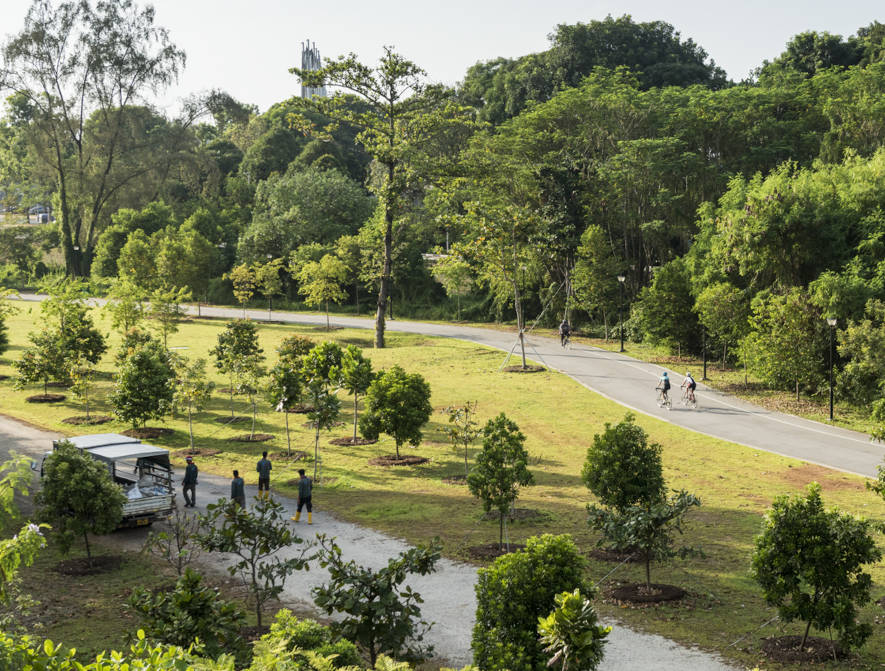
There are over 380 kilometres of park connector trails linking major parks and nature areas across Singapore. These offer networks for cycling and walking, easy access to nature areas and they also help to enhance ecological connectivity between natural habitats.
What stands out is the systemic and data informed approach taken to include ecological considerations in the planning and design of nature areas, parks and public spaces. This not only helps to mitigate urban heat and improves storm water management, but it enhances biodiversity and creates accessible and restorative spaces for communities to bond.
Srilalitha: In addition to planning and design strategies, there is a conscious effort to build up communities of gardeners and champions over time through key platforms such as the Community in Bloom programme and the Singapore Garden Festival. These efforts are equally important in sustaining the City in Nature efforts.
City in Nature strategies
Singapore is one of the greenest cities in the world. After six decades of greening efforts, there is a thriving network of green spaces where nature is restored into the urban environment. The following are five key strategies as part of the City in Nature vision:
Expand the Nature Park Network
Intensify nature in gardens and parks
Restore nature into the urban landscape
Strengthen connectivity between Singapore’s green spaces
Enhance veterinary care and animal management
Learn more about the City in Nature strategies here (opens in new tab).
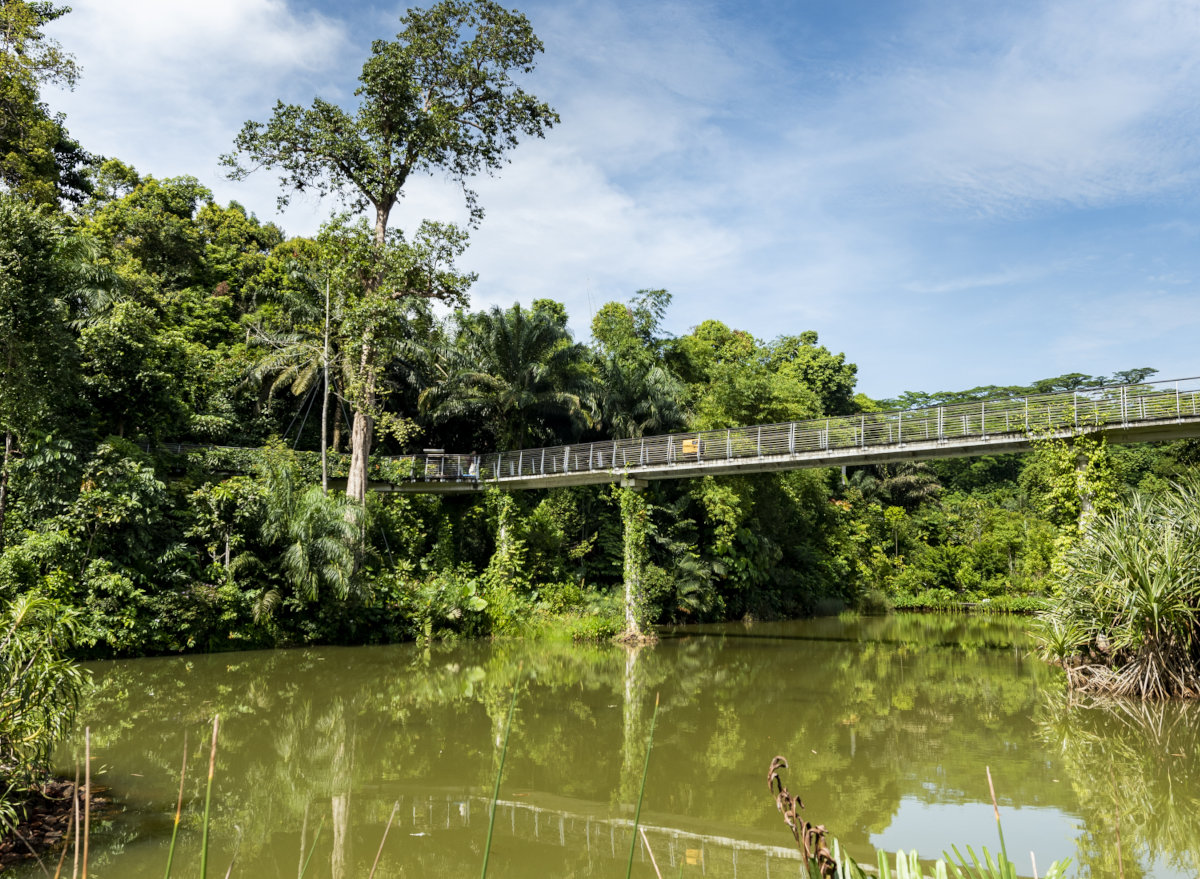
The 10-hectare Learning Forest (above) at the Singapore Botanic Gardens serves as a living laboratory in restoring habitats while enabling people to be able to access and enjoy the lowland rainforest and a freshwater wetland forest.
Multifunctional ecological corridors offer ways for humans and nature to co-exist in harmony. Your research study, “Urban Ecological Corridors: Multifunctional Corridors for People and Ecology3” seeks to deepen our understanding on designing effective ecological corridors. Why are they important?
Thomas: It is no longer enough to just have separate and standalone green spaces and buildings with greenery. As cities increasingly function as living ecosystems, we need to find the best ways to integrate our urban infrastructure with nature.
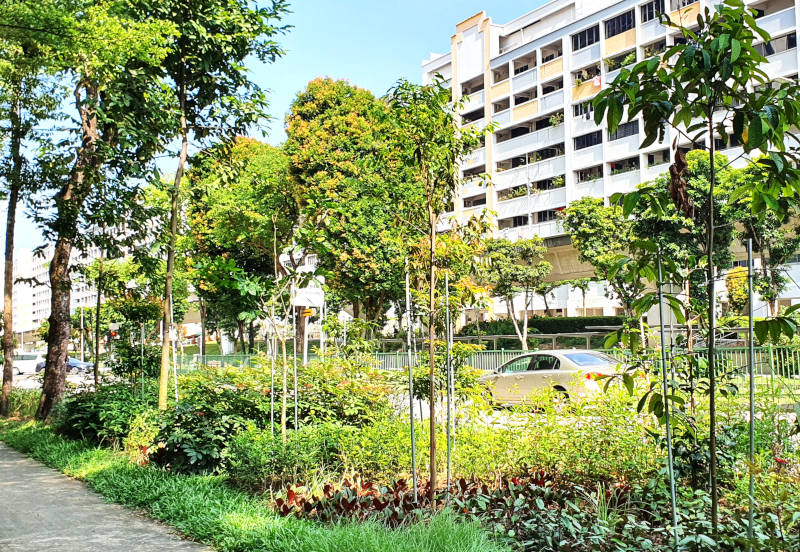
Nature Ways comprise complex multi-layered stratifications of tree canopies and a careful selection of biodiversity-attracting plants and are part of an important strategy for biodiversity conservation. The above shows the Choa Chu Kang Nature Way. Image: National Parks Board.
Ecological corridors are continuous networks of green spaces, such as parks, waterways, roadside greenery and naturalised drains that help to connect fragmented habitats across the city. They allow wildlife and biodiversity to move, adapt and thrive.
In linking key urban networks across Singapore, these could serve as ecological corridors that have multiple functions - they enhance the quality of habitats4, support climate resilience and enable us to continue to enjoy nature close to our homes.
Srilalitha: The idea of ecological corridors encourages us to look beyond individual parks and green spaces to creating larger interconnected networks and systems.
By adding and carefully curating plants along our roads and other paths, we allow for richer biodiversity and habitats to flourish, thereby connecting these paths as important ecological corridors. In doing so, we need to consciously design and create multifunctional shared spaces for humans and wildlife to co-exist together.
Singapore’s ecological corridors
Based on the findings from NParks (National Parks Board)’ terrestrial Ecological Profiling Exercise (EPE), which was completed as part of the Long-Term Plan Review in 2022, NParks has identified key ecological corridors linking core habitats. NParks has since established nature corridors and nature park networks along some of these identified ecological corridors.
Today, Singapore has four nature corridors, Bukit Batok, Clementi, Khatib and Lornie Nature Corridors. Nature Corridors can comprise nature parks, nature ways, park connectors and other trails. Learn more about Nature Corridors (opens in new tab) and the larger efforts to steward Singapore’s nature capital.
Tell us more about the objectives and scope of the study. What is the significance of the study?
Thomas: The study adds to other biodiversity research work in providing more in-depth crucial insights and data in understanding what is happening in the interplay between ecological elements and human activities. With more detailed insights, we can then develop effective strategies for humans and the natural ecosystem to co-exist well. Planning and design strategies will be developed for five types of ecological corridors across Singapore that are contextual to specific environments and conditions. A framework will also be developed for long-term monitoring of human activity and wildlife mobility within the ecological corridors.
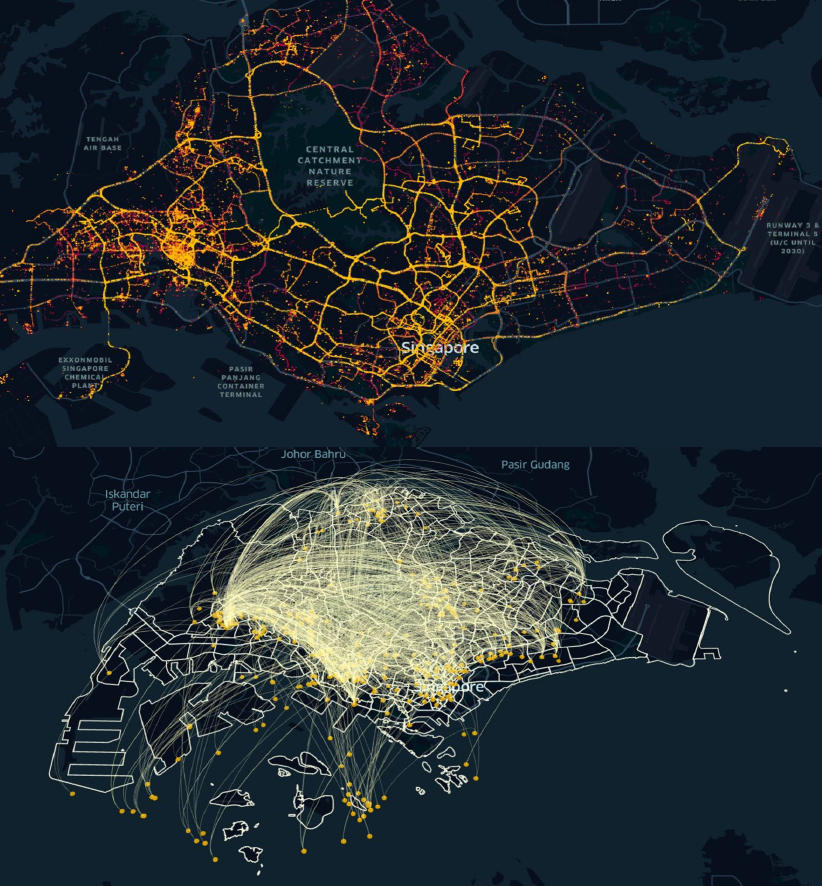
The study will map potential human activities and movements and their interactions with nature areas. The above maps show the movement of 1,000 people across Singapore based on raw GPS data (map above) and their potential trajectories over a month (map below). Image: SUTD and FCL.
Srilalitha: Given Singapore’s context as a land-scarce city state, creating ecological corridors within our urban landscape requires innovative solutions. We are linking naturalised drains and vertical greenery in a very dense cityscape and must balance many multiple functions and needs within the same spaces. This makes the study more significant in setting a new precedent on how to design ecological corridors in a high-density urban environment. This is useful not just for Singapore but for other high-density cities.
What are some interesting tools used in the study?
Srilalitha: In addition to utilising a range of established tools and methods to understand the wildlife and biodiversity in key areas, we are partnering with ETH Zurich to do environmental DNA (eDNA) surveys. Drone robotics are used to pick up and capture wildlife DNA from the trees and plants from the top. Animals typically leave remnants behind such as their saliva and the drone technology can collect such samples by sieving through the leaves and canopies.
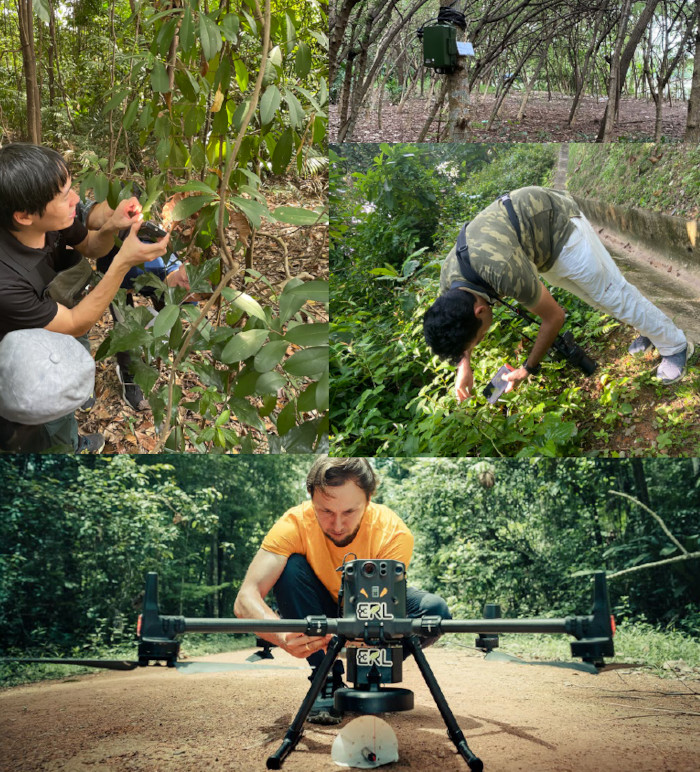
A variety of tools will be used to map biodiversity on ground and in the air through the use of environmental DNA (eDNA) surveys based on drone robotics. Image: SUTD and FCL.
This is a new methodology that is evolving. It complements ground surveys and provides us with more detailed insights in understanding the kind of biodiversity in an area. This is especially useful when you are surveying a dense forest. It allows us to map and understand the biodiversity of a forest without being physically there.
Moving forward, what should be our greening priorities for Singapore to continue to be a liveable city?
Srilalitha: Given Singapore’s limited resources and increasing needs, what is important in sustaining efforts is to have a robust and conscious decision-making process based on meaningful data and evidence. The more knowledge and insights you have, the more informed you will be on what is required. We also need to keep learning from our ongoing efforts in prioritising what is most important to focus on.
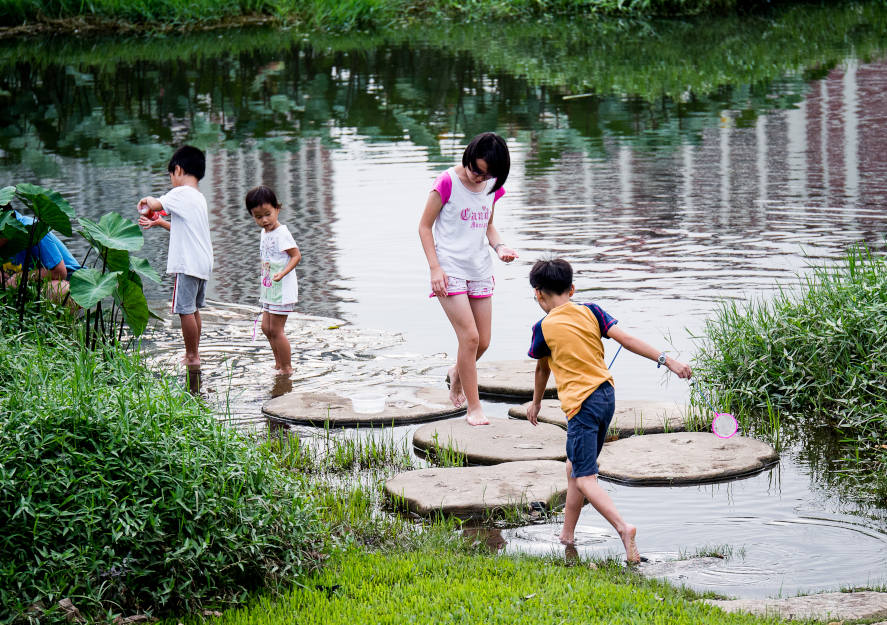
Kids playing at the Bishan-Ang Mo Kio Park.
How are Singaporeans’ relationships with nature evolving? How can we continue to inspire active stewardship in caring for and contributing to enhancing our natural environments?
Thomas: There is an increase in use and appreciation of parks and nature areas. The COVID-19 pandemic has heightened people’s connection to nature. A study reported that 63 per cent of respondents5 had visited parks they had never visited before during the pandemic, citing reasons such as exercise, nature appreciation, social interaction and wildlife observation. A 2022 survey6 by the Jane Woodall Institute also found that about one in five respondents had a more positive impression of wildlife during the pandemic.
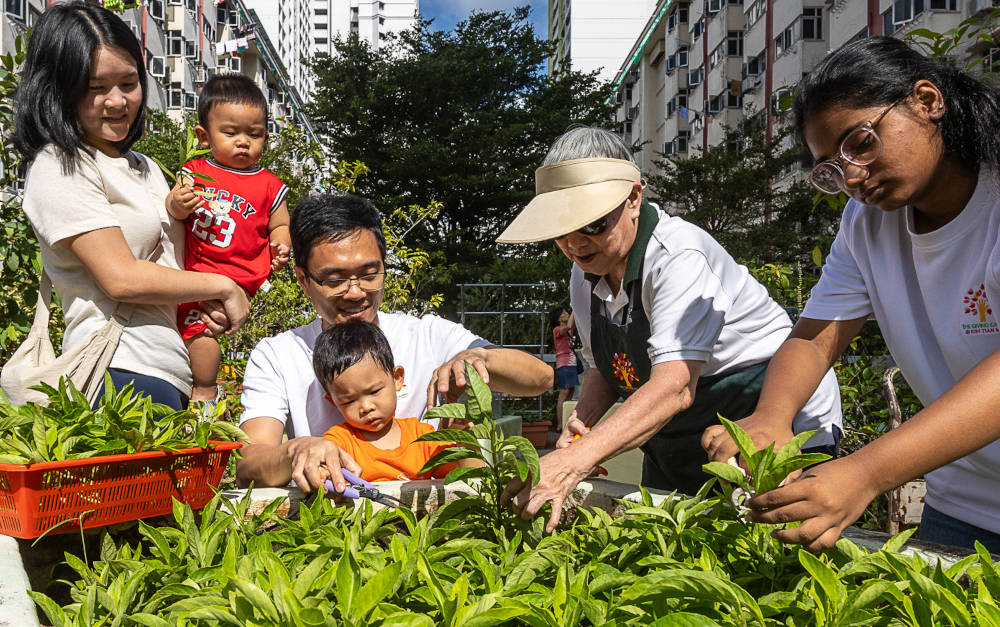
Residents and gardeners harvesting plants at the Giving Garden @ Kim Tian West. Image: National Parks Board.
To deepen our appreciation for nature, we should consciously make nature more visible, legible and participatory for Singaporeans to have meaningful interactions with our natural environments in everyday opportunities. It is also about empowering people to be able to contribute to and be part of shaping their natural environments and community gardens and be involved in co-designing green public spaces to make these their own.
Srilalitha: The interest in our natural environment is certainly growing. Beyond increased use of parks and green spaces, there are more active gardeners, bird watchers and green hobbyists. People are more aware and vocal about their green spaces. This is also an increased interest in citizen science, where people can share data and information about flora and fauna to contribute to research and our understanding of our natural environments. The challenge is in sustaining this interest and ensuring it is growing in the right direction.
Get involved
There are many ways for people to get involved to care for our natural environments. They can also create and lead their own community gardens. Find out more about the National Parks Board’s Community in Bloom programme and how else you can get involved here (opens in new tab).
1 Thomas Schroepfer is Full Professor of Architecture and Sustainable Design at the Singapore University of Technology and Design (SUTD). He is also the Director of the Singapore-ETH Centre Future Cities Laboratory.
2 Srilalitha Gopalakrishnan is Associate Director (Research) of the Future Cities Laboratory Global. She is a landscape architect and the immediate past President of the Singapore Institute of Landscape Architects.
3 The research study, “Urban Ecological Corridors: Multifunctional Corridors for People and Ecology” is funded by the Cities of Tomorrow R&D Programme. It is a three-year study from 2025 to 2028 and is led by SUTD (Prof Thomas Schroepfer) and Singapore-ETH Centre FCL Global (Dr Srilalitha Gopalakrishnan), together with Anuj Jain, Co-founder, BioSEA. It is supported by URA and the National Parks Board.
4 Singapore’s terrestrial habitats are fragmented due to urbanisation over the decades. The fragmentation of large continuous habitats into smaller isolated habitat patches makes it more challenging for native biodiversity to find food and shelter, and to reproduce. Unlike other countries with large hinterlands, Singapore has limited land. It is thus vital for the urban fabric to support and foster ecological connections between core habitats. Finding ways to connect them even as we develop can strengthen the resilience of these ecosystems.
5 Yap, K.K., Soh, M.C., Sia, A., Chin, W. J., Araib, S., Ang, W. P., Tan, P.Y. & Er, K.B (2022). The influence of the COVID-19 pandemic on the demand for different shades of green. People and Nature, 4, 505-518. 2022. The influence of the COVID‐19 pandemic on the demand for different shades of green - Yap - 2022 - People and Nature - Wiley Online Library (opens in new tab)
6 The survey polled 1,000 people aged 16 and above between 31 May and 9 June 2022.