
Placemaking
Can public spaces help a city build resilience?
30 September 2026
Public space champions Dr Chong Keng Hua of Nanyang Academy of Fine Arts, University of the Arts Singapore, and Dr Jeffrey Hou of Department of Architecture, National University of Singapore share how shared spaces can strengthen resilience and why giving people room to experiment, fail and shape these spaces themselves can foster a lasting sense of ownership.
Cities today face pressures from density and ageing to climate change. What role can public spaces play in responding to these challenges?
Jeffrey: As cities become denser, we need sufficient open space to support a growing population. With climate change and rising temperatures, public spaces can also function as places of refuge, and these do not necessarily have to be conventional outdoor parks or squares. They could include indoor and semi-outdoor, cool spaces where people can find relief from heat.
With ageing populations, we also need to think about how public spaces accommodate a much broader range of people. Universal design and accessibility become increasingly important.
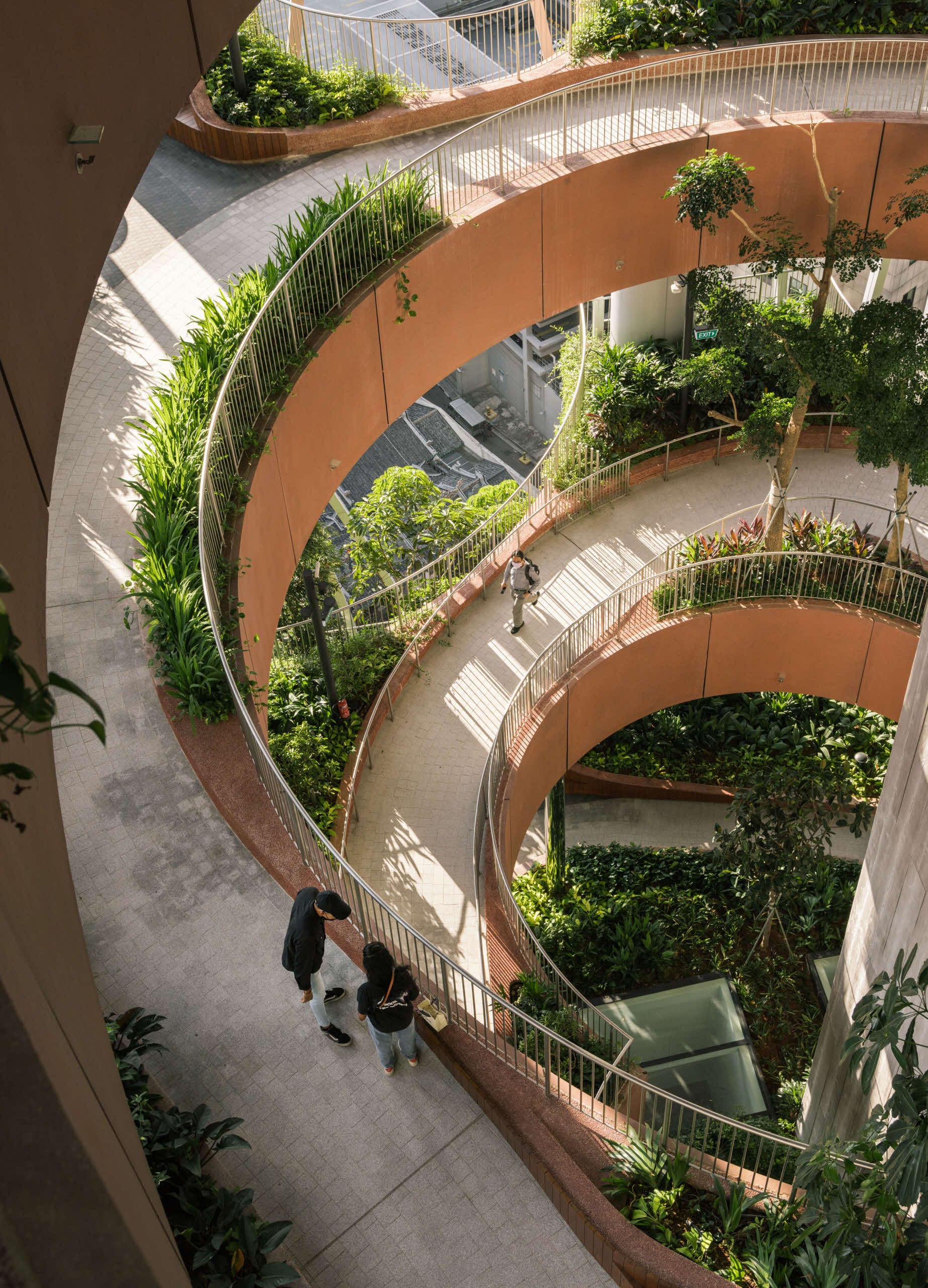
Green spaces can provide some respite from the heat as our city becomes denser. Photo credit: Finbarr Fallon.
Keng Hua: Singapore has done quite well in areas such as universal design and environmental resilience. But there are groups whose needs we are only beginning to understand more deeply. For example, when we work with persons living with dementia, people with autism or other special needs, we realise that accessibility is not simply about physical access.
Psychological and social safety matter too. For some people, even stepping out of their homes and entering a public space can be challenging. We need to think about their caregivers as well. Designing spaces where these groups feel psychologically and socially safe is an area where I think we can do more.
Does an inclusive public space have to work for everyone at the same time?
Keng Hua: Not necessarily. Rather than thinking that every public space must cater to everyone, perhaps the goal should be that everyone can find a public space that works for them.
Sometimes you want to be alone. Sometimes you want an intimate conversation with a friend. At other times, you want somewhere for a large group to gather, or a place where strangers can encounter one another.
The same space can also serve different people at different times perhaps Tai Chi or Qi Gong groups in the morning, and couples or families in the evening.
That means we need to be much clearer about the intent of different spaces and then assess whether their design and qualities produce the outcomes we want.
How important is citizen involvement in creating successful public spaces?
Jeffrey: It is extremely important. People tend to develop a stronger attachment to a public space when they have been involved in creating it. Their voice matters in the decisions that shape the place. But participation isn't simply about asking people for feedback. The harder part is figuring out how different views are translated into design and how differences are negotiated.
Different groups can want very different things from the same space. Bringing them into the design process gives them an opportunity to understand where others are coming from and find common ground.
Sometimes people are unhappy with a design not necessarily because of the design itself, but because they feel they were never part of the process that produced it.
Keng Hua: Building consensus is difficult. There will always be different groups wanting different things. This is why skilled facilitators and community designers are important. We need people who can navigate disagreements, bring different voices into the conversation and help communities find ways forward.
“People tend to develop a stronger attachment to a public space when they have been involved in creating it. Their voice matters in the decisions that shape the place.”— Jeffrey Hou
What are some effective ways to involve communities beyond simply consulting them?
Keng Hua: One thing we've learnt is that it helps to move from designing for people, to designing with people and even building with them.
In one project, we were working with three very different groups living around the same park, Pelatok Park at Changi Simei — residents of HDB (Housing & Development Board) flats, landed housing and condominiums. Each had a different view of what the park should be.
Instead of immediately putting everyone into one room, we first held workshops separately with the different groups. We then took them together on a learning journey to see other places in Singapore. After that, representatives came together for another workshop.
They began to see that despite their differences; there were things they all wanted.
More importantly, they didn't just design the space. They helped to build it. People contributed whatever resources they could. Some provided labour, while residents of landed homes opened their gates to store materials, provided water and offered places for people to rest.
The outcome wasn't simply a better physical space. The process itself brought communities together. Afterwards, they began organising activities such as Mid-Autumn Festival and Children's Day together.
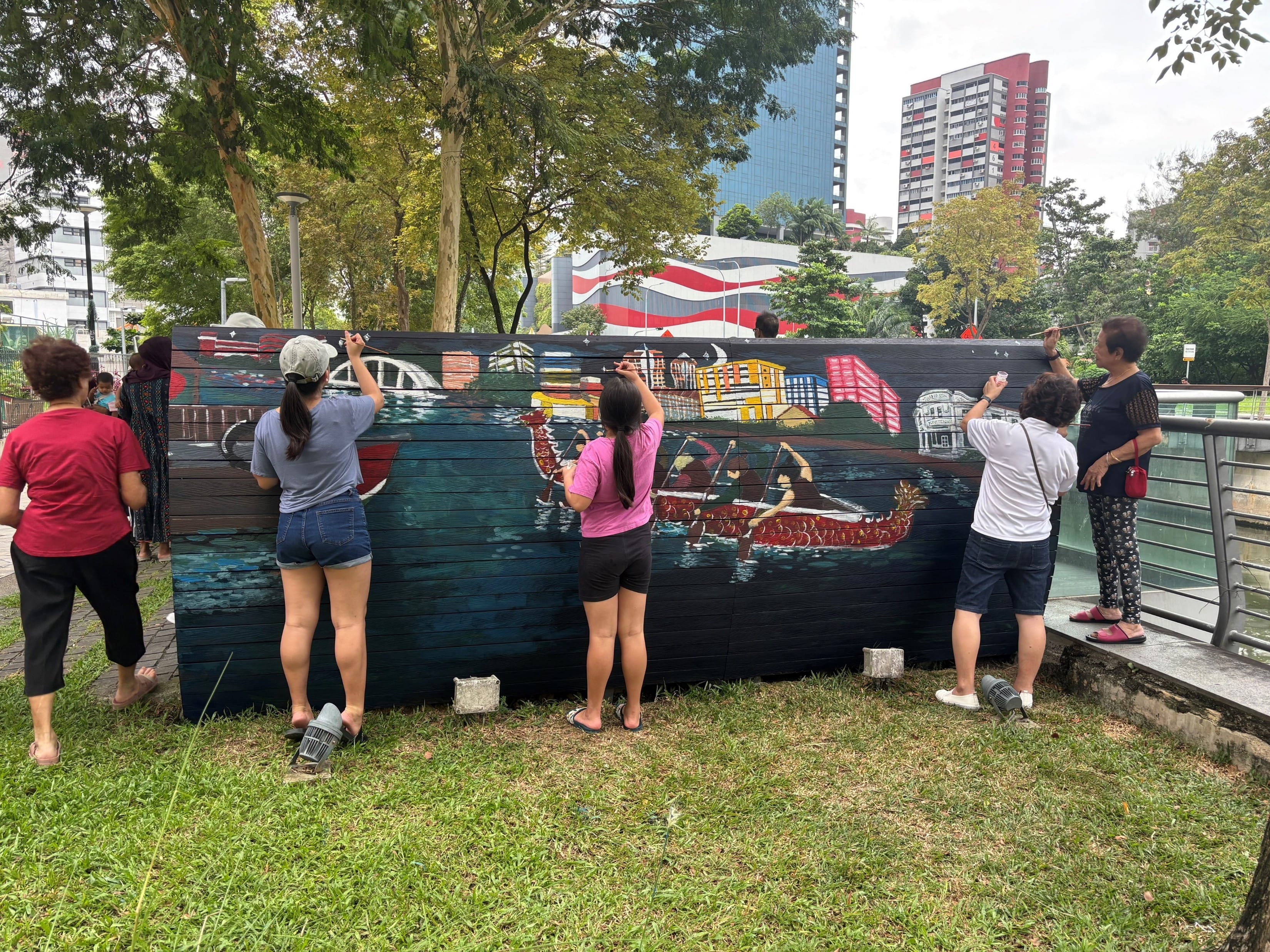
Residents coming together to add colour and life to a shared space at Jalan Berseh.
How do we move from community participation to genuine long-term ownership?
Keng Hua: You must start early — ideally, before the place is designed.
For the TOUCHpoint@AMK433 project, we spent a year working with residents before the space was completed. Through workshops, different task forces began forming around interests such as gardening, exercise, arts, calligraphy and photography.
When we eventually designed the place, we continued engaging these community champions. Their ideas were incorporated, so when the space was completed, they could genuinely say, “I helped design this. I contributed to it.”
Those champions then rallied other residents and continued running programmes themselves. By the time the physical space was ready, community ownership was already there.
This may appear resource-intensive at the beginning. But viewed over the longer term, it can require fewer resources because many programmes become community-led and self-sustaining.
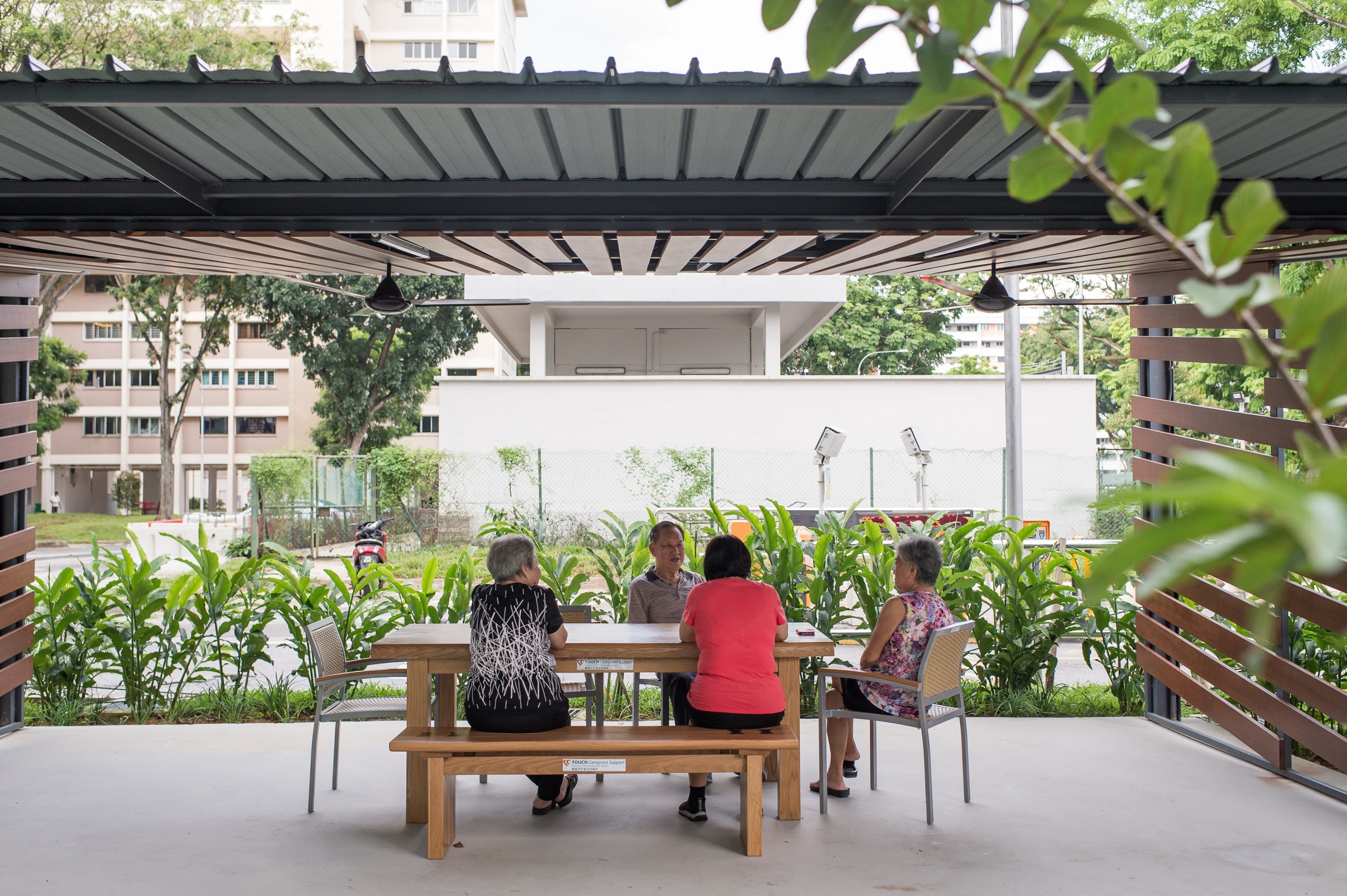
TOUCHpoint@AMK 433: Co-created with residents, a cosy space for the community to come together, stay active and connected. Photo credit: Ordinary Studios.
What does design contribute when communities have very different needs?
Jeffrey: Design can help communities find common ground. In a park project in Seattle's Chinatown International District, we were working with a multicultural community that included Chinese, Japanese and Filipino communities, among others. We first established a community group so that the different constituencies were represented in decision-making.
The challenge was how to create something that responded to different cultural traditions without allowing any one culture to dominate. The design eventually drew on themes that the communities shared — ideas such as abundance, performance and terraced landscapes. Instead of focusing only on what made the groups different, design helped reveal what they had in common.
The process was transparent and open, and people could see how the final design responded to the neighbourhood. So, design is not simply about producing the physical space. It can be a way of negotiating differences and building common ground.
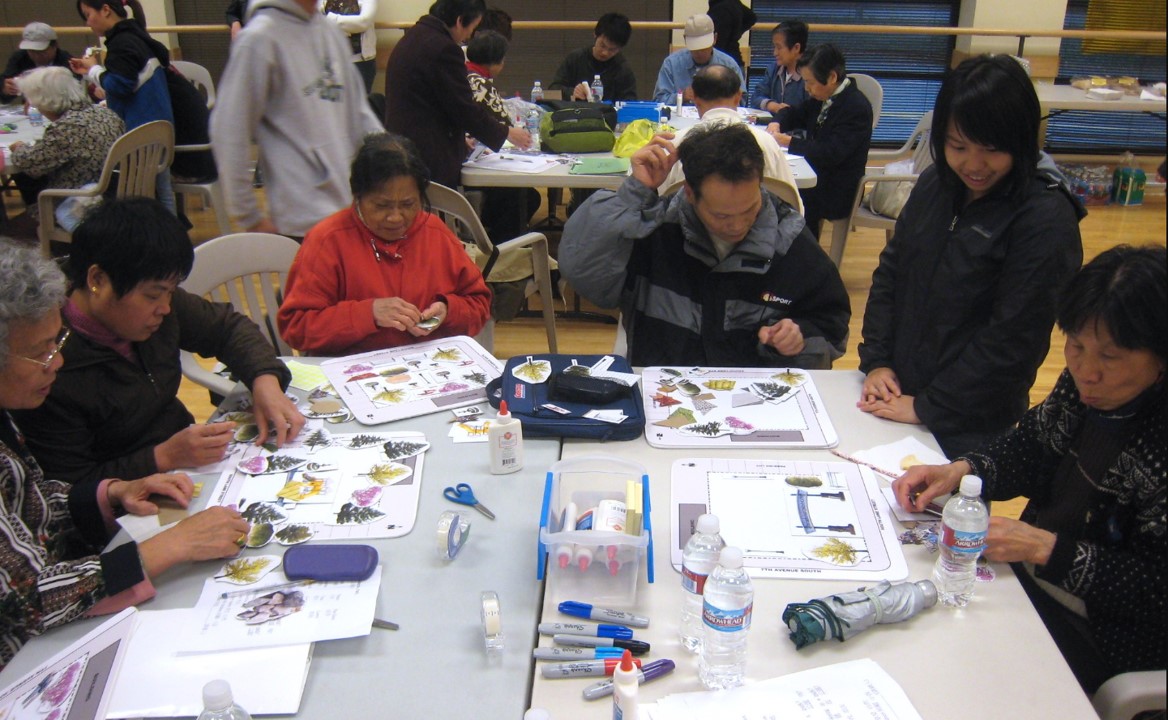
Bringing different voices together to shape a shared space in Seattle. Photo credit: Jeffrey Hou.
How can communities feel empowered to activate and manage public spaces themselves?
Keng Hua: One idea I've encountered recently is “creative messiness.” If everything must be perfectly ordered, proper and clean, you may actually lose some of the creativity and spontaneity that make public spaces interesting.
For public spaces to support many different activities, we need some tolerance for messiness. Residents need room to experiment, try something, perhaps fail, and then try again.
This can be difficult because authorities also receive complaints when things are not perfectly maintained or orderly. But perhaps we need to build a greater collective tolerance for this.
That doesn't mean compromising safety. Safety remains essential. But within those boundaries, can we loosen things up enough to give people greater agency over their public spaces?
Jeffrey: Agency is critical. If every idea requires approval from an authority, people's ability to experiment becomes limited. We need to create room for people to try things. Capacity is built through experimentation — we learn from mistakes as well as successes.
So beyond involving people in designing a place, the next step is giving them enough agency to continue shaping it afterwards.
What is still missing from the way we think about public spaces?
Keng Hua: One area I think we need to consider much more seriously is the role of public spaces in community resilience.
We face increasingly complex threats, from climate change and health crises to other forms of disruption. The question is whether our citizens and communities are sufficiently connected and prepared to come together when something happens.
Public spaces can help us build those relationships during peacetime. People become accustomed to gathering, organising events, running programmes and working with one another.
Then, when a crisis comes, those relationships already exist. People know one another. They know how to organise and rally their communities.
So, perhaps we should see public spaces not only as everyday amenities, but as part of our social infrastructure for resilience.
“If everything must be perfectly ordered, proper and clean, you may actually lose some of the creativity and spontaneity that make public spaces interesting.”— Keng Hua
Jeffrey: We saw some of this during the COVID-19 pandemic, when public spaces became places for mutual aid and people organised activities to help one another.
Looking further ahead, technology will become even more embedded in our lives. One risk is that we lose some of the human connections we currently take for granted.
Public spaces can continue to provide places where those connections are nurtured, where people interact, organise mutual aid and build the relationships that ultimately make communities resilient.
Resilience isn't only built through physical infrastructure. It is also built through civic action and human connection.
If there is one principle cities should carry forward in designing public spaces for the future, what would it be?
Keng Hua: We need to recognise that a public space is more than a physical space. Arts, culture and heritage can bring people together and help create a shared identity.
Public spaces are free and accessible platforms where people can come out of their digital worlds and meet one another physically. That human dimension will become increasingly important.
Ultimately, the public spaces we create today can help build the relationships and resilience we will need tomorrow.
About the profiles
Dr Jeffrey Hou, FASLA, is Provost’s Chair, Professor and Head of the Department of Architecture, National University of Singapore. For over two decades, he has been a pioneering scholar on public space and democracy, community design, and civic engagement. In a career that spans the Pacific, he has worked with indigenous tribes, farmers, fishers, and villagers in Asia and inner-city immigrant youths and elders in North American cities on projects ranging from the conservation of wildlife habitats to bottom-up placemaking.
Professor Chong Keng Hua is Provost and Vice President (Academic) at Nanyang Academy of Fine Arts, University of the Arts Singapore (NAFA-UAS), and Founding Partner of COLOURS: Collectively Ours, a design consultancy specialising in public space and social impact. His research on ageing, health and data-driven collaborative design has contributed significantly to the field of social architecture and community design. Beyond academia, Prof. Chong actively translates research into design interventions, garnering multiple international awards for their innovative and impactful solutions to eldercare and integration of wellness into community spaces.