
Master Plan 2025
Sustaining our love for our built heritage
14 July 2025
This article has been migrated from an earlier version of the site and may display formatting inconsistencies.
Communities and building owners can do more for our built heritage by sharing personal stories of buildings and adopting the robust conservation management plan to manage conserved projects, suggests Professor Ho Puay Peng, Head of National University of Singapore’s Department of Architecture, on how we can deepen our conservation efforts.
Share with us your background that has led you to your current role.
Puay Peng: I chose to study architecture as it offered a wide-ranging creative discipline that could expand my interest in everyday urbanism and city-making. The potential for architecture to enhance our daily lives drew me to the practice. My father was also an architect.
It was when I was doing my PhD research with the University of London that I became more interested in art and architecture history. Being Adviser to conservation projects in Hong Kong and Singapore and getting involved in shaping conservation policies had deepened my passion for the built heritage over the last two decades.
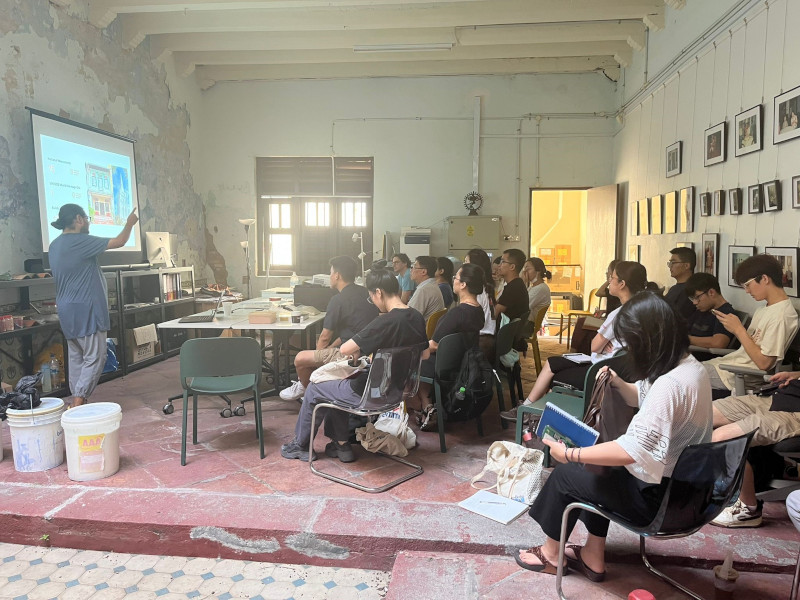
A Master of Arts in Architectural Conservation programme class at the Architectural Conservation living laboratory (ArClab), at 141 Neil Road, one of the oldest shophouses in Singapore, serving as a research and training centre for sustainable management of the historic environment.
In my current role, I hope to strengthen conservation education in Singapore. That is why we introduced the Master of Arts in Architectural Conservation programme in 20171 to build up more critical expertise in building conservation and related fields. I also hope to build up a stronger ecosystem of professionals and community champions in our built heritage and conservation efforts.
Why is it important to build up more community interest and participation in conservation and how can we do it?
Puay Peng: Strong and active community interest and participation is important in supporting and advocating for critical conservation efforts beyond just retaining crucial historic buildings.
Conservation efforts involve a wider spectrum. For example, it includes understanding our local cultures, contexts and history, delving deeper into learning more about the intricacies of building conservation and finding creative ways to promote and keep our heritage alive. This often needs active participation and involvement of local communities.
Our built heritage is an integral part of our daily lives and is closely tied to our personal and collective identities. With this perspective, I hope to see conversations about conservation go beyond just saving and retaining buildings to becoming more multi-faceted and personal.
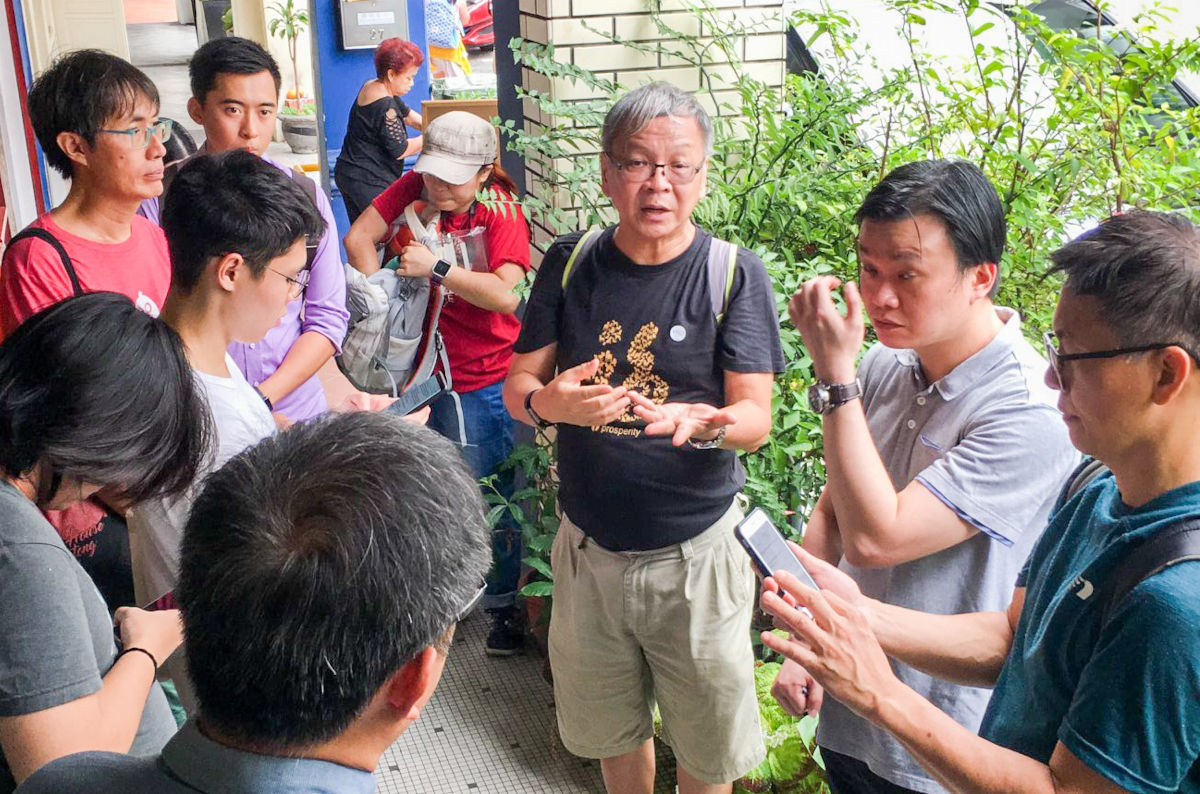
An example of the ecosystem of stakeholders we need to build up that includes the community leading and sharing stories about our built heritage - Chinatown tour led by resident and blogger, Victor Yue. Image: Heritage Society of Singapore.
Learning about conservation should start from our young and become more accessible. Anyone and everyone should be able to learn more about conservation and deepen their knowledge and skills at any point in their lives. For our conservation master’s programme, it should not just be for graduate and geography students. I hope to attract a wider group of students from different walks of life. I recall in Hong Kong that some of the conservation students are journalists.
A city that cherishes it past
Conserving built heritage is an integral part of our planning process. Beyond conservation, there are also different ways to celebrate and recall our heritage. The Heritage and Identity Plan is an initiative to identify, retain and enhance heritage and identity areas, nodes, corridors and buildings across Singapore. It outlines their potential to contribute to the layered history of our island home and keeps the meanings and memories of places alive. This will enhance what has been physically kept and help build a cohesive sense of ownership. Learn more about Singapore’s built heritage efforts.
Singapore has come a long way in making conservation an integral part of planning efforts and having conserved over 7,200 buildings. What else can we do to deepen our conservation efforts?
Puay Peng: I believe the industry can move towards developing more methodical conservation strategies in assessing and managing conservation projects. There are several tools and methodologies we can learn and adapt from. One of them is the Heritage Impact Assessment (HIA) which was introduced in 2022 to complement and support the current systematic approach in assessing the potential impact of developments. The HIA provides a robust framework to help assess the relationship of the conserved building with the surrounding neighbourhood to ensure that the heritage values of historic buildings are retained.
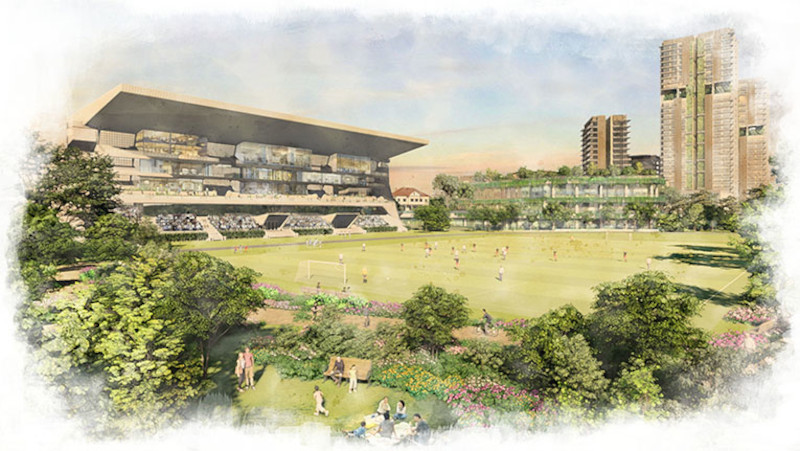
The 2024 HIA study had contributed to guiding the future of the Bukit Timah Turf City as a mixed-use residential area. It will have a variety of public spaces including the prominent green space in front of the Grandstand (shown above), which is twice the size of the Padang.
Beyond the HIA, for conserved buildings, developing the conservation management plan is useful as a rational and scientific strategy to help identify and establish which parts of the conserved building to retain.
In Hong Kong, I’ve been involved in about 60 conservation projects that had adopted conservation management plans. For the successful adaption of the historic PMQ (formerly the Police Married Quarters) into a mixed-use arts and design venue, three conservation management plans were developed. The first one was done to assess the conservation merits of the site, the second one was done by the tenderers in submitting their proposals for the site and the third one was done just before construction works.
Heritage Impact Assessment (HIA) framework
The HIA framework was introduced in 2022 to complement the systematic and consultative conservation approach where pre-development studies of existing sites are done to evaluate the significance of Singapore’s built heritage and future development needs. Under the Heritage Impact Assessment (HIA) framework, large-scale public projects that are likely to cause major impact to significant heritage sites may be required to carry out more detailed heritage studies to identify key heritage elements that should be kept and ways to redevelop sites sensitively. To date, HIA studies have been carried out for the Bukit Timah Turf City (2024) and Club (2022) sites and the former Police Academy at Mount Pleasant (2021). Learn more about the HIA framework.
What is the difference between the Heritage Impact Assessment and the conservation management plan?
Puay Peng: There are some overlaps between the two but essentially, the Heritage Impact Assessment helps us to assess and determine the significance of a building and its impact and relationship between historic buildings and new developments and vice versa.
Heritage conservation seeks to conserve objects, buildings, traditions, or natural heritage, that mean something to people. People must decide what they want to do with these memories and identities and how to transmit these to the next generation. It is for the next generation to decide whether to retain a building.
After you decide that the building is significant and should be retained, then the conservation management plan comes in as a more detailed strategy in determining what elements of the building to keep. Do you keep the entire building? Do you just keep the outside of the building and the interior or parts of the building? In addition, how do you deal with new buildings within the historic site?
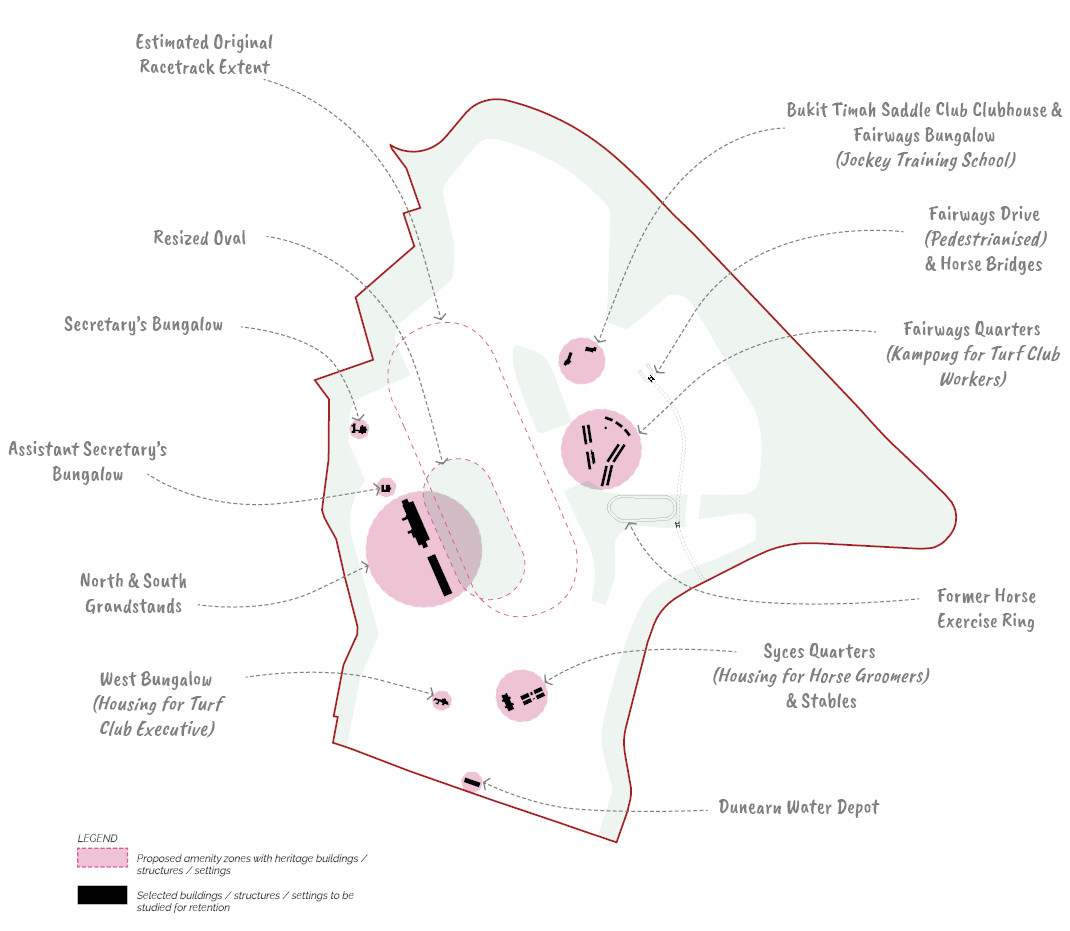
The 2024 HIA study had contributed to guiding the future of the Bukit Timah Turf City as a mixed-use residential area. The image above shows the key amenity zones planned and the selected buildings/structures that will be studied for retention.
Of all the tools available, which is the most important one to help capture and share stories and memories about our built heritage?
Puay Peng: The most important one is on how to engage the community. I am currently involved in the redevelopment of Shaw Towers together with the National Heritage Board. This project could potentially serve as a test bed for how the community can get involved in sharing and sustaining buildings’ stories and memories. Built in the 1970s, Shaw Towers along Beach Road housed some of Singapore’s earliest cinemas.
Building owners and stakeholders are encouraged to explore creative heritage interpretations, which are different ways to share stories about our built heritage. What makes a good heritage interpretation?
Puay Peng: A successful heritage interpretation is one that not only shares the official historical narrative about the building but offers richer and more varied opportunities for people to explore and learn more about its heritage, even if the building is no longer standing, or even if the physical building is not retained.
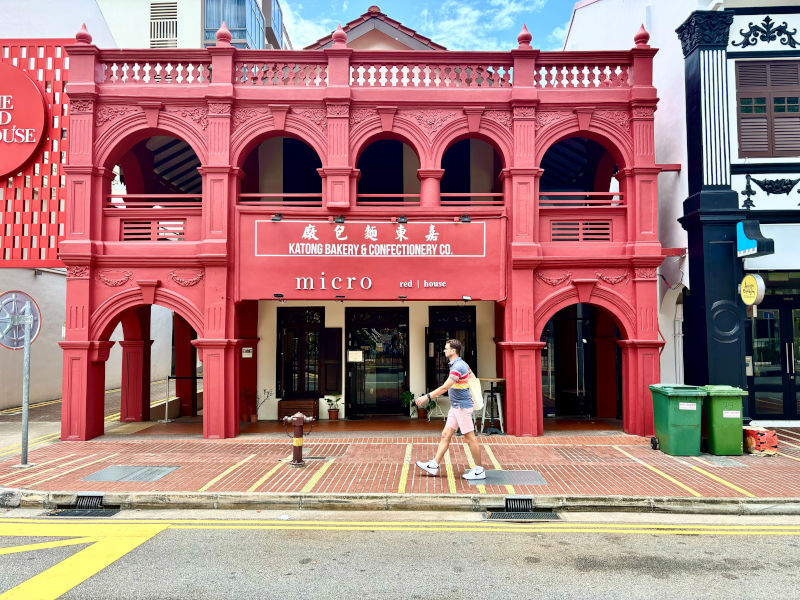
The Red House at 75 East Coast Road continues to celebrate the social memories of the old Katong Bakery by retaining the same use as a bakery and dining space. Stories about the building are shared through a heritage storyboard and walking tours.
For example, for Shaw Towers, while we can share the official history about the building and the Beach Road area, but what if people also want to learn more about the life within the building and around it? Some of us may remember and have fond memories of the two cinemas (Prince and Jade) at Shaw Towers that opened in 1977.
The heritage interpretation options should provide avenues for people to access additional insights that may not be provided in the official narrative. Beyond sharing from official sources, we should offer ways for people to share their own personal stories about the building and feel empowered to make the building’s stories their own.
Heritage Interpretation
Heritage interpretation reflects ways for building owners, developers and stakeholders to share the historical, architectural, cultural and social meanings and heritage values of buildings and sites in actively sustaining interest and engage communities on Singapore’s built heritage. These could be through putting up heritage storyboards, organising relevant talks, publishing books, heritage multimedia contents etc. Check out the heritage interpretation efforts of 16 buildings in Singapore.
URA planners and architects have developed a thematic framework to map and assess sites of heritage significance across time periods that reflect Singapore’s development over the years. Why is this important?
Puay Peng: I think it is fantastic that planners and architects are now looking at larger themes and narratives in assessing sites and buildings that contribute to Singapore’s development.
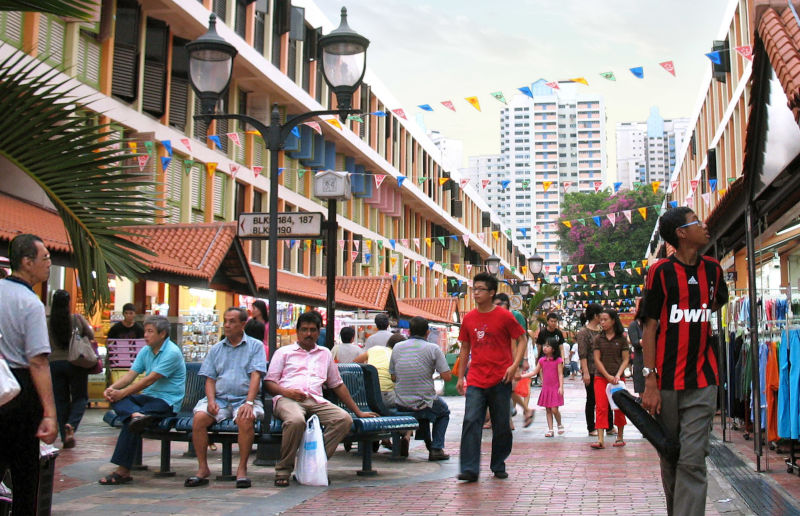
The thematic framework includes public housing, covering key areas of significance such as the Toa Payoh town centre shown above, one of the earliest public housing estates in Singapore.
I don't believe that everything old must be kept. When you want to keep something, a lot of people would give a lot of different reasons, but those reasons may not necessarily be the most important reasons. Buildings come and go, and each have their different lifespans. We can also recreate the building in the digital medium. It's the social aspects and the meaning we attach to buildings that I'm more interested in.
Thematic framework
As part of the Draft Master Plan 2025 Review, beyond the conservation of individual buildings, URA planners and architects are delving deeper to develop an overall thematic framework to map and assess sites of heritage significance across time periods from 1800s till today, covering four key themes - economy (e.g. industry, infrastructure & utility), defence, housing (government staff housing and public housing) and social (e.g. healthcare, schools). This will provide a more robust lens in evaluating and assessing historical sites and buildings in light of important broader narratives shaping Singapore’s development over the years.
What else do you hope to see for the future of our conservation journey?
Puay Peng: I hope to see lower or zero carbon conserved buildings. We can do more to minimise our buildings’ environmental impact by reducing carbon emissions from their construction, operation and potential demolition. When a building is built, a lot of carbon is generated. If you tear it down, the carbon will be lost.
1 The Master of Arts in Architectural Conservation (MAArC) is an advanced programme that offers a unique perspective on diverse Asian cultures by providing students with comprehensive knowledge and essential hands-on training and experience to develop skills for a range of careers in historic building conservation and related fields. You may find out more information about the programme here (opens in new tab).
About Professor Ho Puay Peng
Professor Ho holds the UNESCO Chair on Architectural Heritage Conservation and Management in Asia. Having close to 30 years of experience in the academia, Puay Peng’s main research interests are in architectural history and conservation practices, and how the knowledge can be translated in teaching and practice. Prior to joining NUS in 2017, Puay Peng was Professor of Architecture and served as Director of School of Architecture and University Dean of Students at The Chinese University of Hong Kong. Sustaining his research is the quest to understand religious culture and its architectural forms. His main focus is Buddhist architecture and ritual of medieval China. He is a conservation consultant, architect and adviser to some 100 conservation projects in Hong Kong and Singapore since 2003, including PMQ, Haw Par Villa, Comix Homebase, Oil Street Art Space, Court of Final Appeal, and New Campus for Chicago University Booth School.