
Earthworks, Retaining Walls, and Boundary Walls
Check the guidelines relating to earthworks, retaining walls, and boundary walls for agriculture developments
Last updated on 8 June 2026
Earthworks
Earthworks are defined as any operations or works in, on, or over land which result in substantial modification to the existing ground terrain, land form, or slope. These include excavation, formation of a new slope or embankment, and cut and fill operations.
Extensive earthworks are discouraged as it may change the existing terrain. Earthworks may also result in the building of high retaining walls that mar the streetscape and have adverse impacts on the surrounding areas. Earthworks on any development site, where necessary, shall be minimised.
All earthworks (i.e. earth cut or earth fill) will require endorsement and clearances from the lessor, SFA, and PUB.
Planning permission is required if earthworks cause the level of any point in the land to be more than 1.5 metres above the lower of the following:
the level of that point in the land at the time when the land was leased or agreed to be leased by the State or statutory body; or
the level of any point at the abutting edge of abutting land
Earthworks on a smaller scale than the above may qualify for the agriculture plan lodgment scheme.
The digging of wells and ponds on agriculture land is authorised and do not require planning permission.
Earthworks are generally not encouraged, except in the following circumstances:
When the proposed earthworks are to match the existing platform levels of the neighbouring sites;
When the sites are on undulating or sloping terrain, with large differences in platform levels within the site, or between the site and the road.
Earthworks within the buildable area (i.e. outside the building setback area)
Earthworks within the buildable area of more than 1.5m are subject to evaluation depending on merits.
Earthworks within the entire development site
Earthfill involving the entire development site may only be considered if the proposed earthworks are required to meet the technical requirements of PUB. Such earthfill may be allowed up to PUB Minimum Platform Level (MPL)1 .
1 Minimum Platform Level (MPL): The minimum 1st storey level to be provided within the site. The MPL is determined by the Public Utilities Board (PUB).
Retaining & Boundary Walls
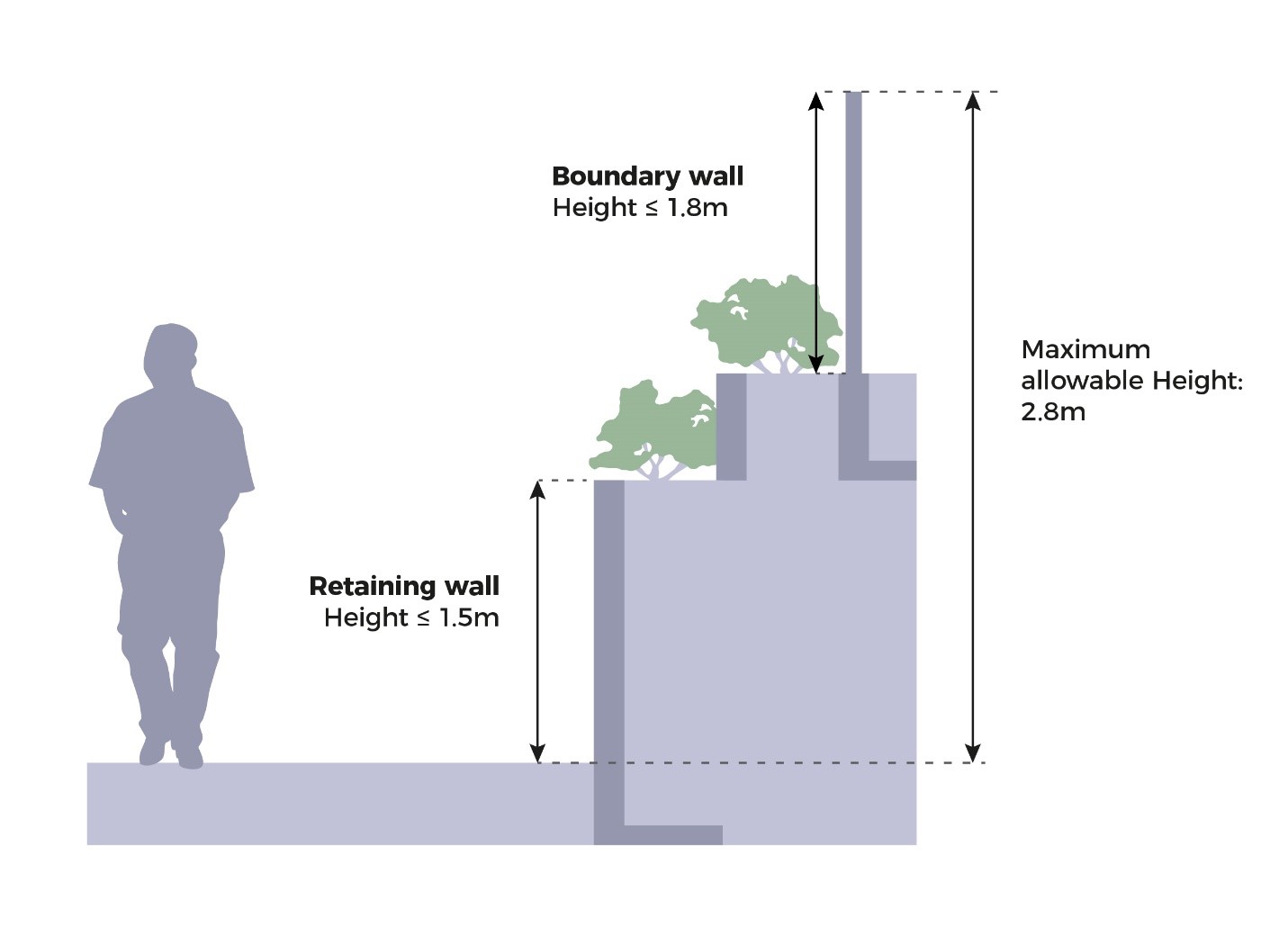
Allowable Height of Retaining and Boundary Walls
The maximum allowable height for boundary walls is 1.8m.
High retaining walls shall be avoided wherever possible, particularly for small in-fill plots. If they have to be built and can be allowed, they shall meet the following requirements:
the height shall be less than 1.5m;
retaining walls higher than 1.5m may be considered because of site constraints and the need for extensive excavation;
the total visible height of the solid boundary-cum-retaining wall shall not exceed 2.8m, of which the solid boundary wall shall not exceed 1.8m.
If the retaining walls are to meet the MPL requirement stipulated by PUB for drainage purposes, the retaining walls along the site boundaries (except along boundaries that abut foreshore, roads, or waterbodies with drainage reserve equal to or more than 17.5m wide) need not be tiered as these are transitory measures, pending the redevelopment of the neighbouring land to the same MPL.