
Circulars
GUIDELINES FOR THE COMMUNITY/SPORTS FACILITIES SCHEME
1 September 2026
Tags
Development Control
Circular No: URA/PB/2026/10-DCG
Our Ref: DC/ADMIN/CIRCULAR/PB_26
Date: 1 September 2026
CIRCULAR TO PROFESSIONAL INSTITUTES
This circular supersedes the previous Circular: URA/PB/2020/01-DCG dated 21 Feb 2020 on “Guidelines for the Community/Sports Facilities Scheme”.
GUIDELINES FOR THE COMMUNITY/SPORTS FACILITIES SCHEME
Who should know
Architects, developers, building owners, community service providers1, national sports associations and childcare centre operators.
Effective date
With immediate effect from 21 August 2026 and to remain valid until 21 August 2029.
Background
1. The Community/Sports Facilities Scheme (CSFS) facilitates the co-location of compatible community and sports uses with highly accessible commercial developments for mutual benefit. Under the CSFS, bonus Gross Floor Area (GFA) for community and/or sports uses (hereinafter referred to as the “CSFS space”) is allowed over and above the maximum permissible GFA under the Master Plan for highly accessible commercial developments2.
2. To qualify for the CSFS, the community/sports uses should be non-profit in nature and endorsed by the relevant championing government agency. The activities carried out within the CSFS space should have a predominant public outreach component that directly serves the public.
Updates to CSFS guidelines
3. Since its introduction in 2003, the CSFS has benefited a wide range of community/sports users, including public libraries and a variety of non-profit community service providers. As part of agencies’ regular review of the scheme, the following updates are being made:
Cessation of support for new childcare centres
(a) Given the increase in availability and accessibility of government-supported childcare centres, new childcare centres are no longer endorsed by the Early Childhood Development Agency (ECDA) as an allowable community use under the CSFS. Existing childcare centres previously approved under the CSFS will continue to be supported by ECDA. To address demand for childcare services, ECDA will continually plan for new childcare centres in HDB BTO developments and selected Government Land Sales (GLS) sites to ensure that childcare centres remain accessible and affordable.
Formalisation of MCCY/NAC-endorsed arts uses
(b) Arts uses with strong community outreach components and endorsed by the National Arts Council (NAC) and the Ministry of Culture, Community and Youth (MCCY) have been supported under the CSFS on a case-by case basis3. This update formalises arts uses as an allowable community use under the CSFS. Arts uses that are non-profit and have a strong community outreach component should seek MCCY/NAC's endorsement if they wish to seek approval under the CSFS.
4. The details of the revised CSFS guidelines are summarised in Appendix 1. The CSFS guidelines will apply to all new applications for community/sport use submitted on or after the effective date.
5. Appendix 2 gives an overview of the parties responsible for ensuring that the community/sports space continues to be used for the approved purpose. Appendices 3A, and 3B are Letters of Undertaking to be submitted by various community and sports users to URA. Appendix 4 charts out the procedure required to obtain approval for the CSFS.
6. I would appreciate it if you could convey the contents of this circular to the relevant members of your organisation. We have updated the same in the Development Control Handbooks (opens in new tab). You are advised to refer to these Handbooks for the most updated guidelines.
7. For other information on the master plan, urban design guidelines, private property use and approval, car park locations and availability, private residential property transactions, and conservation areas and buildings, use URA SPACE (opens in new tab) (Service Portal and Community e-Services). This is an online portal packed with useful data and visualisation to help building professionals, business operators and the general public in their decision-making. It consolidates detailed information on land use and private property into a one-stop platform presented on geospatial maps. For feedback or enquiries, please email (opens in new tab) us.
Thank you.
GOH CHIN CHIN (MS)
GROUP DIRECTOR (DEVELOPMENT CONTROL)
for CHIEF EXECUTIVE OFFICER
URBAN REDEVELOPMENT AUTHORITY
1 Community service providers can be government agencies, Social Service Agencies (SSAs), and Non-Governmental Organisations (NGOs).
2 Bonus Gross Floor Area (GFA) approved under the CSFS is subject to an overall cap of 10% of the maximum permissible GFA for the site allowed under the Master Plan or 2,000sqm (whichever is lower), and will not form the future development potential of the site upon redevelopment. If payable, Land Betterment Charge (LBC) will be levied for the bonus GFA, based on the approved community or sports use.
3 Examples include Singapore Ballet Limited at Bugis+ and The Ground Co. at One Holland Village.
APPENDIX 1
PLANNING GUIDELINES FOR THE COMMUNITY/SPORTS FACILITIES SCHEME
1. The detailed guidelines are as follows:
Table 1: Planning Guidelines for the Community/Sports Facilities Scheme
S/No | Item | Guidelines |
1 | Bonus GFA allowed over and above Master Plan | Under the CSFS, bonus Gross Floor Area (GFA) for the community and sports uses (CSFS space) is subject to an overall cap of 10% of the maximum permissible GFA for the site allowed under the Master Plan1 or 2,000sqm (whichever is lower). If the site qualifies for multiple bonus GFA incentive schemes, the cumulative bonus GFA should be kept within the overall budget of 10% above the Master Plan Gross Plot Ratio (GPR). The additional GFA approved under the CSFS for the community and/or sports use will not form the future development potential of the site upon redevelopment. |
2 | Allowable community and sports uses | The proposed community and sports uses should primarily be intended for public or community use and not profit-driven. In addition, the CSFS space should be predominantly used for community outreach use (e.g. community engagement activities and provision for social services) and any space for ancillary uses (e.g. offices) should be kept to a maximum of 40% of total GFA of the CSFS space. Sports facilities must be endorsed and supported by the Sport Singapore (SportSG). For community uses, they are restricted to the list of social and community services listed below, and must be endorsed and supported by the relevant championing government Ministry and agencies outlined below. Community Uses Only the following categories of social and community services that are compatible in a commercial development can qualify under the CSFS: i. Disability services Disability services, under the purview of the Ministry of Social and Family Development (MSF), refer to services and programmes in place for people with disabilities to help them integrate into society with the support from their families and caregivers. Disability services include day activity centres that provide training in daily living skills; social skills development; and vocational abilities development. The disability services operator must be endorsed by MSF/National Council of Social Service (NCSS) for the CSFS. ii. Family services Family services, under the purview of the MSF, refer to services to the public on family-related matters. Family services include individual and family counselling; family life education; parenting advice, talks or seminars; family finances or financial counselling; and marriage counselling (non-commercial). The family services operator must be endorsed by MSF/NCSS for the CSFS. iii. Eldercare services Eldercare services refer to services that: a) Facilitate the elderly to age in place in the community; b) Enrich their lives by engaging the elderly and promote their continued participation in the community; and c) Provide support to the elderly, and their caregiver. The services may include active ageing programmes, befriending, information & referral, custodial day care, respite care and community rehabilitation. These services must be endorsed by Ageing Planning Office (MOH) to have satisfied their policy objectives and requirements. iv. Volunteerism and volunteer-based programmes These programmes refer to those that: a) Reach out, recruit, train, and/or deploy volunteers to serve the social sector (i.e. volunteers in arts and sports, for example would not qualify); and b) Provide services that are long-term and/or on-going basis and not on a project basis. The need for the space for volunteer-based programmes should be clearly justified and the programme endorsed by MSF/NCSS. v. Community Libraries Community libraries, under the purview of the National Library Board (NLB), provide the public easy access to information to promote a knowledgeable and engaged society. vi. Community Clubs Community Clubs, under the purview of the People’s Association (PA), provide a venue where citizens can connect for community bonding, carry out volunteer work, and promote active citizenry and multiracial harmony. vii. Arts uses Arts uses, under the purview of the National Arts Council (NAC), refer to arts programmes for community outreach and engagement. The need for the space for these arts uses should be clearly justified and endorsed by MCCY/NAC. viii. Other uses URA would evaluate other deserving proposals on a case-by-case basis. The proposal should be endorsed by a suitable championing government agency acceptable to URA before an application is made to URA for evaluation. Sports Uses For sports uses, the CSFS is only applicable to selected sports facilities that are not provided for by the public or private sector (e.g. competition ice-skating rink). Other types of sports facilities that are currently provided for (e.g. bowling alleys) would not qualify. Uses That Are Not Supported Pure office, religious uses, and recreational clubs are not supported. ECDA will no longer support new childcare centres under the CSFS. For existing childcare centres previously approved under the CSFS, ECDA will continue to support these provided the incumbent operator continues satisfactory operations complying with ECDA’s qualifying criteria. Any request for expansion of the existing premises or increase in GFA will not be supported by ECDA under the CSFS. Incumbent operators currently approved on temporary permission should seek ECDA’s support before making an application to URA for the extension of the temporary permission. |
3 | Replacement of community / sports user | In the event that the original user of the CSFS space no longer requires the CSFS space or fails to maintain the endorsement of the relevant championing government agency, it must immediately cease to occupy and use the CSFS space. The owner of the CSFS space will work together with the championing government agency to identify a replacement community or sports user to occupy the CSFS space. The replacement user would similarly have to be endorsed by the relevant championing government agency and meet the guidelines stated in this Appendix. Appendix 2 shows the parties responsible for ensuring that the use of the CSFS space continues for the approved purpose. The community or sports user and the owner of the CSFS space shall seek approval from the Competent Authority on any change of user or change in the usage of the CSFS space. If no replacement community or sports user can be found, the vacated CSFS space should either be removed or the overall GFA of the development should be reduced to the allowable maximum GFA permissible under the Master Plan. The vacated CSFS space cannot be converted to other uses. |
4 | Ancillary Uses | Ancillary uses (e.g. ancillary office) to support the community or sports uses within the CSFS space can be allowed up to a maximum of 40% of the total GFA of the CSFS space. Any commercial uses, if permitted by URA, within the CSFS space (e.g. cafes, souvenir or gift shops) will be computed as part of the overall commercial quantum of the development. |
5 | Eligible Commercial Developments | The co-location of community or sports uses under the CSFS is intended primarily for commercial retail developments which are highly accessible. The commercial development that can be considered for the community and/or sports uses under the CSFS must be in close proximity to transport nodes or town centres / neighbourhood centres, and the additional CSFS space can be supported from the land use and transport planning points of view. Community and sports uses under the CSFS would not be supported in hotel developments as the resultant synergies are limited. Community and sports uses under the CSFS in office developments will only be considered if it is clear that the use has clear synergies with the office development and caters to the needs of the office workers. |
6 | Ownership | For community uses in CSFS spaces, developers have the option of offering a government agency or the community user endorsed by the relevant championing agency either the strata-title of the CSFS spaces or a long lease with a minimum tenure of 10 years of the CSFS space with option of renewal. Direct transfer of ownership or leases to the community user using the CSFS space is allowed, subject to support from the relevant championing government agency. For sports uses in CSFS spaces, developers shall offer SportSG the option to either take up ownership of the strata-title of the CSFS space or lease of the CSFS space, with a minimum tenure of 10 years with option of renewal by SportSG. SportSG will take the lead in the operation and management of the sports facility and may appoint a suitable managing agent to operate the facility. The party that holds the strata-title/lease of the approved CSFS space shall ensure that the use of the CSFS space complies with the terms and conditions of the CSFS guidelines. In the event that there is a change in ownership arrangement of the CSFS space, the seller or owner of the CSFS space is to inform the new buyer or lessee on the obligation to ensure that the CSFS space shall at all times be used for the approved purposes. The seller or owner of the CSFS space should also keep the championing agencies informed of any such changes. |
7 | Land Betterment Charge (LBC) | If payable, Land Betterment Charge (LBC) will be levied at Civic & Community Institution rate for the additional CSFS space for community uses and the relevant sports/recreational rate for the additional CSFS space for sports uses. |
2. The following are the procedures:
(a) A formal application to obtain Provisional Permission (PP) is to be submitted to URA for consideration.
(b) The following documents should be included as part of the formal application to URA to obtain PP:
i. A letter of undertaking (LOU) from the community service provider for community use (see Appendix 3A), and from SportSG for sports use (see Appendix 3B).
ii. An endorsement letter from the relevant championing government Ministry and agency for the proposed use and/or ownership arrangement of CSFS space.
(c) To facilitate developers to make use of this scheme, we have outlined the procedure for obtaining the relevant approval under the Planning Act in Appendix 4. We have also included the step-by-step procedure to guide community service providers / National Sports Associations (NSAs) who are keen to propose the co-location of community or sports uses under the CSFS in Appendix 4.
The CSFS space shall at all times be used in a manner that complies with the terms and conditions of the CSFS guidelines.The relevant championing government agency will conduct regular reviews to ensure that the users of the CSFS space would continue to provide meaningful community or sports services for the general public for the duration of their occupation of the CSFS space.
1 The total maximum permissible GFA allowable under the Master Plan does not include any additional GFA that may be allowed for a site under planning guidelines or incentive schemes approved by the Minister as provided under para 9.1 of the Master Plan Written Statement.
APPENDIX 2
Who is responsible to ensure that the use of the community/sports space under the CSFS continues for the approved purpose?
1. When the original community/sports user terminates the use of the CSFS space it occupies, the party responsible for finding a replacement community/sports user depends on the ownership arrangement for the CSFS space as shown below:
Table 1: Ownership Arrangement and Party Responsible for Finding Replacement Community/Sports User
No. | Ownership Arrangement for the Community/Sports Space | Who is responsible for finding replacement Community/Sports user? |
1 | Government agency takes strata title | Government agency |
2 | Government agency leases space from developer (minimum ten year duration) | During the term of the lease: Government Agency After the term of the lease: Developer or, where applicable, the owner of the CSFS space |
3 | Community user (i.e. NGO, SSA endorsed by the relevant championing agency) takes strata-title directly from developer1 | Community user |
4 | Community user (i.e. NGO, SSA endorsed by the relevant championing agency) leases space directly from developer (minimum ten-year duration) | During the term of the lease: Community user After the term of the lease: Developer or, where applicable, the owner of the CSFS space |
2. The party that holds the strata-title/lease of the approved CSFS space shall ensure that the use of the CSFS space complies with the terms and conditions of the CSFS guidelines. In the event that there is a change in ownership of the CSFS space, the seller or owner of the CSFS space is to inform the new buyer or lessee on the obligation to ensure that the CSFS space shall at all times be used for the approved purposes. The seller or owner of the CSFS space should also keep the championing agencies informed of any such changes.
1 Direct transfer of the strata-title or lease of the community space to the proposed community users is subject to the support of the relevant championing government agencies.
APPENDIX 3A
Letter of Undertaking (LOU) to be provided by NGO/SSA/Government agency to URA for co-location of community space within * existing development / new erection proposal
Chief Executive Officer
Urban Redevelopment Authority
as Competent Authority
under the Planning Act (Cap 232)
UNDERTAKING FOR THE PROPOSED CO-LOCATION OF COMMUNITY SPACES UNDER THE COMMUNITY/SPORTS FACILITIES SCHEME IN THE *EXISTING / PROPOSED _________________ DEVELOPMENT AT __________________
WHEREAS for the purpose of co-location of community uses within the existing / proposed commercial development at Lot ____ MK/TS ____ known as (address of development)_________________ (hereinafter referred to as “the Development”) for the more efficient use of land, the Competent Authority under the Planning Act has agreed to grant the written permission for the proposed works to the existing development / for the Development and, in particular, for the gross floor area of ________ square metres of the Development shown verged in _________ (colour) in the Plan _______ annexed hereto for community uses (hereinafter referred to as the "Community Space") under the Competent Authority’s Guidelines for Community/Sports Facilities Scheme (URA/PB/2026/10-DCG) dated 1 September 2026.
In consideration of the Competent Authority agreeing to grant written permission for the Development and in particular, for the Community Space within the Development under the said Guidelines for Community/Sports Facilities Scheme, we, __________________ (Name of government agency / NGO / SSA), hereby undertake
-
(a) * to lease the Community Space for __________ (lease tenure, at least 10 years) on or before the issue of the Certificate of Statutory Completion for the Development;
-OR-
* to acquire ownership of the Community Space on or before the issue of the Certificate of Statutory Completion for the Development;
(b) to ensure that the Community Space is used strictly only for non-profit generating community uses as approved by the Competent Authority and not for any other use. We also undertake that we shall not charge any other approved user of the Community Space any rent, fee or similar or like consideration to use the Community Space, except such payments based on pro-rated cost recovery basis;
(c) to seek prior written approval from the Competent Authority for any change in the use of the Community Space or any part thereof and where applicable, to obtain prior written permission under the Planning Act for any such change in use;
(d) * to cease to occupy and use the Community space, in the event that we fail to maintain _________________ (Name of relevant championing government agency) endorsement for the Competent Authority’s Revised Guidelines for Community/Sports Facilities Scheme (NOTE: Applicable only for cases where Community user is not a government agency);
(e) to inform _________________ (Name of relevant championing government agency) and the Competent Authority in the event that any user(s) of the Community Space has terminated its operation or cease to occupy the Community Space, regardless of whether any new user has been appointed to use the Community Space;
(f) * to work with the relevant championing government agency to identify and endorse a replacement user in the event that we or any user(s) of the Community Space has terminated its operation or cease to occupy the Community Space (NOTE: Applicable only for cases where NGO / SSA directly takes ownership of the Community Space); and
(g) * In the event that the Community Space is to be sold, to inform the new buyer that the usage of the Community Space shall at all times be used in a manner that is in compliance with the terms and conditions of the Competent Authority’s Revised Guidelines for Community/Sports Facilities Scheme (NOTE: Applicable only for cases where NGO / SSA directly takes ownership of the Community Space).
For and on behalf of the ______________________ (Name of government agency / NGO / SSA)
Signature : ______________________
Name : ______________________
Designation : ______________________
Date : ______________________
*Delete if not applicable.
APPENDIX 3B
Letter of Undertaking (LOU) to be provided by SportSG to URA for co-location of sports space within *existing development / new erection proposal
Chief Executive Officer
Urban Redevelopment Authority
as Competent Authority
under the Planning Act (Cap 232)
UNDERTAKING FOR THE PROPOSED CO-LOCATION OF SPORTS SPACE UNDER THE COMMUNITY/SPORTS FACILITIES SCHEME IN THE *EXISTING / PROPOSED ___________________ DEVELOPMENT AT _____________________
WHEREAS for the purpose of co-location of community uses within the *existing / proposed commercial development at Lot ____ MK/TS ____ known as (address of development)_________________ (hereinafter referred to as “the Development”) for the more efficient use of land, the Competent Authority under the Planning Act has agreed to grant the written permission for the Development and, in particular, for the gross floor area of ________ square metres of the Development shown verged in _________ (colour) in the Plan _______ annexed hereto for sports uses (hereinafter referred to as the "Sports Space") to be operated by _______________ (the Managing Agent operating the Sports Space) under the Competent Authority’s Revised Guidelines for Community/Sports Facilities Scheme (URA/PB/2026/10-DCG) dated 1 September 2026.
In consideration of the Competent Authority agreeing to grant written permission for the Development and in particular, for the Sports Space within the Development under the said Guidelines for Community/Sports Facilities Scheme, we hereby undertake -
(a) * to lease the Sports Space for __________ (lease tenure, at least 10 years) on or before the issue of the Certificate of Statutory Completion for the Development;
-OR-
* to acquire ownership of the Sports Space on or before the issue of the Certificate of Statutory Completion for the Development;
(b) to ensure that the Sports Space is used strictly only for non-profit generating sports use as approved by the Competent Authority and not for any other use. We also undertake that we shall not charge any other approved user of the Sports Space any rent, fee or similar or like consideration to use the Sports Space, except such payments based on pro-rated cost recovery basis; and
(c) to seek prior written approval from the Competent Authority for any change in the use of the Sports Space and where applicable, to obtain prior written permission under the Planning Act for any such change in use.
For and on behalf of the ______________________ (SportSG)
Signature : ______________________
Name : ______________________
Designation : ______________________
Date : ______________________
*Delete if not applicable.
APPENDIX 4
Procedure for Community Users / Sport SG
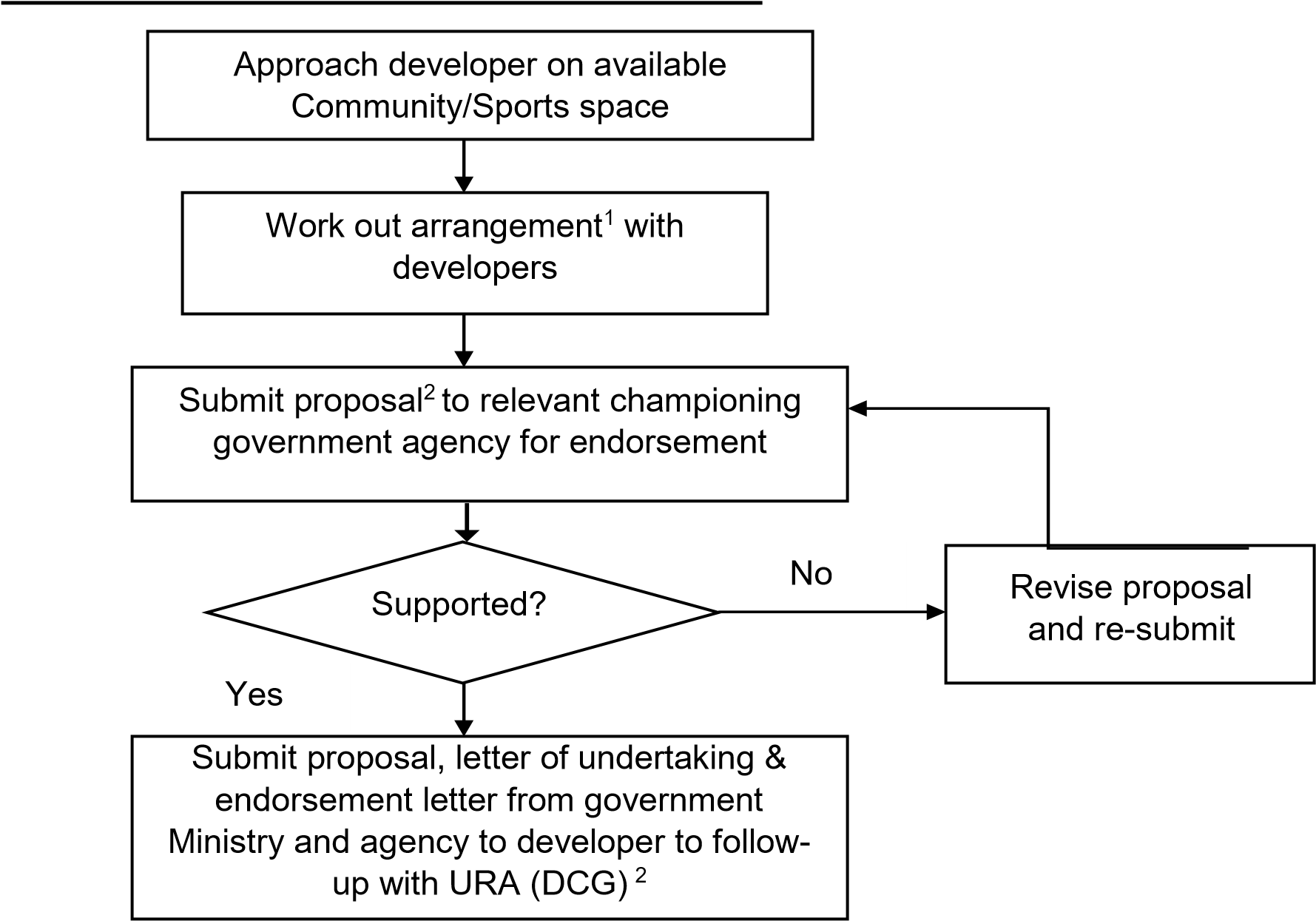
Procedure for Community Users / Sport SG
Procedure for Developers to Obtain URA’s Approval
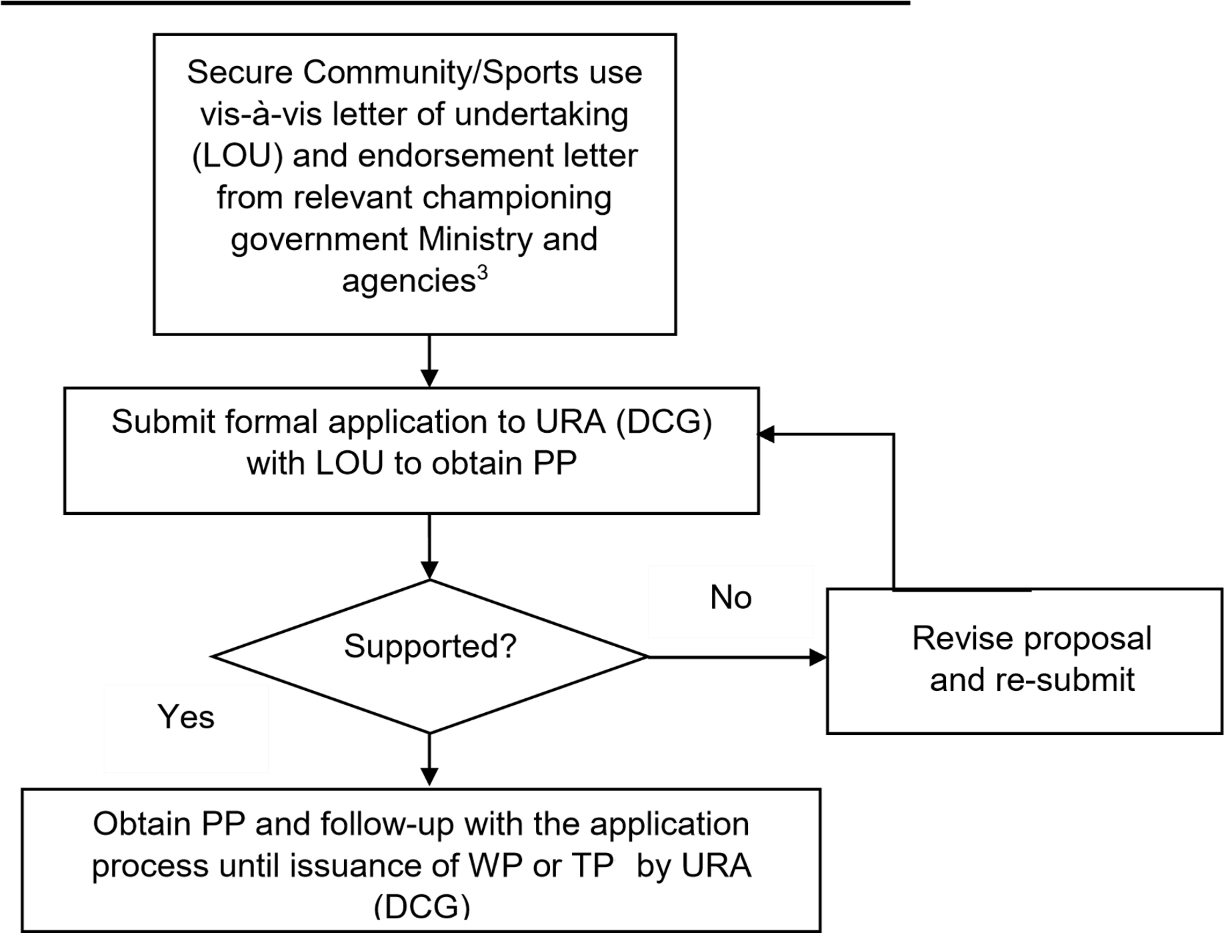
Procedure for Developers to Obtain URA’s Approval
1 This may include the choice of strata-title or lease with minimum tenure of 10 years, GFA of the Community/Sports space, monthly rental and who pays DC/DP (if applicable).
2 Proposal should include the nature of the Community/Sports use, GFA, GFA breakdown of uses within Community/Sports space and choice of strata-title or lease with minimum tenure of 10 years.
3 For sports uses, the endorsement letter is to be obtained from SportSG.