
Conserved Building
11 Mandalay Road
Applicable Guidelines
Other Building Guidelines
Conservation Area
Mandalay Road Conservation Area
Historic address: 107 Mandalay Road
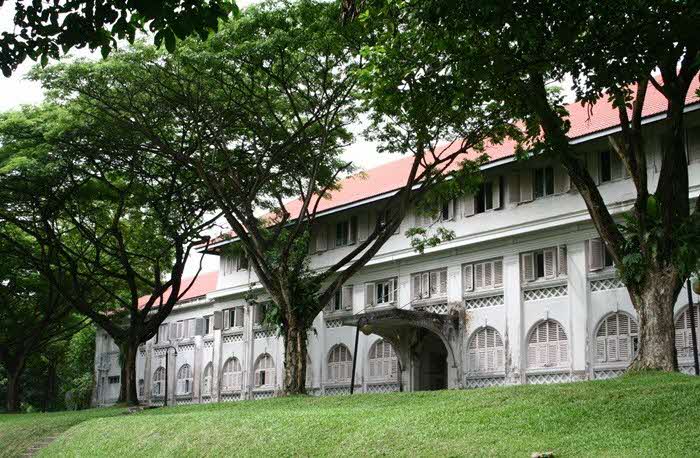
Former Nurses' Quarters
About
The Tan Tock Seng Hospital (TTSH), set up in 1844 by entrepreneur and philanthropist Tan Tock Seng, was the first privately-funded hospital in Singapore. It is also the second oldest hospital in Singapore – the first hospital was the General Hospital (now Singapore General Hospital), which was established in 1821.
The History
TTSH was originally named ‘Pauper’s Hospital’. It was intended to serve labourers and coolies without discrimination of race and religion, who could not afford proper healthcare. When it was established in 1844, it was one of the earliest and grandest examples of philanthropy in Singapore. The original hospital was built at Pearl’s Hill before shifting to Serangoon Road / Balestier Road in 1860. This led to the area being called ‘Rumah Miskin’ – or ‘Poor Man’s home’. The same year, it was renamed ‘Tan Tock Seng Hospital’ in honour of its founder. TTSH moved to its current location on Balestier Hill, along Moulmein Road in 1909. The second site was then taken over by the Kwong Wai Shiu Hospital.
At the Balestier Hill area, the hospital was surrounded by a variety of institutional and residential buildings. The latter buildings were a mix of private and public residence, as the area had become developed over the years as the wealthy moved out of the congested city centre, into the more salubrious suburbs. An example of such a private residence is the National Monument : Sun Yat Sen Nanyang Memorial Hall, housed in the former Wan Qing Yuan, a bungalow on the northern side of Balestier Hill.
TTSH continued its operations throughout World War II (WWII). During the Japanese Occupation, the hospital functioned briefly as a military hospital before converting to civilian use under the name ‘Hakuai Byoin’ (‘Universal Love Hospital’).
Although the original 1844 wards at Pearl’s Hill have long been demolished, some buildings from the second TTSH at Serangoon Road have been conserved in 2012 as part of today’s Kwong Wai Shiu Hospital. TTSH as an institution is representative of the contributions of generations of philanthropists towards wider society.
Three notable buildings related to the history of TTSH are conserved. One of them i.e. the former Nurses’ Quarters at 107 Mandalay Road, was conserved on 15 March 2013. The other 2 buildings are the bungalows at 142 and 144 Moulmein Road were conserved on 6 June 2014.
The Building
A 2-storey Neo-Classical block built in reinforced concrete and brickwork in the early 1940s, this is a prominent building along Mandalay Road. Due to its size and length, it has been considered by many people to be an identity marker within the large hospital grounds.
Situated at the top of a small hill, the building has a long symmetrical front façade composed of a series of arches at the first storey. The arches are complemented by two-storey-high pilasters, which reinforce the sense of rhythm of the building. The front entrance is marked by a reinforced concrete canopy that is supported by arched bracings and slender wrought-iron stays.
The Legacy
With conservation, the building will continue to serve as a tangible reminder of the development of architecture for health-care use as well as the history of the area.
Gazetted on 15 March 2013.
Guidelines and Procedures
All proposed works will need to comply with the Conservation Guidelines and the Specific Restoration Guidelines (SRG). Conservation Permission is required before all additions & alteration works and operations of new use can begin.
Residential Fronts are characterised by timber casement windows flanking a double-leafed timber door. All buildings with residential front which is existing and/or identified in the 'Specific Restoration Guidelines', regardless of land use zoning, shall be retained and restored.
Any proposed additions and alterations to this conserved building are subject to evaluation. Please submit your proposal for URA’s review.
Apply for Specific Restoration Guidelines (SRG) (opens in new tab)
Explore Street View
The building can be found at this street.