
Conserved Building
141 Serangoon Road
Applicable Guidelines
Other Building Guidelines
Conservation Area
Little India Conservation Area
Historic address: 141 Serangoon Road
Sri Veeramakaliamman Temple
About
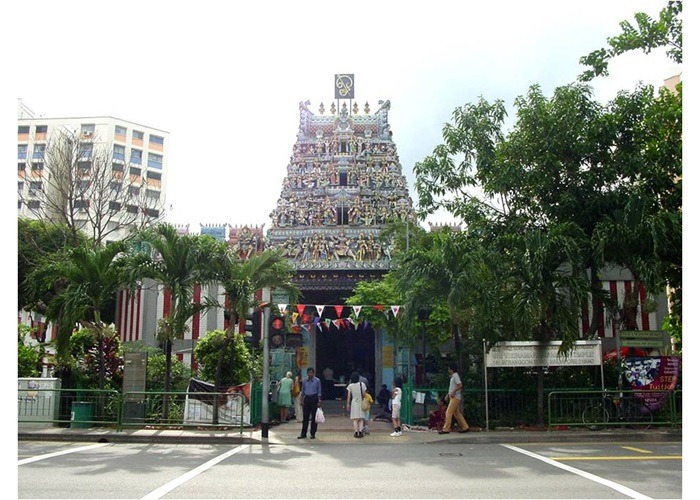
The Sri Veeramakalaliamman Temple is located at 141 Serangoon Road in the Little India Conservation Area, also popularly known as "Kandang Kerbau" and/or "Tekka". The temple is dedicated to the Hindu Goddess Kali, the destroyer of Evil. She is an embodiment of Shakti and also of Parvati, the wife of the Hindu God Shiva.
The History
The temple was founded in 1835 by Tamil pioneer workers who built a small clay shrine to worship the goddess Veeramakaliamman, for protection, prosperity, health, and knowledge. Around the mid-19th century, there were already some 13,000 Indians in Singapore, many of whom lived in this area. Having a temple in their midst helped them feel at home, recreating what they had been familiar with in their country of origin.
These immigrants were involved in both the cattle and dairy trade, as well as the construction business. The cattle trading gave the area its Malay name of Kandang Kerbau — Buffalo Shed. The construction business and the associated lime kilns gave the temple its informal name of "Soonambu Kambang Kovil", meaning the "temple at the lime village". It is historically and socially significant to the community as it is the oldest Hindu temple in the Kampong Kapor area.
A statue of the goddess was shipped in from South India in 1908. By 1938, other deities were added, including Lord Murugan and Lord Ganesha, and a chariot was also purchased in the same year. In 1953, additions and alterations were carried out, which included the first perimeter high wall. In 1987, the old wall was replaced with the present perimeter high wall, including the Gopuram. During the Japanese Occupation, many devotees took refuge in the temple.
The Building
What started off as a small hut in the 1800s was eventually rebuilt in 1983 with an impressive four-tier Gopuram marking the entrance to the temple in the South Indian Tamil Nadu style. The Gopuram symbolises the reach to heaven and divinity, indicating the temple as a place of God. The main temple doors below the Gopuram are adorned with bells to be rung by devotees when they enter or leave the temple. Apart from announcing the arrival of the devotees to the Gods, the bells are also a plea for the Gods to listen to their prayers and grant their wishes.
Throughout the complex can be seen exuberant carvings, sculptures, and paintings. The roof of the complex is an arrangement of domes of different sizes. Equally eye-catching is the wall of the temple compound, which is decorated in vertical stripes of red and white — a traditional decorative scheme closely associated with Tamil Hindu temples. Interestingly, the temple has a silver flag post which symbolises a cosmic flag post to reach the heavens; it is one of its kind in Singapore.
The Legacy
The temple is not only a place of worship but also a meeting place for the Hindu community and tourists from India. The establishment and subsequent growth of the temple is a testament to the growth of the Tamil and Hindu community in the area. It is an integral part of the surrounding Little India Historic District and a landmark in the architectural landscape. Together with the surrounding conservation shophouses, it illustrates the history of settlement in the area and acts as a marker of community identity that strengthens the sense of place. The temple was gazetted for conservation on 6 June 2014.
Guidelines and Procedures
All proposed works will need to comply with the Conservation Guidelines and the Specific Restoration Guidelines (SRG). Conservation Permission is required before all additions & alteration works and operations of new use can begin.
Residential Fronts are characterised by timber casement windows flanking a double-leafed timber door. All buildings with residential front which is existing and/or identified in the 'Specific Restoration Guidelines', regardless of land use zoning, shall be retained and restored.
Any proposed additions and alterations to this conserved building are subject to evaluation. Please submit your proposal for URA’s review.
Apply for Specific Restoration Guidelines (SRG) (opens in new tab)
Explore Street View
The building can be found at this street.