
Conservation Area
Kwong Wai Shiu Hospital Conservation Area
Applicable Guidelines
Other Building Guidelines
Conservation Area
Kwong Wai Shiu Hospital Conservation Area
Find out more about Kwong Wai Shiu Hospital Conservation Area.
Important Information
All proposed works will need to comply with the Conservation Guidelines and the Specific Restoration Guidelines (SRG). Conservation Permission is required before all additions & alteration works and operations of new use can begin.
Owners, architects and engineers intending to carry out restoration works or development within conservation areas are required to comply with the conservation principles, planning parameters and restoration guidelines for conserved shophouse and bungalow building typologies, as well as planning parameters and envelope control guidelines for new buildings within conservation areas accordingly.
For other building types, which do not conform to the standard shophouse or bungalow typology, these will be evaluated on a case-by-case basis in accordance with conservation principles. [1]
About
The present site of the Kwong Wai Shiu Hospital 廣惠肇留医院,started out its life as a hospital for the British in 1850, before being taken over by the Tan Tock Seng Paupers’ Hospital in 1861 (which had started out at Outram). After the TTSH moved up to Balestier Hill, the site then passed into the hands of the Kwong Wai Shiu Hospital (KWSH), who have been operating there ever since.
The History
The KWSH was founded in 1910 by a group of leading Cantonese immigrants (The founding leaders were Wong Ah Fook, Leong Man San and Yow Ngan Pan) connected with the 3 prefectures of Guangdong Province of Kwong-chau, Wai-chau and Shiu-heng, initially, to look after the poor and needy of the Cantonese community. Its importance was such that a special Ordinance was passed by the Colonial Govt for the setting up of the Hospital and to oversee its operations.
Through the Kwong Wai Shiu Free Hospital Ordinance, the land at the present site, together with only 3 single-storey 1850s colonial-era hospital blocks left over from the TTSH era, was sold by the Colonial Government to KWSH for 99 years at a nominal price.
As a major health care landmark for the Serangoon Road, which is the main trunk road leading up to Upper Serangoon Road and Kangkar (currently Sengkang) area, its role as a hospital for the poor, first, under TTSH and later under KWSH, gave the area its popular Malay name of Rumah Miskin – Pauper’s House.
After KWSH took over, more buildings were built through fund raising by the Cantonese community. After the 1950s, a garden pavilion was also built for patients to relax. In 1960, the final main front block facing Serangoon Rd was completed for wards and administration after a $300,000 fund raising effort. The foundation stone for this main block was laid on 13 December 1959 by Leung Yun Chee, the founder of the Leung Kai Fook Medical Company (maker and distributor of Axe Brand Universal Oil).
In its early days, the hospital only admitted Cantonese as in-patients while providing out-patient services to all who came, in particular the poor of the Serangoon Road neighbourhood. However, at an extraordinary meeting on 11 March 1973, the constitution of the hospital was amended to admit in-patients from all ethnic groups, so that KWSH would be in keeping with independent Singapore’s national ideology of inclusiveness. On 15 June 1974 the new policy came into force.
Even after universal public healthcare was introduced by the government since independence, KWSH continues to provide long term in-patient care for the poor and needy. Thus, it is also known as ‘Lau Yee Yun’ (Cantonese), loosely translated as a community hospital where one can stay and recuperate. It remains funded by public contributions for all its operations.
The Architecture
Main Front Block
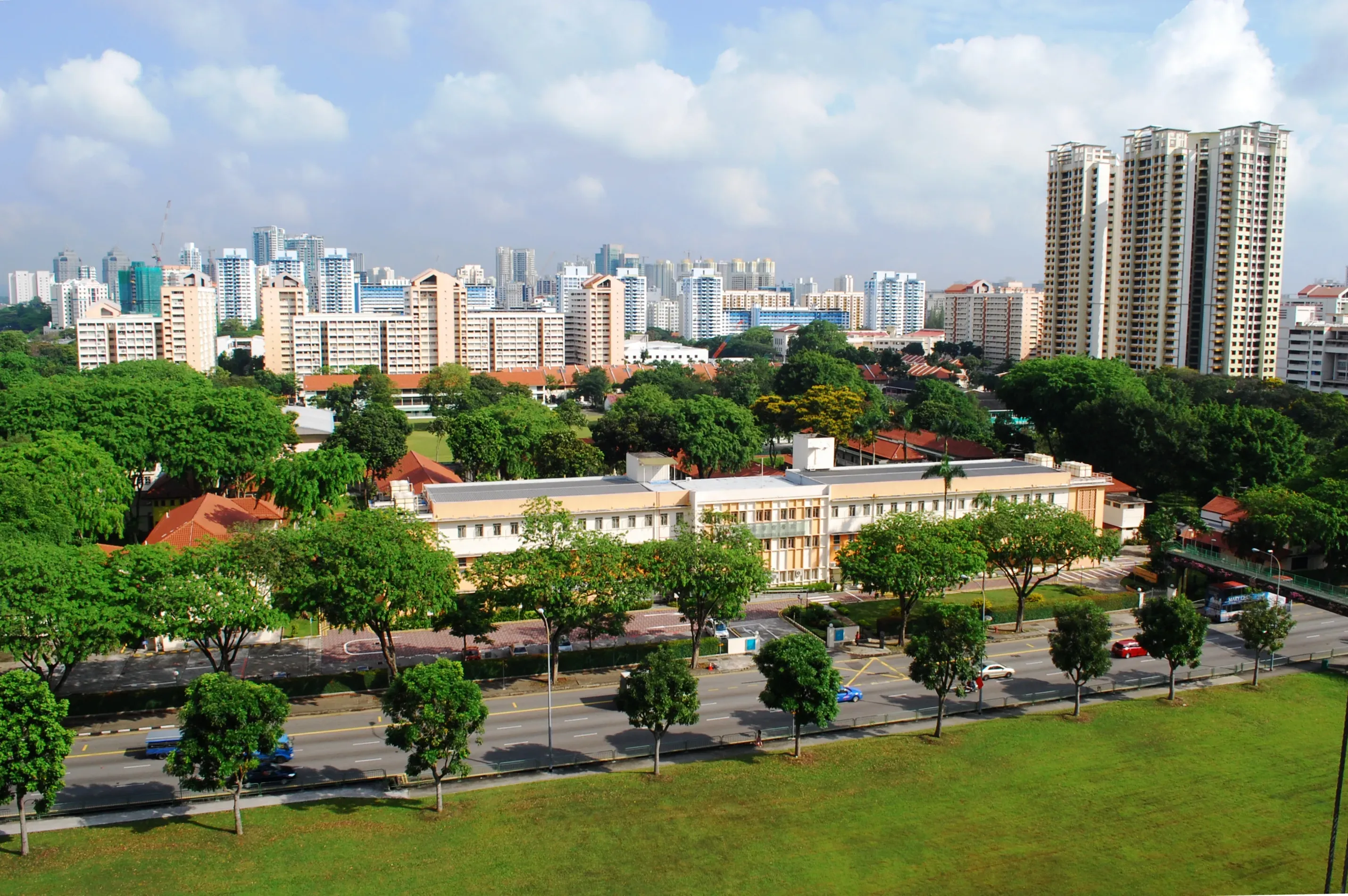
The 3-storey Main Front Block facing Serangoon Road and completed in 1960 substantially increased the floor space for more wards and administrative offices. Its modern style projects an image of modern health care when it was first opened. The building does not have any extravagant decorative feature. Architecturally, it is well composed through the careful placement of windows, functional sun shading and ventilation blocks for corridors and staircases. It is a good example of the combination of economy and aesthetics of Modern Architecture. With its prominent frontage along Serangoon Road, it is a key landmark located along the thoroughfare linking the city to the north-eastern sector of the island.
Single Storey Wards
The three single-storey buildings are one of the earliest blocks built in the 1850s by John Turnbull Thomson (10 August 1821 – 16 October 1884). J.T. Thomson was the Government surveyor for Singapore, who is best remembered by the Thomson Road which runs through central Singapore. Thomson was also the architect for the Horsburgh lighthouse on Pedra Branca, the Hajjah Fatimah Mosque, the spire of St Andrew’s Cathedral and Thomson Bridge, the first bridge across the Kallang River.
Each building is made of brick and plaster columns and walls. The appearance is one of a long squat building, with a large tiled roof supported by robust-looking Doric columns on the two long elevations. At the front is colonnaded perimeter corridor which is anchored at both ends by twin columns.
The tiled pitch roofs and Doric columns were typical of the early British architecture during the 19th century that was developed in British India through the merging of European styles and local Indian building traditions. This building style was later imported into Malaya and Singapore.
The three blocks surround a pleasant green lawn, forming a quadrangle, with the 1950s Modern Chinese pavilion as a focus.
The Legacy
Together with the other conserved buildings in Little India and Jalan Besar Conservation Areas, the conserved Kwong Wai Shiu Hospital buildings trace the physical and social development of the north-eastern corridor of Singapore, and remain an important local social landmark.
Architecturally, they also showcase the development of buildings used for healthcare and of architecture for the tropics.
The buildings are also a testament to the centuries-long effort by communities to help themselves and to help the wider public in the spirit of charity and inclusiveness. They hold significant geographical and social value at both the local and national level to many Singaporeans.
Gazetted on 2 August 2012.
Guidelines and Procedures
Resources
[1] The conservation guidelines for shophouses and bungalows will generally be applied by URA in the consideration of a development application. However, if the circumstances or planning considerations relevant to a case warrant it, URA may in its discretion decide to depart from these general guidelines. The guidelines, principles and illustrations found in the guidelines are not exhaustive in covering all possible site conditions and variations in building type. Persons intending to carry out a development are advised to take this into consideration and check with URA through enquiries or development applications to confirm if their proposals can be allowed.