
Conserved Building
2 Beatty Lane
Applicable Guidelines
Other Building Guidelines
Conservation Area
Jalan Besar Conservation Area
Historic address: 2 Beatty Lane
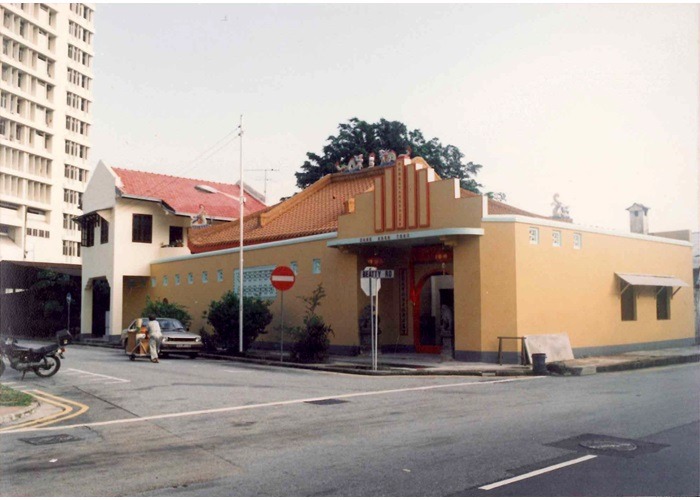
Thekchen Choling Entrance Gate
About
The gate used to be the main entrance to the former Chee Kong Tong. It was a shrine dedicated to the deity Chee Kong (济公), an eccentric Chán (禅) Buddhist monk (more popularly known as the ‘Mad Monk’) of the Southern Song Dynasty in China.
The History
Based on the Chinese inscriptions on the pediment of the entrance gate, Chee Kong Tong was built in the 28th year of the founding of the Chinese Republic i.e. in 1939, and further repaired in the 40th year of the Chinese Republic i.e. in 1951. Sources indicate that Chee Kong Tong was set up by a Shanghainese migrant who first had a small altar near the front gates of the New World Amusement Park nearby before he secured the Beatty Lane site for a proper shrine.
When the current occupant, the Thekchen Choling took over the premises in 2007, the Tibetan temple continued to keep the original statue of the Chinese deity among the other Tibetan Buddhist deities. The temple has placed the vintage of the Chee Kong statue at approximately 200 years old.
The Building
The entrance gate is Art-Deco in style and as with many structures of this style, the year of construction is indicated on its pediment. The gate is shaded because it is recessed as well as covered by a streamlined reinforced concrete canopy supported on decorative brackets. Located at the junction of two roads, the design of a stepped-pediment creates an eye-catching corner for the passersby.
The use of Art-Deco became popular in Singapore from the late 1920s to the early 1950s. The Jalan Besar area underwent urbanisation after WW1, became an area that was built largely in the Art-Deco style.
Above the arched doorway is the name plaque of Chee Kong Tong carved in granite, and on either sides of the doorway, a pair of couplets inscribed with Chinese characters and finished in terrazzo. Reading from right to left, a loose translation of the couplets is as follows: “Stepping on a reed and crossing the ocean to bless the good Chinese people; Jalan Besar has built this precious sanctuary to honor this great monk of the Southern Song Dynasty.” In addition to the couplets framing the doorway, there formerly was a fine pair of Chinese granite lions guarding the gateway.
The Legacy
Today, while the current temple serves as an identity marker within the Jalan Besar Conservation Area, the entrance gate contributes positively to the heritage of the site by serving as a link between the past and present and contributes to the ‘Art-Deco’ identity of the district.
Gazetted on 6 June 2014.
Guidelines and Procedures
All proposed works will need to comply with the Conservation Guidelines and the Specific Restoration Guidelines (SRG). Conservation Permission is required before all additions & alteration works and operations of new use can begin.
Residential Fronts are characterised by timber casement windows flanking a double-leafed timber door. All buildings with residential front which is existing and/or identified in the 'Specific Restoration Guidelines', regardless of land use zoning, shall be retained and restored.
Any proposed additions and alterations to this conserved building are subject to evaluation. Please submit your proposal for URA’s review.
Apply for Specific Restoration Guidelines (SRG) (opens in new tab)
Explore Street View
The building can be found at this street.