
Conserved Building
4 Telok Blangah Drive
Applicable Guidelines
Other Building Guidelines
Conservation Area
Ban Siew San And Koon Seng Ting Conservation Area
Historic address: 4 Telok Blangah Drive
Koon Seng Ting Temple
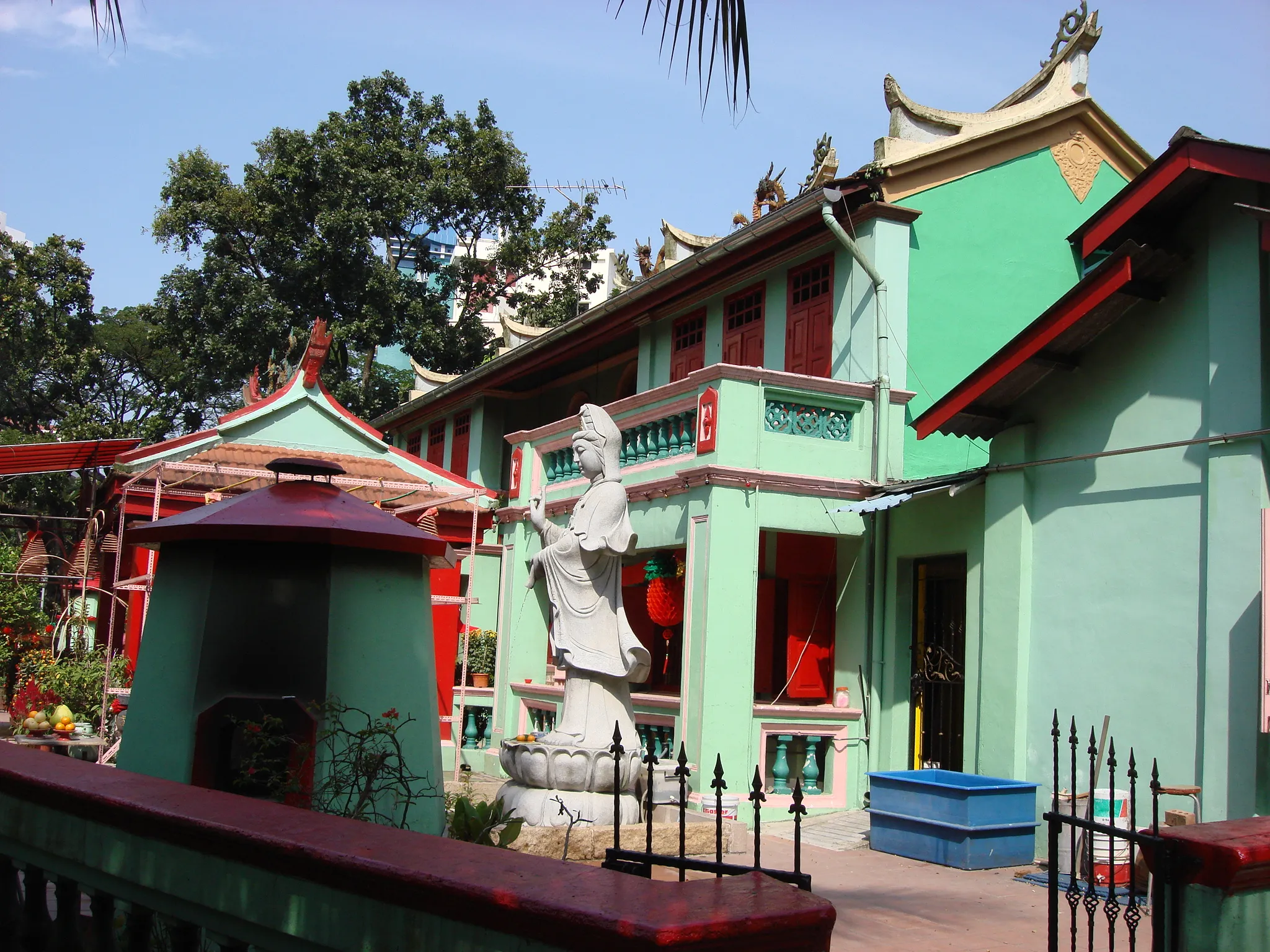
About
Koon Seng Ting (Hall of the Formation/Completion of the Earth) is a Taoist temple (although the current main deity is of the Buddhist deity Guan Yin) founded by a Teochew lady named Teh Chit Yee and is located on Telok Blangah Hill at 4 Telok Blangah Drive.
The History
It began as an attap house before the current building was completed in 1881. It is one of two temples (the other being Ban Siew San) established alongside each other in the late 1800s to serve the spiritual and social needs of immigrants who had settled in this area.[1]
It is also a reminder of the early days where there used to be a small kampung around the hill with a community of Hokkien, Cantonese and Hainanese, with the Hokkiens being the larger dialect group.
For many rural Chinese settlements in Singapore (and South East Asia), such temples, were the focal point for the religious and cultural life of the settlements. Many such temples also played a charitable role, and in this case, this temple became well-known as a refuge for baby girls who were orphaned or abandoned in the early days. In the old society, female children were seen as less desirable than males. The present caretaker, Chua Peng Nyet, was one of the adopted girls of the temple.
[1] Norman Edwards and Peter Keys, Singapore: A Guide to Buildings, Streets, Places (Singapore: Times Books International, 1988) p.345.
The Building
This building is a unique example of cultural hybridisation within the diverse Chinese communities in Nanyang (as this region was known to the immigrants from China). Though the founder was of Teochew origins, the building’s main architectural style follows Hokkien convention. At the same time, there are substantial 19th Century European influences.
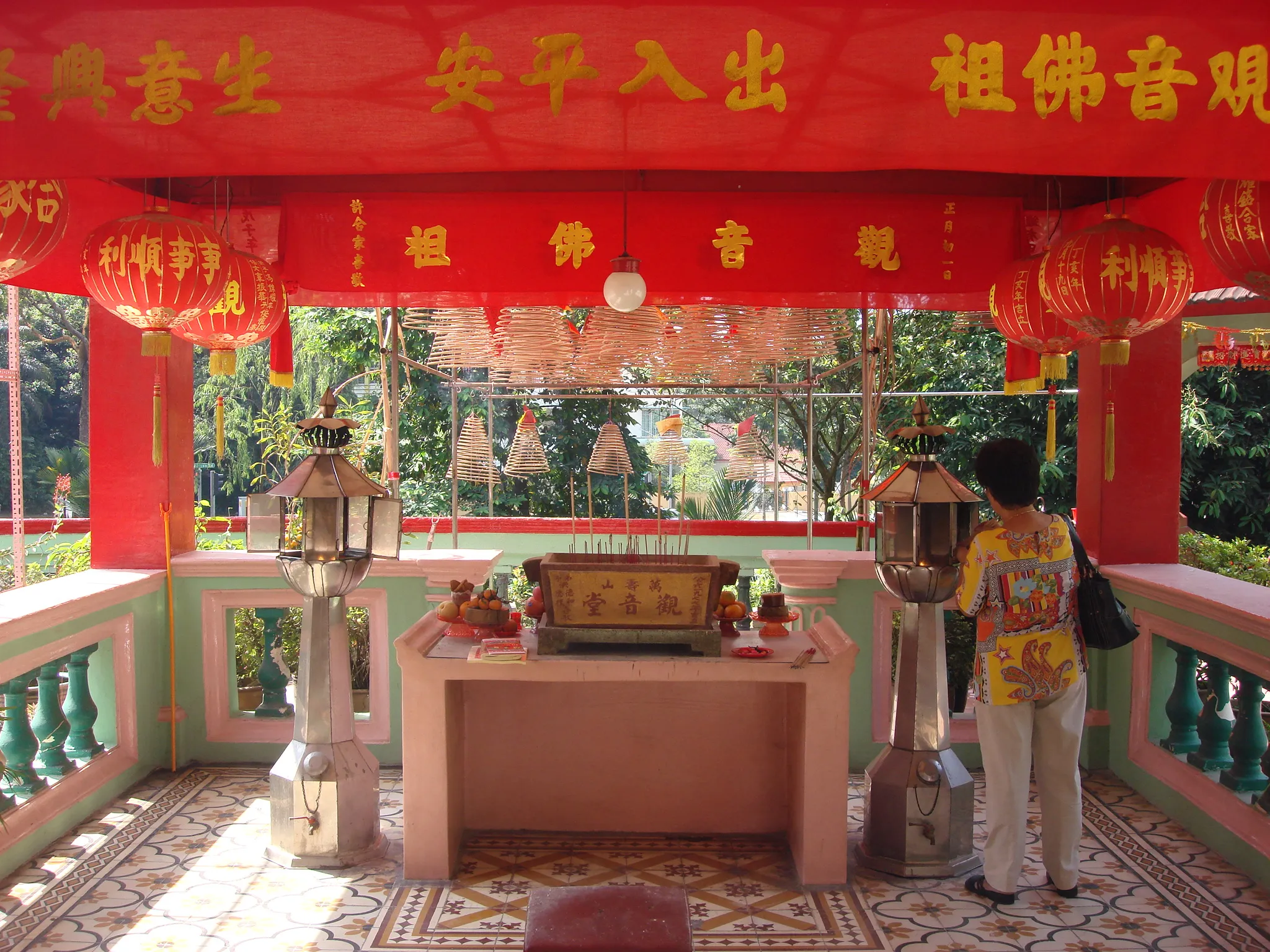
Built halfway up a hill, its location follows traditional geomancy where it is advantageous to have higher ground at the back of a building’s compound. The visitor approaches the temple via a flight of steps arrives at an open terrace that fronts the temple. Located on the terrace infront of the temple is a pavilion that has a Hokkien-styled roof supported on four masonry columns of European Neo-classical design. The pavilion is surrounded by a parapet of European-styled pre-cast ‘Bottle’ balustrades. The flooring is of coloured cement tiles with geometric patterns to form an attractive ‘carpet’ for the floor. Such European balustrades and colured tiles were very popular early 19th Century.
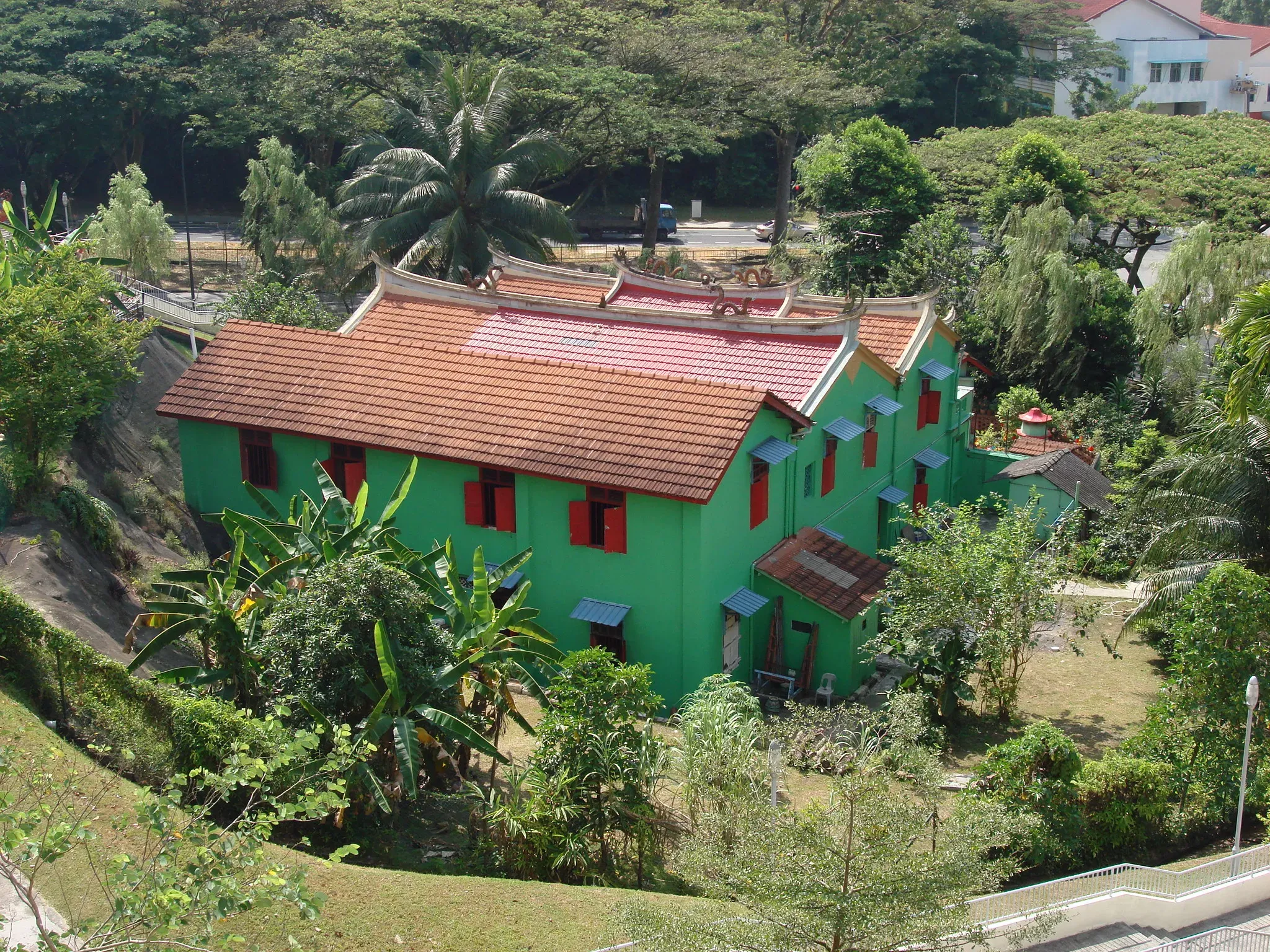
As for the main building, today, there are 3 parallel halls that are joined together, with the first two halls being the oldest part of the complex. The roofs of the first two halls feature a gently curving masonry roof ridges with raised ‘swallow’s tails’ ridge ends. This is a feature that identifies the building’s Hokkien construction origins, and can be found on many notable Hokkien buildings such as Hong San See and Thian Hock Keng temples. The profile of the gable ends symbolises the ‘Fire-element’ in Chinese belief. The choice of which of the Five-elements to use as a gable profile is often dictated by the characteristics of the site, its builder and the intended occupant. Natural-coloured terracotta Marseilles roof tiles are used throughout the building. It is not clear if they were original or a subsequent replacement of the traditional finish of natural coloured terracotta tiles that are typical of Hokkien buildings.
The actual building is unusual in that it is 2 storeys high, as most temple complexes are of a single storey. The layout is also unusual in that the two main buildings are joined together with no internal air-well to separate the two.
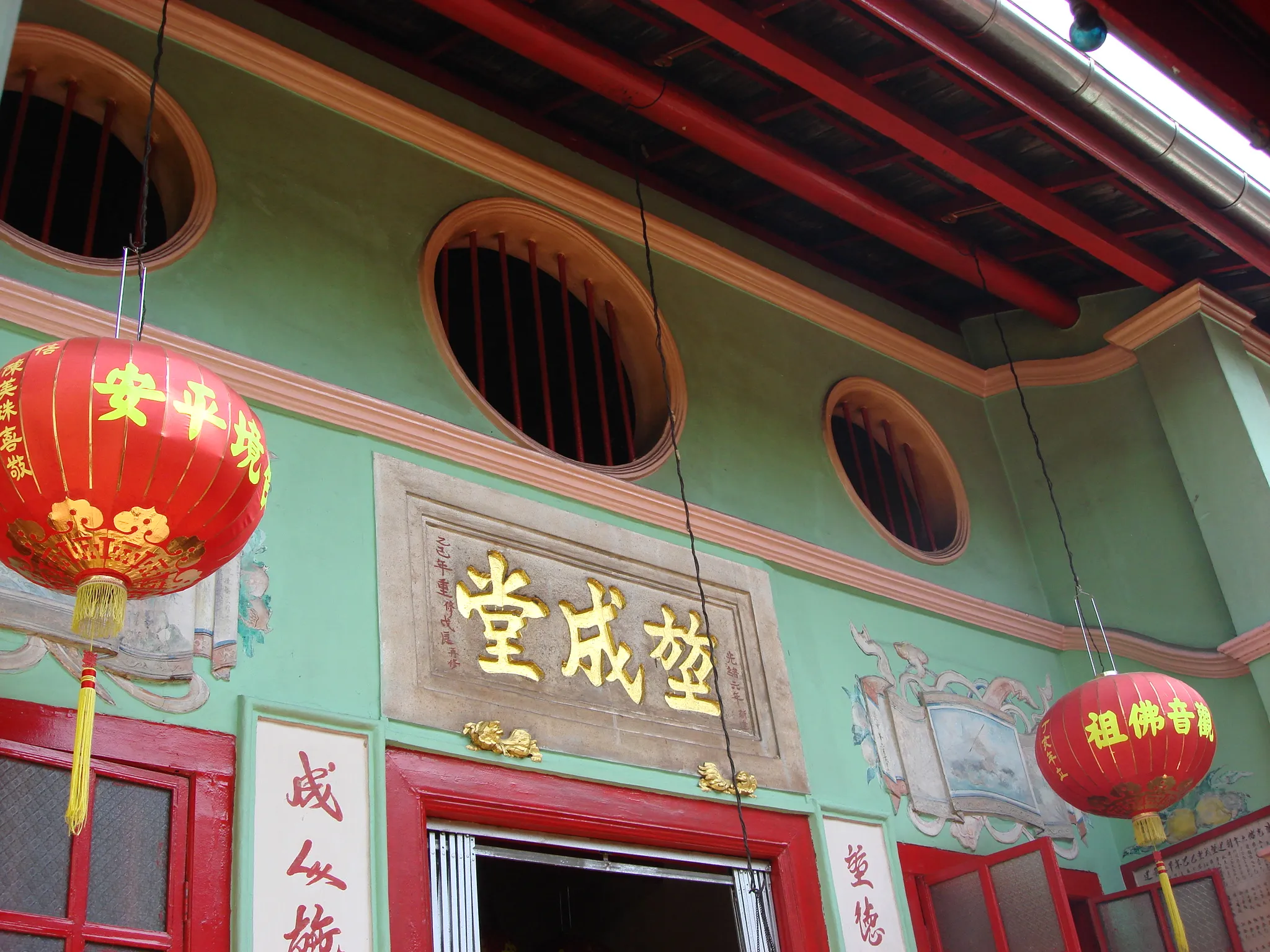
From the front façade, one can see a series of eye-catching circular openings at the upper level above the front door. These could be either for better ventilation or for geomancy/religious purposes. The pair of European 2nd floor terraces are also a unique add-on to the Hokkien building. Similar models can still be seen back in the Hokkien, where merchants who were exposed to foreign styles and tastes, built their homes in such a fusion of styles.
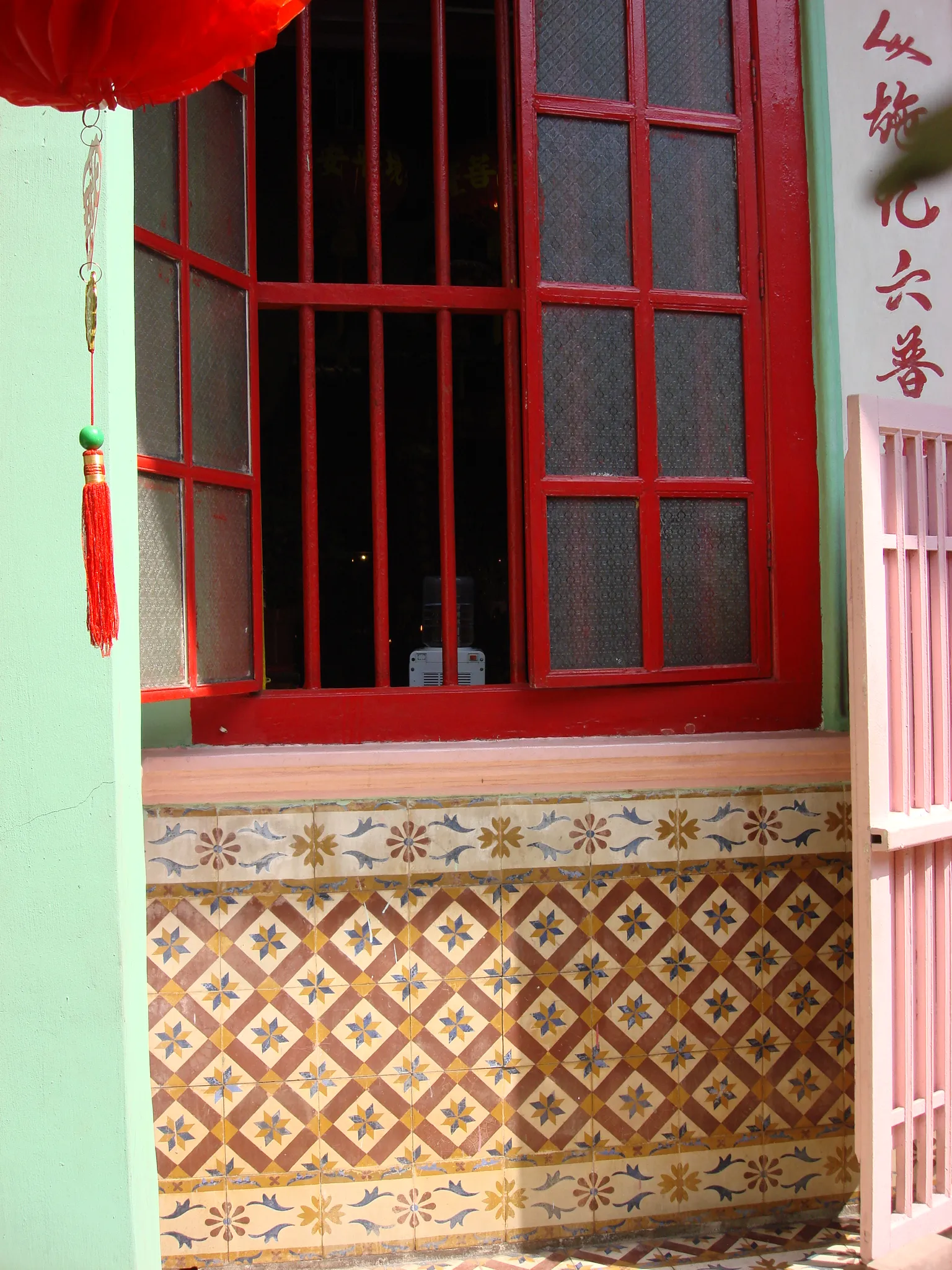
The entrance of the building is a recessed bay, and the main doorway is of a stout timber frame, flanked by two sets of European timber windows. Beneath the windows are decorative panels made of coloured European tiles that are normally seen on floors. Once more, this is a hybridised decorative approach as traditional Hokkien buildings would have such decorative panels executed in moulded plaster work. Above each window is a moulded plaster relief in the form of a ‘painted Chinese scroll’ that is typical of Hokkien buildings.
Flanking the main door are a pair of moulded plaster panels with Chinese characters forming an auspicious couplet. Above the doorway is the name of the building carved in a granite plaque set into the wall. The plaque also states the dates of the construction (6th year of Emperor Guangxu of the Qing Dynasty – CE. 1881) and subsequent repairs.
This temple’s main hall has a set of eye-catching plaster panels that mimic Chinese wall scrolls of paper and silk on either side of the main altar. These two largest plaster panels feature the characters for Fortune (right of altar) and Longevity (left of altar).
Of particular note is the extensive use of European floor tiles for the internal spaces. These take the place of the usual plain terracotta tiles that would have been used in older buildings or back in China. Unlike the plain floors that would have been traditional, the European tiles of various geometric designs are laid out to create an effect of having decorative ‘carpets’ within the building. The tiles here are of the ‘embossed’ variety in two colour tones. Similar types of tiles can be seen in other heritage buildings such as the R.C. Church of Our Lady of Lourdes, and the Parish House of the Cathedral of the Good Shepherd.
Within this building can also be seen an array of antique 19th century hardwood chairs and tables that were imported from China.
This building is considered a unique example of the Nanyang architectural style, a hybrid of Southern-Chinese, European and South-East Asian designs.
The Legacy
The temple site is a good example of perfect feng shui – “sitting on the hills and looking at the sea”[1]. As a building, it is a fine example of the cultural hybridisation that happened in Singapore in the 19th Century.
Situated strategically on a hill at the junction of Telok Blangah Drive and Henderson Road. It enhances the surrounding HDB estate by adding colour and variation to the architectural landscape. In addition, together with the adjacent Ban Siew San, it illustrates the history of settlement in the area and acts as a marker of community identity that strengthens the sense of place.
Gazetted on 6 June 2014.
[1] Evelyn Lip, Chinese Temples and Deities (Singapore: Times Books International, 1981) p.58.
Guidelines and Procedures
All proposed works will need to comply with the Conservation Guidelines and the Specific Restoration Guidelines (SRG). Conservation Permission is required before all additions & alteration works and operations of new use can begin.
Residential Fronts are characterised by timber casement windows flanking a double-leafed timber door. All buildings with residential front which is existing and/or identified in the 'Specific Restoration Guidelines', regardless of land use zoning, shall be retained and restored.
Any proposed additions and alterations to this conserved building are subject to evaluation. Please submit your proposal for URA's review.
Apply for Specific Restoration Guidelines (SRG) (opens in new tab)
Gallery
Explore Street View
The building can be found at this street.