
Understanding the Shophouse
Find out more about shophouses, one of Singapore's most prevalent heritage building types. Discover these contiguous, two- to three-storey terraced blocks with their iconic sheltered walkways at the front.
Last updated on 17 June 2026
Overview
Constructed between the 1840s and the 1960s, these shophouses formed the majority of the pre-World War II urban fabric of the old city centre as well as several other parts of Singapore. They are also commonly found throughout the historic cities of South East Asia.
Shophouses therefore form the bulk of our gazetted conservation buildings. The key elements of the shophouses have been carefully restored and conserved according to our conservation guidelines.
Shophouse Typology
The conservation guidelines for shophouses and terrace houses relate to the key elements of the typology of the building. Constructed between 1840 and 1960, these simple buildings are two- to three- storeys high, built in contiguous blocks with common party walls.
The design and material of the shophouses and terrace houses vary according to the architectural style of the building. Singapore shophouses fall into six styles. They are:
The First Transitional Shophouse [PDF, 3.25 MB] (opens in new tab)
The Second Transitional Shophouse [PDF, 3.60 MB] (opens in new tab)
Key Elements of the Shophouse
The quality restoration of a shophouse requires an appreciation and understanding of the architecture of the building. The key elements that need to be respected in the restoration of a typical shophouse are listed in the table and documents below.
Key Elements of a Typical Shophouse [PDF, 1.77 MB] (opens in new tab)
Elements of the Shophouse Facade [PDF, 3.02 MB] (opens in new tab)
Key architectural elements of shophouses and their functions in supporting structure, ventilation, and streetscape
Key Elements of the Shophouses | Description |
Roofs | Roofs are usually pitched and finished with overlapping V-profile clay tiles, laid on timber battens and bonded with mortar. Shophouses from the 1900s onwards tend to use natural coloured, unglazed flat-interlocking tiles (also commonly called ‘Marseilles’ tiles). Where the tiles end at the edge of the front and rear shophouse roofs, they are often covered with a timber fascia complete with galvanised iron gutters and downpipes. Roofs are waterproofed using bituminous asphalt, galvanised iron flashing and copings. |
Party Walls | Party walls are principal load-bearing walls which demarcate one shophouse from its neighbour. The party walls normally protrude approximately 30cm above the roof of the shophouse and break the continuous length of the shophouses into individual lots. Party walls are constructed of bricks laid out in continuous stretcher bond courses. The internal surfaces of the party walls are usually unpierced and unadorned. To ensure structural stability, the base of the party wall is thickened to transfer the dead-load to the base of the foundation. |
Timber Structural Members | The timber structural members include the main timber beams, the secondary timber beams, the timber floorboards and the timber rafters which support the roof. The main timber beams are key horizontal structural members that run parallel to the facade, spanning from one party wall to the other. They are usually made of chengal, a hardwood timber which is resistant to the dead-load transferred from upper floors. The secondary timber beams supporting the timber floorboards for the upper floors serve as horizontal structural members to evenly distribute the dead and live load from the upper floors to the party walls. The timber floorboards are thin horizontal structural members laid horizontally on the secondary beams and joined to one another by the traditional tongue and groove method. Timber rafters are inclined structural members supporting the pitched roof. They are in turn supported by timber purlins or roof beams spanning between the party walls. |
Airwells | Airwells are positioned between sections of the tiled roofs. They are exposed to the sky to provide natural ventilation and lighting to the interior of the shophouse. The airwells lend interest to the spatial experience of shophouses by offering alternating naturally lit spaces. |
Rear Court | The rear court is an open space at the back of the shophouse bounded by the rear boundary wall, the service block, the rear facade of the main part of the shophouse and the party wall. The juxtaposition of these elements produces several different rear court configurations. The windows in the walls facing the rear court allow light to penetrate into the interior of the shophouse. They are normally casement windows of a design compatible with the windows on the front facade. The existing doors on the rear facade are either timber doors or original metal (mild steel) doors. This area was traditionally used for functional needs such as the kitchen and the toilet. |
Timber Windows | Shophouse windows include the timber windows of a French or casement design. Some have solid infill panels while others will have operable timber shutters/jalousies to allow for air and light. French windows, found on the upper storey façade, are full-height, side-hung and double-shuttered, and may feature transom windows or fanlights above them. The timber post and rail or cast-iron balustrades are part of the original design of the French windows. Casement windows are only half the height of French windows, with openings starting at the balcony rail height. Casement windows on the first storey, unlike those on the upper storeys that swing outwards, always open inwards and are recessed to allow for installation of security devices. |
Timber Staircase | This refers to the staircase inside the shophouse, which are often of timber structural construction. Internal staircase arrangements vary between shophouses and range from straight and dog-leg designs to curved quarter and half-turn designs. In some houses, the timber balustrades and newel posts can be of ornate design and reflect early Dutch influences. Handrails are made of polished hardwood. |
Front Facade | The front ‘face’ of the house that faces the street. Facades from different architectural styles will have different aesthetic approaches. The shophouse facade has six distinct elements:
|
The Upper Floor | This projects over the five-footway to form a covered pedestrian arcade. |
The Columns | Located at the front of the building. They support the upper floors and form five-foot way colonnades. |
The Five-Foot Way | This provides pedestrians with a sheltered environment for passage away from the hot sun and torrential rain. This feature was mandated by Raffles since the first Town Plan for Singapore. It is an important element that contributes to the experience of walking through a conservation area. The elements that contribute to the experience are the floor, colonnade, residential or shopfront and the ceiling. In order to retain the traditional character of the five-foot way, the original height of the covered walkway, the design and size of the columns are to be retained. The retention or reintroduction of the traditional materials and finishes of the five-foot way is encouraged. Traditional finishes for the five-foot way floors include cement screed, terra cotta tiles, clay tiles, cement terrazzo, mosaic, marble-chip terrazzo or granite slab. The five-foot way often features granite edging parallel to the road side drain and granite steps. Tile patterns used on the five-foot way are sometimes repeated on the front wall of the shophouse either ending as a skirting or under the window to form a decorative wall. Where the existing floor finishes are not original, traditional materials are to be considered. The selection of the floor finishes preferably matches the architectural style of the shophouses. For instance, it is common for Early Style shophouses to have red-coloured cement screed with gridded rope indentations and granite edge slabs. Art Deco shophouses may have marble-chip terrazzo finish in a variety of colours or mosaic finish. It is untraditional for five-foot ways to be finished in ceramic tiles or slate. |
The First Storey | The First Storey may be a residential front or an open shopfront. Residential fronts are characterised by a double-leafed timber door flanked on both sides by timber casement windows, or by two double leafed timber doors and a timber casement window. The main door often has a pair of half-doors, known as ‘pintu pagar’, which are often intricately carved. The timber-framed windows usually have timber panelled shutters, which open inwards and vertical iron security bars. Shopfronts have a range of traditional features including demountable timber shutter boards, timber or metal sliding and folding doors, or glass display cases. Access doors are incorporated into the shopfronts and these may be single or double-leafed, glazed or timber-panelled, louvred or of rail and stile design. |
The Forecourt | Some residential terrace houses also feature a Forecourt. The forecourt is an important feature that gives spatial and green relief to the usual narrow street that is lined with traditional houses. Some forecourts feature ornamentation on walls and gateposts and have decorative gates and entrance arch with lamp. |
Adaptive Reuse of Shophouses
Traditionally, shophouses are designed to provide for business premises on the ground floor and residential accommodation on the upper storeys; terrace houses and bungalows are designed purely for residential use. Structurally speaking, the original use is always the best use for a conserved building.
However, old buildings may often have to be restored and upgraded to meet modern living needs or to accommodate new uses. In restoring and adapting a conserved building to new uses, it is important to adhere to the conservation principle in order to retain the intrinsic character and historical value of the building. Alterations or strengthening of the building structure is to be done in the most sympathetic and unobtrusive way, using the original methods and materials wherever possible.
The restoration and adaptation of conserved buildings to new uses require an understanding of the behaviour of traditional buildings, traditional building construction methods, and how the buildings hold themselves together by the intricate interaction of the various elements.
Case Study: The NUS 'Baba House'
Once the ancestral home of a Straits-Chinese family, the NUS ‘Baba House’ located at No. 157 Neil Road, is an example of an architectural beauty that has been carefully restored by the URA to illustrate conservation best practices. . It is one of the last few untouched Straits-Chinese Houses in Singapore.
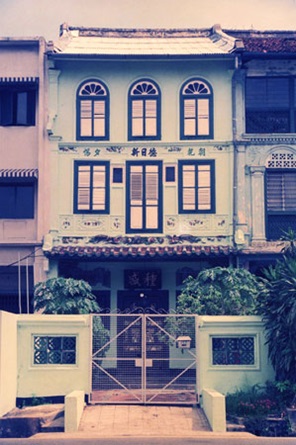
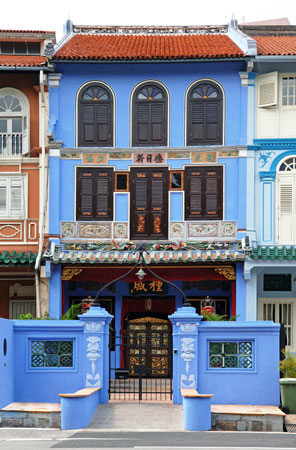
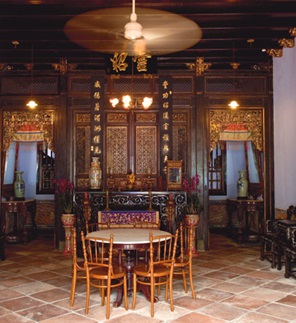
Not only has its façade been revived with original ornamental details, the restoration also showcases the 1920s domestic culture of the Straits Chinese community in Singapore. Welcoming visitors to the Baba House are the wooden half doors or pintu pagar, a typical cross-cultural feature that used to be common in Singapore’s historic residences.
The main hall features elaborate and intricately carved structures of floor to ceiling screens and partitions.
The Baba House is representative of the visual interest that a well restored shophouse can provide to our urban landscape, and at the same time, remind us how these shophouses are representative of Singapore’s unique cultures and aesthetic tastes